Harvard professor John Kenneth Galbraith, the renowned economist whose influence stretched from presidents, as adviser and diplomat, to Main Street, as a prolific best-selling author and TV host, has died at age 97.
...
The Canadian-born Galbraith became one of America's best-known liberals, and was outspoken in his support of government action to solve social problems. He served as adviser to Democratic presidents from Franklin D. Roosevelt to Bill Clinton, and was John F. Kennedy's ambassador to India.
His 1958 book, "The Affluent Society," caused the country to reconsider its values and helped propel him into the international spotlight.
It argued that the American economy was producing individual wealth but hadn't adequately addressed public needs such as schools and highways. U.S. economists and politicians were still using the assumptions of the world of the past, where scarcity and poverty were near-universal, he said.
"As a result, we are guided, in part, by ideas that are relevant to another world," he wrote. "We do many things that are unnecessary, some that are unwise, and a few that are insane."
In 1999, a panel of judges organized by the Modern Library, a book publisher, picked "The Affluent Society" as No. 46 on its list of the century's 100 best English-language works of nonfiction.
Galbraith also was known for his theories on countervailing forces in the economy, where groups such as labor unions were needed to strike a political and social balance.
Richard Neustadt, a Harvard colleague and fellow aide to presidents Kennedy and Truman, said Galbraith demonstrated how "you have to empower people directly before they could fight for themselves."
Sunday, April 30, 2006
Death of an Economist
Not more than a week after I had finished reading a massive biography of the man (available here--very enjoyable if very "techie" and seemingly told in real time), popular economist John Kenneth Galbraith has died:

Friday, April 28, 2006
Robot Holocaust VII--These Bots Were Made for Walking
We'll never outrun them now!
Robot Shatters Speed-Walking Record
A simple-minded, two-legged robot named RunBot can't run. But boy, can it walk!
The 1-foot tall European speed demon moves at 3.5 leg-lengths per second [Video].
That's the equivalent of a human walking almost 10 feet per second; and more than twice as fast as its closest running mate, Spring Flamingo, who hails from the Massachusetts Institute of Technology.
Creature Discomforts
Again, far be from me to disparage advances in science and technology, but wasn't this an X Files episode?
Glow-in-the-Dark Creature to Provide View Inside Human Body
Tiny semiconductor crystals called quantum dots may soon light their own paths through the human body. Scientists are splicing modified proteins from a glow-in-the-dark ocean creature onto the microscopic semiconductors to make self-illuminated dots.
Thursday, April 27, 2006
Mo' Better Boos
When you go out to a restaurant or check into a hotel, are you worried that there may be ghosts around? Want to find out just how haunted your house is? Or are you so starved for company that you'll even seek out the nearly departed? Well, then, a new product is right up your alley: the ghost detector.

If there is a ghost in the area, the button lights up, easy as pie. This device is available for $18.I'm not exactly certain what one is supposed to do should the button light up. Perhaps it should come with a video of old "Casper the Friendly Ghost" episodes so we'll know the proper reaction to detecting a ghost. I wonder if people wearing white sheets over their heads will fool it.

Hollywood Calling
Movies on a cellphone? Well, I guess it would be perfect for The Terror of Tiny Town. Sez Wired:
This week at the San Francisco International Film Festival, 20 movies made for mobile devices with 2-inch-by-3-inch screens will be shown as part of the festival's Pocket Cinema program.
...
The Pocket Cinema program highlights the art world's contribution to mobile video, which the entertainment industry hopes will be the next big content boom. Fox, for example, is releasing mobisodes of the TV show Prison Break, while Touchstone Television Productions is producing a version of Lost just for mobiles.
"Think internet video circa 1999 with networks optimized for video and (with) a built-in payment engine," said Seamus McAteer, senior analyst with MMetrics, a San Francisco market research firm. "The business will mature much faster than internet video."
Wednesday, April 26, 2006
Policing the Fed
Perhaps I'm becoming even geekier in my old age (assuming that was even possible), but I was quite amused by a music video put together by some Columbia Business School students that gives the "Weird Al" treatment to The Police's "Every Breath You Take" with changed lyrics about the new chairman of the Federal Reserve, Ben Bernanke.
"First you move your lips,http://www0.gsb.columbia.edu/students/organizations/follies/media/EveryBreath.wmv.
Hike a few more bips,
When demand then dips,
And the Yield Curve Flips
I'll be watching you"
Robot Holocaust VI-The Comfy Chair!
Now this looks like an intriguing idea--be one elderly or not--save for the fact that at some point it will turn on its owner and unleash an orgy of death and destruction. Aside from that, though...
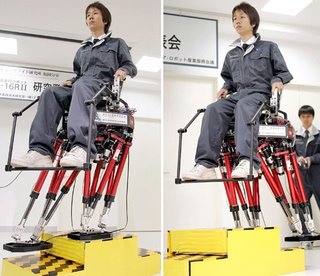
prototype model of a chair robot called "WL-16 II" developed at Waseda University in Tokyo. The two-legged robot is aimed at enabling people in wheelchairs to go up steps or move heavy goods on uneven land.

Tuesday, April 25, 2006
Woo Hoo!
A good interview with Matt Groening at this week's Onion A.V. Club. Perhaps the best thing about it was the news that they will be doing four new feature-length direct-to-DVD movies of one of my all-time favorite shows, Futurama, which Fox unceremoniously killed, despite the fact that it consistently won its timeslot, even though they regularly pre-empted it with football.
Sudafed Up
Speaking of drugs, call me square (or at the very least rectangular) but the only "experimentation" I ever did with drugs in college (or ever) involved Sudafed (and not in the way mentioned below). But now, battling the sniffles brought on by Syracuse winters will be that much harder, at least according to John Tierney in the N.Y. Times (it's behind the Times' paywall, but can be read via The Economist's View blog):
This month, pharmacists across the country are being forced to lock up another menace to society: cold medicine. Allergy and cold remedies containing pseudoephedrine, a chemical that can illegally be used to make meth, must now be locked behind the counter under a provision in the new Patriot Act. Don't ask what meth has to do with the war on terror. Not even the most ardent drug warriors have been able to establish an Osama-Sudafed link.If cold medicine is outlawed, only outlaws will get colds.
The F.D.A. opposed these restrictions for pharmacies because they'll drive up health care costs and effectively prevent medicine from reaching huge numbers of people ... These costs are undeniable, but it's unclear that there are any net benefits. In states that previously enacted their own restrictions, the police report that meth users simply switched from making their own to buying imported drugs that were stronger — and more expensive, so meth users commit more crimes to pay for their habit.
Blowing Smoke
For those who are only selectively interested in good health--for example, more worried about, say, scurvy than cancer or emphysema--there is now the VitaCig, easily the most ludicrous thing I've seen in a long time:
A Quebec company is producing a cigarette it claims does not stain teeth, has less of an odour than regular brands and contains beneficial ingredients like vitamin C.What's next, calcium-fortified crack?
Called the "VitaCig," it was invented by non-smoker Roger Ouellette for his wife, who has smoked a pack of cigarettes every day since the age of 14.
"We give you all the vitamins you lose, plus some vitamins to help you," he told CTV News.
Ad Infinitum
Sez B-to-B Online:
New York—Total magazine rate card-reported advertising revenue rose 4.2% in the first quarter compared with the same period in 2005, while ad pages were essentially flat. Ad revenue in March rose 5%, but pages were flat. The first-quarter figures were not much of a departure from February figures. For the first quarter, just five of the 12 major advertising categories posted gains, including drugs & remedies (up 16%), financial, insurance & real estate (up 9%) and technology (up 8%). On the downside, food & food products fell 10% and home furnishings & supplies fell 6%. Results were mixed for the general business publications. In the first quarter, ad revenue for BusinessWeek was down 3.2% while pages rose nearly 3%; Fortune was down approximately 14% in both ad pages and ad revenue; and Forbes was up 4.4% in revenue and down just a fraction in ad pages.
Ancient Chinese Secret, Huh?
Oh, I don't know:

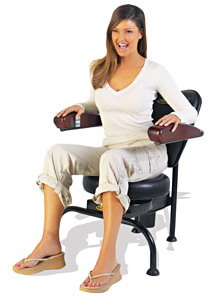
[The Hula Chair is] “the biggest sensation in Japan”, incorporates “ancient traditional Chinese medicine”, and is named for the Hula (Hawaii). It will also…
Improve your balance and coordination as it gently aligns your spine and improves blood circulation. You’ll love how it feels as it works out your abs and mid-section. And there’s no better way to warm up for any activity.
Monday, April 24, 2006
Gas Pains
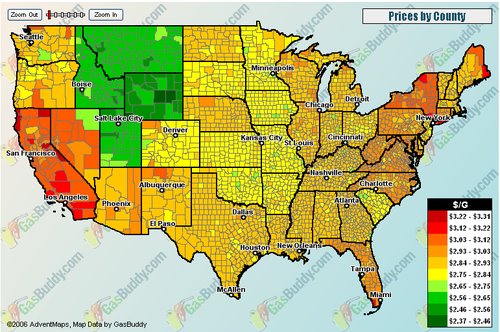
Looking for cheap gas? Via The Big Picture blog, the site Gas Buddy a map of average gas prices around the country. (Green is cheapest, red is the most expensive--click either link for a bigger/more readable map.) Hey, I can save about 70 cents a gallon if I drive to Montana to get gas.
 Let's remember, though: we're not really near historic highs. After adjusting for inflation, gas would have to hit $5.80 a gallon in order for it to reach the level it was during the oil embargo of the 1970s. As I think I pointed out last year when gas prices were rising, that's a very picayune point that doesn't really mean much if you--like me--were not driving a car in the 1970s. It's also not a very big help to those who have to commute to work now--I guess just be lucky you probably won't pass through any time portals back to the 1970s when your gas gauge gets low.
Interestingly, in New Jersey, thanks to an agreement between the turnpike authorities and gasoline suppliers, stations on the NJ Turnpike and the Garden State Parkway can only change gas prices once a week (on Friday--see here). I was told the other day that a similar rule applies to travel plazas on the New York State Thruway, but I have been unable to confirm it.
 Let's remember, though: we're not really near historic highs. After adjusting for inflation, gas would have to hit $5.80 a gallon in order for it to reach the level it was during the oil embargo of the 1970s. As I think I pointed out last year when gas prices were rising, that's a very picayune point that doesn't really mean much if you--like me--were not driving a car in the 1970s. It's also not a very big help to those who have to commute to work now--I guess just be lucky you probably won't pass through any time portals back to the 1970s when your gas gauge gets low.
Interestingly, in New Jersey, thanks to an agreement between the turnpike authorities and gasoline suppliers, stations on the NJ Turnpike and the Garden State Parkway can only change gas prices once a week (on Friday--see here). I was told the other day that a similar rule applies to travel plazas on the New York State Thruway, but I have been unable to confirm it.
Venus Envy
The lamely named but successful Venus Express spacecraft launched by the European Space Agency went into orbit around Venus back on April 11, and has started sending back some cool close-up pictures of the second rock from the sun. More info can be found here.


Robot Holocaust V-The Turtle Supremacy
Yep, another brick in the wall of humanity's eventual doom:
A robotic turtle could help engineers build better autonomous underwater vehicles and answer fundamental questions about how prehistoric beasts swam. The robot, called Madeleine, is already helping researchers understand when it is best to swim with four flippers and when to use two.Sure, roboturtles can still enslave and destroy humanity--just much more slowly than the Slitherbots (see below).
Madeleine is similar in size and weight to a Kemp's Ridley or Olive Ridley sea turtle, measuring 80 centimetres by 30 cm and weighing 24 kilograms. The robot also has a comparable power output, between 5 and 10 watts per kilogram, depending on how hard it is working.
The iLiad Odyssey
From today's New York Times, the latest news on e-paper. Boy, everyone--me included--uses that Minority Report example:
In the Tom Cruise sci-fi thriller "Minority Report," a subway passenger scans an issue of USA Today that is a plastic video screen, thin, foldable and wireless, with constantly changing text.
The scene is no longer science fiction. This month, De Tijd, a Belgian financial newspaper, started testing versions of electronic paper, a device with low-power digital screens embedded with digital ink — millions of microscopic capsules the width of a human hair made with organic material that display light or dark images in response to electrical charges.
This is only one test of new e-paper devices competing to become the iPod of the newspaper business. Other e-paper trials are being undertaken by the paper Les Echos, which is based here, by the newspaper trade group IFRA in Germany and, in the United States, by The New York Times.
The International Herald Tribune, which is owned by The New York Times Company, is also in discussions to make subscriptions available later this year for the same e-paper devices used by De Tijd, according to Michael Golden, the International Herald Tribune's publisher.
Veni, Vidi, Da Vinci
I confess, I've never read The Da Vinci Code, but it seems that people are taking it far more seriously than what is essentially a crime thriller should be taken; I was in Barnes & Noble the other day, and there was an entire table devoted to books and other materials related to The Da Vinci Code. (A friend of mine who is a professional magazine editor read it--or started to--and said it weas badly written, and I tend to take his word for things like that.) I was, however, amused to read this passage from a BBC.com story about a talk given by Da Vinci Code author Dan Brown:
During the event Brown said he often uses a pair of gravity boots during writing, finding it easier to work out difficult plot points while dangling upside down.O-o-o-k-a-a-a-ayy-y-y... Bats in the belfry?
Changing Channels
This is unsurprising; sez eMarketer:
According to the 2006 edition of "The National Directory of Catalogs," from Oxbridge Communications, the number of product catalogs in North America that were available only in an online format nearly doubled in 2005.
Online catalogs made up 78% of 11,438 catalog listings in 2005, compared to only 60% in 2004, and 1,320 of them were available online only. In 2004 only 772 of the catalogs listed were online only.
The reason for the migration is clear. As the Direct Marketing Association (DMA) reported late last year, printed catalogs accounted for 65% of multi-channel retail sales in 2002, but only 40% in 2005.
On the other hand, website and e-catalog sales rose from 14% to 30% of the total in the same period.
Saturday, April 22, 2006
Bath Fitting
Being a shape-shifter would be cool, but raises the question: could a single bathtub accomodate all of one's potential bodily forms? Well, shape-shifters of the world need not worry about this any longer, thanks to...
the Sony Bathman - or whatever the company decides to call its latest bizarre brainwave: the shape-shifting bath.
Sony engineer Tetsujiro Kondo says in this patent application that the bathtub would have interior walls made of a strong flexible polymer, with elastic cushioning panels behind them, supported in turn by electrically controlled pressure rams. These rams give the bath's interior walls their overall shape.
A bath-mounted controller could then be used to adjust the rams and consequently the height and width of the bath's walls. Of course, there's no point making the bath narrower if it's already full, as the water would spill out. So Kondo suggests the controller could use a water level sensor to only allow the tub to adjust to shapes that can safely contain the water within it.
Drove My Chevy to the Levee and My Ford to the Ford
From our friends across the pond, here's an example of why we shouldn't trust technology too much: when your GPS sends you into a river, there is no reason to believe it! From the Times of London:
Since a road closure, dozens of drivers have blithely followed directions from their satellite navigation systems, not realising that the recommended route goes through the ford.
Normally the water — the start of the River Avon — is about 2ft deep but it can swiftly double in depth after heavy rain.
Every day since the main B4040 was closed after a wall collapsed on April 8 one or two motorists have been towed out, having either failed to notice or ignored warning signs. Some farmers have been charging £25 to give a tow with tractors.
Subscribe to:
Posts (Atom)