A new survey has found that the majority of business travelers are opposed to allowing cell phone use on board aircraft, doubtless quaking at the prospect of a red-eye ruined by ring tones and chatter.So, come December, there will literally be absolutely nothing pleasant about flying. Sorry; count me out. I'd sooner walk.
Until now, most airlines have outlawed phone use, claiming possible interference with aircraft electronics.
The ban also prevents onboard cell phones disrupting communications on the ground as they sweep through regionalized networks at high speed.
But all this is set to change from December 2006, following revisions by U.S. federal regulators.
Soon, flights will be able to carry an onboard transmitter that will link the aircraft to satellites, allowing passengers to use their mobile phones as normal.
Tuesday, January 31, 2006
Fly the Unfriendly Skies
Say what you will about my desire to avoid flying, but this is not likely to turn me around any time soon:

Myth America
LiveScience has an interesting feature up this week: the best-known science myths. Some choice excerpts:
The Great Wall of China is the only manmade structure visible from space
There are several variations on this folkloric statement, and they're all quantifiably false. Astronauts can spot the Great Wall from low-Earth orbit, along with plenty of other things like the Giza pyramids and even airport runways. But they can't see the Wall from the Moon.
Humans use only 10 percent of their brains
This media darling has been around for at least a century. Fortunately, it's just not true. MRI imaging clearly demonstrates—with fancy colors no less—that humans put most of their cerebral cortex to good use, even while dozing
Water drains backwards in the Southern Hemisphere due to the Earth's rotation
Not only is the Earth's rotation too weak to affect the direction of water flowing in a drain, tests you can easily perform in a few washrooms will show that water whirlpools both ways depending on the sink's structure, not the hemisphere.
A penny dropped from the top of a tall building could kill a pedestrian
A penny isn't the most aerodynamic of weapons. A combination of its shape and wind friction means that, tossed even from the 1,250-foot Empire State Building, it would travel fast enough merely to sting an unlucky pedestrian.
The five second rule
Having an arbitrary rule justifying the consumption of food dropped on the floor within a certain time frame is convenient, especially when said food is a brownie. Unfortunately, tests (and logic) confirm that germs will stick to most foods right on contact.
Mustang Sally, Better Slow That Cellphone Down
Don't like Ford cars? Maybe you'll like their ringtones even better. From the "you-can't-make-this-s**t-up" department:
Ford is trying to curry its fans’ favor by releasing ringtones (and wallpapers) of its cars. One of which is the Ford Mustang, whose ringtones include that most American of songs, “The Star Spangled Banner.” Now, it’s not just, you know, instruments playing these songs. Nope, Ford went ahead and recorded engine and other car sounds to serve as the instruments.It's almost hard to believe Ford is in such dire straits. Let's hope the guy who thought up this idea was one of the ones laid off.
And She Was
Ever dream you could fly like the birds--or at the very least hover a few inches above the ground? Well, the dream can be yours, all for a trip to Hammacher-Schlemmer, $17,000, and a willingness to look like an utter dork.
 Emergency health care plan (and personal dignity) sold separately.
Hammacher Schlemmer has released the first levitating hover scooter. The Levitating Hover Scooter hovers just a few inches above the ground and travels at up to 15 MPH.
The scooter will be able to travel on any solid ground and even go up inclines. The personal hovercraft will travel up to an hour on a tank of gas.
Acceleration is handled via the throttle ond clutch on the handlebars. To increase acceleration, simply lean forward. Breaking is accomplished by turning off acceleration, and will take about twenty feet of coasting. Turning is handled via leaning left or right.
 Emergency health care plan (and personal dignity) sold separately.
A Wicked Pack of [E-] Cards
Funny, I never thought the e-greeting card went away. An early proponent of e-cards was--of all people--my mother who, back in 1999/2000 (when she was on AOL) had an inordinate fondness for Blue Mountain e-cards. She went offline a couple years later (she moved and couldn't find a table she liked for her iMac--don't ask), but my sister-in-law has picked up the reins and is fond of sending Hallmark e-cards. I have to admit, the quality (both of the animation and the basic concepts) has gotten a lot better over the years. I wish I could say the same for printed greetings cards--they seem to be getting lewder and less clever, and last Christmas I didn't see the variety I remember from past years. (In fact, I came across many of the same cards I recall from the previous year.)
Again, I think printed greeting cards are one of those things that will ultimately be victims of generational changes in preferred media.
Sez the New York Times:
Again, I think printed greeting cards are one of those things that will ultimately be victims of generational changes in preferred media.
Sez the New York Times:
THE online greeting card industry is starting to make some noise again. Just ask the screaming banshee.
The highly freaked-out woman, known by millions from an animated Halloween e-card from Hallmark.com, is back, this time in a Valentine's Day revival of her hair-raising neuroses.
The character's return helps punctuate the quiet resurgence of the e-card category, which was an icon of the dot-com boom and a quick — and for some, deserving — victim of the bust. Companies are designing more heavily animated cards to circulate among high-speed Internet users, and despite the costs of creating and distributing these cards, businesses are generating profits, thanks to a healthy online ad market and a willingness among millions of consumers to pay for the cards.
Not that anyone will have to pay to hear the banshee scream: Hallmark, the behemoth of the greeting card industry, uses her as an Internet rainmaker of sorts. The company distributes all of its e-cards free, in exchange for the right to show short in-house commercials to senders and recipients.
Natalie Hartman, Hallmark.com's marketing manager, said the company had followed this approach since Blue Mountain Arts, the pioneer of free e-cards, forced most of its competitors to follow suit in the late 1990's.
Excite@Home, the ill-fated online portal and high-speed Internet service, bought Blue Mountain for $780 million in 1999, partly for its ability to give advertisers a way to reach a wide swath of the Internet audience. Excite sold Blue Mountain two years later for $35 million to American Greetings, Hallmark's chief competitor, and shortly thereafter the site began charging for subscriptions.
But Hallmark gains enough business from its cards that they are worth giving away, Ms. Hartman said. The company, which is privately held, does not disclose how much more money e-card senders and recipients spend with Hallmark, both online and off.
"But if you get customers to interact with you both online and in the stores, they're better customers," Ms. Hartman said. "We're seeing that."
Hallmark's e-card operation has also turned out to be an ad hoc business incubator. The company's e-card team dreamed up Hoops & YoYo, a pair of talking dogs whose quick popularity prompted Hallmark to create T-shirts, dolls and a Christmas CD around the characters. "It's in the midst of taking off," Ms. Hartman said.
The same can be true for the e-card unit of American Greetings. The business earlier this month announced it had reached 2.5 million subscribers, who pay $14 annually to send an unlimited number of cards, after stagnating at about 2.1 million for nearly two years.
According to Sally Babcock, the senior vice president of American Greetings' online division, the company will probably deliver three million e-cards this Valentine's Day, the peak day of the year. That's about 15 percent more than last year, she said. "After settling for more than two years, the marketplace is now increasing," she said.
Ms. Babcock attributed the growth chiefly to an improvement in the quality of the cards. "You can customize the cards more than ever," she said. "There's better animation, better music, better captions."
Of the roughly 8,000 e-cards available on the site, Ms. Babcock said 80 percent were animated, compared to 50 percent last year. By midyear, nearly 90 percent will be animated.
AmericanGreetings.com gives away a small number of those "as kind of a sampling model," she said. "But we also know some of those people won't subscribe, and we want them to stay with us."
In addition to revenues gleaned from subscriptions, the company earns money from advertisements it sells on the site and on the e-cards when they play. The company does not say how much advertising revenue it generates, but Ms. Babcock said such revenues jumped by 25 percent last year.
Of course, none of this means much if the company cannot earn a profit. American Greetings will not release figures for its e-commerce division, but Ms. Babcock said its profits were "incredibly strong," and growing.
That is a good thing for American Greetings — the greeting card industry in general is in a bit of a slump, as consumers have migrated to cheaper cards sold by Wal-Mart and other mass market retailers in recent years.
...
Perhaps the biggest surprise of the online greeting card market is that the most popular site is not Hallmark or American Greetings, but a five-person company in Britain, JacquieLawson.com.
According to the Internet consulting firm Nielsen/NetRatings, JacquieLawson.com had 22.7 million visitors in December, more than twice its closest competitor, AmericanGreetings.com.
The business started on a whim when Ms. Lawson, an artist working for a Web site developer, created a Christmas card in 2000 and sent it to a dozen friends while she was on vacation. Ms. Lawson returned from vacation to 1,600 e-mail messages from people who had seen the card, and a company was born.
Now, JacquieLawson.com has 527,000 subscribers who pay about $8 annually to choose from among about 60 cards Ms. Lawson and a colleague have created.
Time to Go
A stern warning to anyone in publishing: even if your company is doing well financially, it doesn't mean there won't be downsizing, as the shifting media mix continues. To wit:
Time Inc. to Cut 100 More Jobs as It Focuses on Web Business
Time Inc., after eliminating 105 management jobs just before Christmas, is moving to cut about 100 more, including up to 10 at its flagship, Time magazine.
Both editorial and business-side employees are being cut at several of the company's domestic magazines. About 40 business-side employees were notified yesterday that they were losing their jobs, as were 26 editorial employees who are not in the Newspaper Guild.
...
Two of the titles most affected will be Time and Money magazines. But there will be cuts across the board, including at other Time Inc. brand names like Fortune, Sports Illustrated and Real Simple.
The cuts come as the company continues the reorganization it began late last year, when it sought to streamline its multilayered management structure. The current round of cuts is largely because of reallocation of resources as the company increases its online presence and consolidates some of its business functions, Ms. Bridges said. And some magazines must cut costs to bring expenses in line with revenues.
She said the cuts had less to do with any sluggishness in advertising and that, in fact, the financial picture to be reported tomorrow for Time Warner, the parent company, would be relatively bright.
"As you'll see Wednesday, we're in better shape than most," Ms. Bridges said. "But we're moving from being a magazine publishing company to a multiplatform media company, and we have to reallocate our assets. The people you need, the investments you need to make, are different if you're going to be building Web sites and making TV shows and doing wireless deals and events and partnerships."
Monday, January 30, 2006
Soft Cells
Having a senior moment? Killed too many brain cells at your last Christmas party? Not to worry. Just print some more! Check it out:
A printer that spits out ultra-fine droplets of cells instead of ink has been used to print live brain cells without causing them any apparent harm. The technique could open up the possibility of building replacement tissue cell by cell, giving doctors complete control over the tissue they graft.
The device is a variant of a conventional ink-jet printer. Instead of forcing individual droplets of ink through a needle-shaped nozzle and onto the page, the cell printer uses a powerful electric field to produce droplets just a few micrometres in diameter, far smaller than is achievable by other means.
Several research groups have shown that modified ink-jet printers can spray droplets of live cells suspended in a sustaining solution. But these devices have not been able to print droplets smaller than 20 m across, because ultra-fine nozzles are prone to blocking.
Pod People
This is not so surprising:
Sour grapes on my part? Oh, probably. Still, I can't help but think that audio files have certain limitations in educational applications: they can't be easily skimmed or studied in the same way that something printed (or written and disseminated electronically) can. So a podcast is really only good as a supplement to something in written form.
In its latest move to broaden its iPod and iTunes franchises, Apple Computer Inc. has introduced "iTunes U," a nationwide expansion of a service that makes course lectures and other educational materials accessible via Apple's iTunes software.I remember, back in the day, that unmotivated students would take a tape recorder to class, plop it on the desk, hit Record, and then go to sleep. (Yes, they were tape recorders and not Edison wax cylinders.) Now, they can bypass the whole "getting up and going to class" part of the process.
...
Apple's service offers universities a customized version of the iTunes software, allowing schools to post podcasts, audio books or video content on their iTunes-affiliated Web sites. The iTunes-based material will be accessible on Windows-based or Macintosh computers and transferable to portable devices, including Apple's iPods.
Sour grapes on my part? Oh, probably. Still, I can't help but think that audio files have certain limitations in educational applications: they can't be easily skimmed or studied in the same way that something printed (or written and disseminated electronically) can. So a podcast is really only good as a supplement to something in written form.
I, Drunkard
Bender lives! In Asia, a new robot has been invented that is
capable of storing up to six 350ml beer cans in its little refrigerator compartment. And with a press of a button, the robot opens a can, tilts the glass, and pours you a nice cool glass of beer, with a perfect head every single time!
Super Bowls
Worried about running out of food and booze at your next Superbowl party? Research has found that if "you fear running out of snacks and ale, break out smaller bowls and tall, thin glasses." Why? Check it out:
Researchers invited 40 college graduate students to a Super Bowl party last year and served them roasted nuts and Chex Mix from one of two buffet tables.
One table had two big bowls of the snacks. The other had the same amount and type of snacks split into four small bowls.
Those who took from the large bowls ate 56 percent more than those who munched from the smaller bowls.
The difference: 142 calories.
"The size of serving bowls provide a subtle cue of how much we should eat," says Brian Wansink, a Cornell University marketing professor who led the work. "A handful of Chex Mix from a large bowl doesn't seem like enough, but one from a medium bowl seems just about right."
The study was reported last year in the Journal of the American Medical Association.
Wansink sees a useful flip side to the tactic:
If you want your family to eat more carrots or other healthy snacks, put them in bigger bowls.
When it comes to rationing the beer, you'll need to adjust your tactics.
In a study reported last month, Wansink and colleagues found that bartenders unintentionally pour 20 to 30 percent more booze into short, squat glasses than into tall, thin ones.
"Yet, people who pour into short, wide glasses consistently believe that they pour less than those who pour into tall, narrow glasses," Wansink said.
Another test done with college students pouring their own drinks had similar results.
"People generally estimate tall glasses as holding more liquid than wide ones of the same volume," he said. "They also focus their pouring attention on the height of the liquid they are pouring and insufficiently compensate for its width."
With Friends Like These...
According to their Web site, the Print Council is "a business development alliance dedicated to promoting the greater use of print media." Last week, WhatTheyThink had a story trumpeting: "The Print Council's Expenditures Approach $1 Million." Dr. Joe, though, went into statistical overdrive and calculated that:
for every $1 achieved by the Print Council, printing volume goes down by $5000.This is either the plot of a Mel Brooks movie or else conspiratorial forces are at work!
Meat the Press
Via Marginal Revolution, an utterly disturbing blog for those who aparently feel that their hearts are far too healthy for their own good: SuperSizedMeals.com. The 22-slice bacon sandwich is cringe-inducing.
Mac Mall
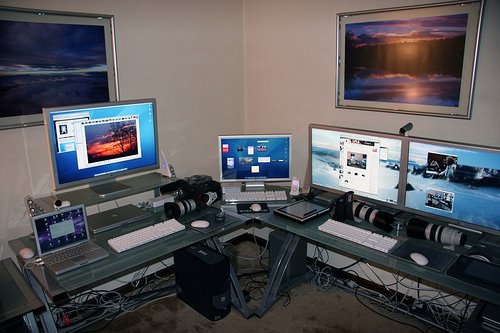
OK, you know, I love my Apple Powerbook and have been a Mac aficionado since 1985--but even I have to admit that this home setup is a bit over the top:

Friday, January 27, 2006
This is Just Wrong, Part XXVI
From the "please kill me" files: a plush bed for one's cellphone:
 Speaking of cellphones, while I was in Boston this week, I read the new Stephen King book, Cell. I liked the premise: some sort of mysterious "pulse" turns everyone who is talking on a cellphone into a violent, homicidal zombie (hmm...not sure how one can tell)--I'm not giving anything away, since this happens on the first page. Like most of King's books, the story is pretty gripping, but with his usual unpleasant characters (who are less unpleasant than usual this time around, though) and some really bad dialogue. The ending, like many of King's endings, is also woefully anticlimactic. Without really giving anything away, it seems he based the "science" of what happens on the mistaken notion that humans use only 10% of their brains, which is one of the more persistent "urban legends" out there (we use most of our brains, although it doesn't always seem like it).
Perfect for your cellphones or small-sized portable media players. Plus, those adorable slippers are actually screen wipers!
 Speaking of cellphones, while I was in Boston this week, I read the new Stephen King book, Cell. I liked the premise: some sort of mysterious "pulse" turns everyone who is talking on a cellphone into a violent, homicidal zombie (hmm...not sure how one can tell)--I'm not giving anything away, since this happens on the first page. Like most of King's books, the story is pretty gripping, but with his usual unpleasant characters (who are less unpleasant than usual this time around, though) and some really bad dialogue. The ending, like many of King's endings, is also woefully anticlimactic. Without really giving anything away, it seems he based the "science" of what happens on the mistaken notion that humans use only 10% of their brains, which is one of the more persistent "urban legends" out there (we use most of our brains, although it doesn't always seem like it).
Spam, Spam, Wonderful Spam
Some more goofy Sent From "names" on a few recent spam messages amused me:
Wetness O. OverchargesIt's the middle initial that makes it comedy.
Pushier R. Skunks
Genuflect O. Cutlass
Celery R. Dogfish
Institutionalized Q. Flesh
Tuesday, January 24, 2006
Shower Showings
Oh, I don't know:

UK's Aquavision offers a line of LCD TVs specifically designed for bathrooms and showers.
The waterproof LCD TVs have a heated screen to prevent steaming up. The Bathroom TVs come with a waterproof and floating remote control - they thought about everything.
Available sizes are 10.4, 15, 17 and a 16:9 23 inch TV.
Casio has a line of portable Bathroom LCD TVs we reported about already back in 2004.

That's Cool
Want cool air in the summer but hate those ugly air conditioners? Do you swelter because of your finely honed aesthetic sense? Well, sweat no longer, with the ART COOL picture frame air conditioner:
LG Electronics today unveiled a picture-frame air conditioner as part of the ART COOL product line. The ART COOL line includes renditions of classic art pieces by famous painters such as Van Gogh and Sisley featured on the product's front panel. The picture-frame air conditioner can display your favorite image up to approximately 17-by-17 inches under its transparent front panel by simply opening the panel and replacing the image. Besides being pretty, the AC unit does other things, such as provide cool air to your environment and purify the air. Available in April 2006 in two different BTU levels 9,000 BTUs and 12,000 BTUs, with a MRSP $2,500 to $3,000.
End of an Era?
Perhaps even more upsetting than Nikon's discontinuing film cameras (for those who are disoriented by the inexorable march of technology), Matsushita, the parent company of Panasonic, has announced that it will discontinue "analog" television sets. Welcome to the digital/HD future.
Saturday, January 21, 2006
The Bee's Niece
I am officially an uncle:
Lucy Bee Romano was born at 11:07 a.m. on Saturday, January 21, 2006, Weight: 7 lbs., 7 oz.
 And already she has movie star good looks:
 Maybe it's me, but all newborn babies seem to resemble Edward G. Robinson.
Lucy Bee Romano was born at 11:07 a.m. on Saturday, January 21, 2006, Weight: 7 lbs., 7 oz.
 And already she has movie star good looks:
 Maybe it's me, but all newborn babies seem to resemble Edward G. Robinson.
Not-So-Critical Masses
I read this in the Skeptical Inquirer a month or so ago, and was a tad concerned:
The researchers don't make any attempt to explain why this might be--and we need to be careful not to confuse "correlation" with "causation." But I think this is just a small piece of a larger societal tendency to not place a very high emphasis on critical thinking--whether it comes to the paranormal or anything else, for that matter. And even to articles in the Skeptical Inquirer. I'm reminded of the old gag:
PERSON 1: "Did you know the word 'gullible' isn't in the dictionary?"
PERSON 2: "Really? I didn't know that."
On a side note, and in the "everyone thinks they're a comedian" category, back in the late 90s when I lived in L.A., I went to the post office to mail some letters, one of which was a subscription renewal to the Skeptical Inquirer. The postal clerk read the address and said, "Skeptical Inquirer, huh? They're probably not going to believe this is from you." Boy was I happy when online bill paying was invented.
Contrary to researchers' expectations, a poll of 439 college students found seniors and grad students were more likely than freshmen to believe in haunted houses, psychics, telepathy, channeling and a host of other questionable ideas.
The results are detailed in the January-February issue of the Skeptical Inquirer magazine.This isn't entirely surprising by itself; what I found particularly interesting--in the original SI article, not mentioned in the LiveScience article--was that they cross-tabbed the respondents by area of study, and those who were studying the sciences were not significantly lower in their tendency to be "believers" than other majors. Although, ironically, the smallest number of believers were studying the fine arts (although the article admits that there were few respondents to the questionnaire who were fine arts majors).
The survey was modeled after a nationwide Gallup Poll in 2001 that found younger Americans far more likely to believe in the paranormal than older respondents.
The new study was done by Bryan Farha at Oklahoma City University and Gary Steward Jr. of the University of Central Oklahoma.
...
More significantly, the new survey reveals college is not necessarily a path to skepticism in these realms.
While 23 percent of college freshmen expressed a general belief in paranormal concepts—from astrology to communicating with the dead—31 percent of seniors did so and the figure jumped to 34 percent among graduate students.
"As people attain higher college-education levels, the likelihood of believing in paranormal dimensions increases," Farha and Steward write.
The media are likely responsible for some people's beliefs in alien abductions and other paranormal concepts, the scientists write, based on their survey of existing studies. And some people tend to selectively confirm whatever ideas might be in their heads. Even smart people might believe in something offbeat because, in part, they're good at defending whatever they believe.
In general college students checked the "Believe" box less than the general population surveyed by Gallup. But the lack of "Don't Believe" responses among college students was lower for six of the 13 categories: psychic or spiritual healing, haunted houses, demonic possession, ghosts, clairvoyance and witches. That means a higher percentage of college students put themselves in the "Not Sure" column on these topics.
The researchers don't make any attempt to explain why this might be--and we need to be careful not to confuse "correlation" with "causation." But I think this is just a small piece of a larger societal tendency to not place a very high emphasis on critical thinking--whether it comes to the paranormal or anything else, for that matter. And even to articles in the Skeptical Inquirer. I'm reminded of the old gag:
PERSON 1: "Did you know the word 'gullible' isn't in the dictionary?"
PERSON 2: "Really? I didn't know that."
On a side note, and in the "everyone thinks they're a comedian" category, back in the late 90s when I lived in L.A., I went to the post office to mail some letters, one of which was a subscription renewal to the Skeptical Inquirer. The postal clerk read the address and said, "Skeptical Inquirer, huh? They're probably not going to believe this is from you." Boy was I happy when online bill paying was invented.
Subscribe to:
Posts (Atom)