In the not-too-distant future when you see someone impatiently tapping their sleeve while waiting for a flight , they might in fact be writing a letter of complaint to the airline company.
German electronics company Infineon Technologies reckons the main reason wearable computers have yet to take off is that there is no simple way to use a keyboard for text entry. The solution, according to Infineon, is to fit a keyboard into a jacket during manufacture.
The garment can be woven from ordinary cloth. The arm of the jacket is then interlaced with a criss-cross of thin insulated wires, with the insulation etched away at spots corresponding to the keys of a keyboard layout. When a low voltage is fed through the wires, touching the pads bridges the wires underneath, turning the sleeve into a keyboard.
To protect the keyboard from wear-and-tear and washing, the overall area is sealed with insulating polymer. The woven wires would be connected directly to the rest of the electronics, which would either be embedded in the lining of the coat or carried somewhere on the body.
Wednesday, October 05, 2005
Dry-Clean Only, No Doubt
The New Scientist's patent office reporter finds this patent pending: a keyboard embdedded into a jacket sleeve.

WiMax on the Horizon
A "souped up" version of WiFi is on the verge of taking over the world, sez Business Week.
Who will deliver universal WiFi hotspots (Google?) and how they are delivered is still up for grabs, but the biggest driver of increased WiFi (or WiMax) hotspots will simply be the increasing expectation that they will exist.
Demand [for WiFi] is soaring, thanks to faster, cheaper, and more reliable technology, and to open standards that let tech giants like Intel (INTC ) bundle Wi-Fi radios into mass-market computers. The number of Wi-Fi users is expected to soar 57% this year, to 118 million worldwide, according to Pyramid Research. Not bad for a technology that's only a few years old.It's amazing how quickly we get spoiled by WiFi. It's reached the point where I get annoyed if I check into a hotel that doesn't have it (or charges through the nose for it). So bad has my jones for WiFi become that last week when my car was being worked on, I asked naively if the Saturn service center had WiFi in its waiting room (I can't believe I actually asked that question with a straight face!) and then proceeded to discover that I was in the only place in the universe (Central Avenue in Albany) without a Starbucks nearby.
Who will deliver universal WiFi hotspots (Google?) and how they are delivered is still up for grabs, but the biggest driver of increased WiFi (or WiMax) hotspots will simply be the increasing expectation that they will exist.
What if You Have a St. Bernard?
You know, whenever I go driving, I can never find a place to store my dachshund. The clever folks at Honda have it covered, apparently.
(Thanks to Audrey for the freakish link.)
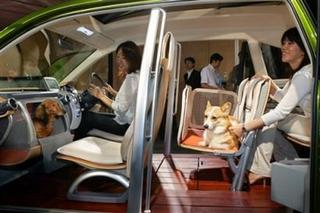
(Thanks to Audrey for the freakish link.)
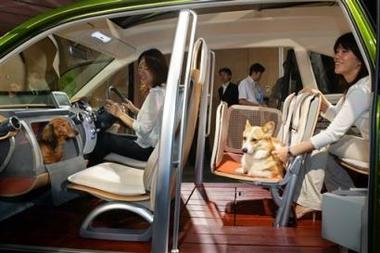
Tuesday, October 04, 2005
What Have I Done?

Well, it's official: I bought a house. Closed a scant 45 minutes ago. Let the carnage begin!
Quantum Computing
Hoo boy. Scientists have trapped a pulse of laser light and can map information onto it, setting us up for a style of computing--called quantum computing--based on principles that maybe two people in the world understand (kind of like Windows, come to think of it...). The first company that names its computing system "Schrodinger's Cat" is going to get neutered.
Office Acrobatics
OK, so MS says the new version of Office will natively allow users to save documents as PDFs (without needing the colossally flaky PDFMaker plug-in). Yeah, I'll bet that will work flawlessly.
Georgia On My...Mind
Georgia-Pacific is cutting jobs, and it's odd which product lines are affected because you'd think, that there are certain, um, applications for paper that will never go away.
Lamp Unto My Feet, Apparently
Well, this--slippers with headlights--is either a good idea, or just plain silly. You be the judge.
Dr. Demento?
Sez the BBC:
Of course, it does nothing for those of us who are demented now.
Exercising for half an hour at least twice a week during midlife can significantly cut a person's risk of dementia later, say researchers.
People in their late 40s and early 50s who do this could reduce their risk of dementia by about 50%, according to a study reported in Lancet Neurology.
No No NO!
Oh, good: more mutually incompatible DVD formats on the horizon.
Sorry--I made the transition to from vinyl to CD, and from VHS to DVD. I'm done transitioning to new formats. Until movie studios offer upgrade pricing, I'll pass.
[T]he six major studios were evenly split between the Blu-ray technology backed by Sony Corp. and HD DVD supported by Toshiba Corp.
Both formats deliver movies in sharp high-definition and can store more data than traditional DVDs, which will allow them to offer interactive features such as games.
But the formats are incompatible and will force consumers to choose one over the other, a potentially costly decision if one format ultimately wins in the marketplace, the case when VHS defeated Betamax for home video in the 1980s.
Sorry--I made the transition to from vinyl to CD, and from VHS to DVD. I'm done transitioning to new formats. Until movie studios offer upgrade pricing, I'll pass.
Our Expanding Universe
According to the New York Times, last summer's discovery of a 10th planet (named Xena, after TV's warrior princess--sorry, I've never actually seen the show, but don't call me Xenaphobic) and last week's discovery that Xena had a moon (named Gabrielle, after Xena's sidekick, apparently), the question "what the heck is a planet?" rages again. Some may recall the debate back in 1998 or so when the powers that rule the heavens (or so it would seem) wanted to demote Pluto from "planet" to "Kuiper Belt object" or the more poetic (at least to me...) "trans-Neptunian object." Although, if you ever take the tour of the Lowell Observatory in Flagstaff, AZ (where Pluto was discovered), they're having none of it. To their mind, Pluto may as well be Jupiter.
Monday, October 03, 2005
Bad Words
One buzzphrase I would like to see wished into the cornfield: "viral marketing." I have nothing in particular against the phenomenon it refers to but surely we can come up with a better term for it than that.
Disneyland Goes to Us
Sez WSJ:
Robert Iger, who takes over today as Walt Disney Co.'s chief executive, is shaking up the Magic Kingdom by pushing a mandate for the digital age: Consumers must be able to use Disney content whenever and wherever they want it.
Mr. Iger is talking about selling episodes of ABC hits such as "Lost" and "Desperate Housewives" online like songs. He is roiling the movie-theater industry by publicly floating the idea of releasing movies in cinemas and on DVD at the same time. He is negotiating with telecom companies about ways to deliver entertainment over cellphones.
Google Takes on the Telecoms
Now that WSJ.com is back, I can read the article that was forwarded to me. And the plot thickens:
Internet companies are making an aggressive and unprecedented push into services traditionally offered by phone and cable companies -- threatening to upend the business of transmitting voice and data.But wait, there's more:
Google Inc. unveiled the latest such effort Friday with a proposal to provide free, wireless high-speed Internet access in the city of San Francisco. The service would allow users to bypass fee-based connections of cable and local phone companies in favor of wireless links.
Users could log on through computers and email, surf the Web, download music or do anything else they can do with a traditional Internet connection -- including, potentially, make phone calls with voice-over IP, or VOIP, technology.
More troubling for telecoms, it would bring their industry an entirely different business model. Google generates nearly all its revenue, which totaled $3.2 billion last year, from the small advertisements it shows alongside search results and other Web content.I am curious, though: Google's whole model is advertising-based. Indeed, both Google and Yahoo!--among others--can offer free maps, free searches, free VoIP, free this, free that, because it's all advertiser-supported. But is that truly sustainable? What happens to all our connectivity if the model collapses?
By offering consumers free service, Google could pressure traditional providers to slash fees for Internet access, a growing source of telecom revenue -- when they don't have Google's advertising revenue to make up the difference, and have large, extensive networks for transmitting voice and data to maintain.
Google's proposal to use wireless fidelity, or Wi-Fi, technology would cost far less than a traditional network. It also would give Google a direct pipeline into consumers' homes -- long the big edge for telephone and cable companies.
Video To Go
Oh, I don't know:
TV service on the go is being touted as the next big moneymaker for mobile phone operatorsI do have mixed feelings about the idea of video on cellphones. I do like the idea of portable video players, especially while traveling. (Kind of like map laptop computer, on which I watch DVDs while on the road.) However, a cellphone is a pretty lousy medium for watching video. And I can see where this is going: the same dips**ts who cluelessly walk or drive while yakking will now be cluelessly walking or driving while watching TV. Not wild about this idea, speaking as someone who occasionally leaves the house and has unpleasant encounters with these people.
Score 1 For Print
Hmm...
Still, once I've actually had the paper in hand, nothing has ever stood in the way of my ability to read it (barring some Burgess Meredith/"Time Enough at Last" eyeglasses problem).
Notice to Readers:I never got that error message in a print edition. Although, to be fair, I have had the print equivalent, I guess you could call it: newspaper subscriptions in which, at times papers weren't delivered; got stolen (in NYC, natch); ended up, I later discovered, on my roof; or, in the case of one exceptionally skilled L.A. Times delivery person, under my car at the exact point where it was unreachable from any direction without starting and moving the car.
Full access to The Wall Street Journal Online is unavailable due to technical difficulties. Please see the What's News column for highlights of the top news of the day. We apologize for the inconvenience
Still, once I've actually had the paper in hand, nothing has ever stood in the way of my ability to read it (barring some Burgess Meredith/"Time Enough at Last" eyeglasses problem).
@ Large
CNet today mentions alternative terms for the "@" symbol that has become ubiquitous in our lives. This seems like as good a time as any to repeat a little history of the symbol I compiled for an e-letter a couple years ago:
Ever wonder where the “@” sign came from? It’s been a standard character on computer keyboards (and before that typewriters) practically since day one, and it’s a ubiquitous symbol these days, but it dates from the days of monk-based communication—in Medieval manuscript copying, “@” was how monks abbreviated the word “ad” which is Latin for “at.”
However, “@” as we know it technically comes not from Latin but Spanish.
In the 15th century, the symbol “@” began to be used an abbreviation of the word “arroba,” which is a Spanish and Portuguese unit of measure (equivalent to 25.37 pounds in Mexico and 32.38 pounds in Brazil) used in trade. The sign “@” itself soon came to become associated not with the weight of shipments but with billing and invoicing—“3 goats @ $5.00,” where it remained for centuries. As a result, it was for many people an arcane symbol that was merely the shift of the “2” key.
Until 1971. Bolt Beranek and Newman was a company hired by the U.S. Department of Defense to build the first Internet (then called ARPANET). One of the team members was a computer engineer named Ray Tomlinson, and in 1971 he invented the ability to send electronic messages from one computer to another. Naturally, messages needed to be addressed in some way so that the file transfer system knew where to send them. Tomlinson chose the “@” symbol to refer to what user was “at” which computer. The first e-mail message ever sent? The decidedly prosaic “QWERTYUIOP,” which was sent from a computer over the ARPANET to the computer sitting right next to it.
E-mail wouldn’t become ubiquitous until more than 20 years later.
Interestingly, one of the first organizations to grok the idea of e-mail was, seemingly ironically, the U.S. Postal Service. In the 1970s, the Post Office had created a system called E-Com, which was a network of 25 sites around the country among which electronic messages could be transmitted. Letters could be “e-mailed” (or “E-Commed,” you could probably say) from one site to another, where they could be printed on what was considered at the time to be high-speed laser printers. Once received and printed, a message could then be delivered as first class mail to the ultimate recipient.
But it was not to be. The telephone and telegraph companies freaked out about the idea of the Post Office becoming their competition, so they ran to the FCC, who, post haste (as it were), barred the Postal Service from getting into the electronic message business. As a kludge, the Post Office tried “snail mailing” magnetic tapes from site-to-site, but that was far less compelling. And that was the end of E-Com.
Saturday, October 01, 2005
Harrumph!
I don't get ESPN2, which is where today's Syracuse-Florida State game is being televised. I did notice that you can watch games over the Internet via a kind of pay-per-view system but, alas, I tried and got this error message:
Interesting wording: "Windows 98 or better." I have a Mac; it is better. Growl. Oh, well, at least the game is on the radio. Then again, maybe I don't want to see this game...
I STAND CORRECTED: the game is actually on ABC, not ESPN2. But I was right: I don't want to see it...
We have detected that your system is not currently equipped to use ESPN Motion. A Mac OS X version is in development, but for now, if you would like to use ESPN Motion, you must be using a PC with Windows 98 or better.
Interesting wording: "Windows 98 or better." I have a Mac; it is better. Growl. Oh, well, at least the game is on the radio. Then again, maybe I don't want to see this game...
I STAND CORRECTED: the game is actually on ABC, not ESPN2. But I was right: I don't want to see it...
E-Mail Notice
I am switching Web hosts this weekend, which will affect (or, hopefully not affect adversely) all e-mail sent to my richtextandgraphics.com domain address(es) and, of course, my Web site at www.richtextandgraphics.com. There shouldn't be any interruptions of service (but, well, you know), but if anyone notices any e-mail bouncing on Monday, please let me know. My spam magnet--I mean, my Roadrunner address--rromano2@nycap.rr.com is still active and unaffected.
Hmm...suddenly, this blog is serving a constructive purpose...
Hmm...suddenly, this blog is serving a constructive purpose...
They Called Him MISTER Tharp
I don't know how many of the folks reading this (if any) knew of Rick Tharp, an award-winning San Francisco-based graphic designer. In the late 1990s, we were always covering his firm Tharp Did It! in the Northern California Edition of Micro Publishing News, and we used to chuckle because Rick always insisted (with tongue-in-cheek, I later learned) on being referred to as "Mister Tharp." I met him once at a party in San Francisco in 1998 or so; this was about the time that the first batch of redesigned $20 bills were coming out and we were commenting about the redesign--I joked that the new money looked like it was the result of a font substitution (for those not in the know, this is what happens when the device printing something doesn't have the fonts that the designer used--a common problem in digital prepress). This amused him greatly and for several weeks afterward he tried to enlist my help in starting a rumor in the trade press that the new money was actually the result of a major production error at the Bureau of Printing & Engraving (it didn't work). We kept in touch for a short time afterward, but although I didn't know him well, I always remember him as a funny guy (and at the time I thought he looked like Frank Zappa, which is always a plus in my book). It hit me very weirdly, then, when I read this morning in Graphic Design: USA that, last summer, he apparently jumped off the Golden Gate Bridge. Very sad; he was extremely talented. A full bio here.
Subscribe to:
Posts (Atom)