 It wouldn't be unreasonable to place this little warning sign on just about every object in my house...
Friday, October 27, 2006
Icon Tact
I bought this Braun hand blender (er, I mean, handheld blender) and I was looking through the impenetrable instruction book and came across the greatest warning icon I have ever seen:
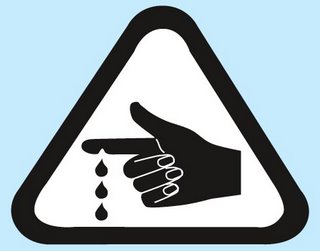 It wouldn't be unreasonable to place this little warning sign on just about every object in my house...
It wouldn't be unreasonable to place this little warning sign on just about every object in my house...

Radio, Radio
Today they're called podcasts, but back in the Golden Age of Radio, they were called radio shows.
For those who love old-time radio dramas, here is a link to 100 horror dramas from the good ol' days, including "The Phantom of the Opera," "Sorry, Wrong Number," "The Day the Earth Stood Still," "The Dummy," "Buried Alive," "Donovan's Brain," "Frankenstein," and "Jack Benny Throws a Hallowe'en Party."
Needless to say, Vincent Price is all over the place. And that's a good thing.
For those who love old-time radio dramas, here is a link to 100 horror dramas from the good ol' days, including "The Phantom of the Opera," "Sorry, Wrong Number," "The Day the Earth Stood Still," "The Dummy," "Buried Alive," "Donovan's Brain," "Frankenstein," and "Jack Benny Throws a Hallowe'en Party."
Needless to say, Vincent Price is all over the place. And that's a good thing.
Last Class Mail
On the subject of the mail, when I receive letters from my bank or credit card company that say "Important Information About Your Account" on the envelope, it really irks me when I open it to discover it is another stupid credit card offer. I have seen data that indicate that printing lines to that effect on the envelope stimulate recipients to open them three times faster, but I have to say it makes me stuff them into the paper shredder 50 times faster.
Prize Patrol
So I get this card in the mail today that reads, in part:
You are an official prizewinner in our new Mercedes, BMW,Now, granted, I always ignore notices telling me that I have won contests I never actually entered, but this scam would be a tad more compelling if the last three people who lived at this address didn't receive the exact same card on the exact same day.
Porsche, or $40,000 cash promotion. We have been unable to contact you...
The Great Pumpkin
For those who need a heavy dose of cute, herewith the niece, Lucy Bee, 9 months and growing (tempus fugit!), dressed up as the Human Pumpkin Girl. I bear at least some of the responsibility for the pumpkin costume....
 As it turns out, I will be on jury duty on Halloween, and they say to dress in a manner that is respectful of the court. I was thinking of a similar pumpkin outfit. Or, better yet, a Starfleet uniform, like that juror in the Clinton trial back in the 90s....
 As it turns out, I will be on jury duty on Halloween, and they say to dress in a manner that is respectful of the court. I was thinking of a similar pumpkin outfit. Or, better yet, a Starfleet uniform, like that juror in the Clinton trial back in the 90s....
Thursday, October 26, 2006
The Soul of Wit
...is brevity, of course. And in today's attention-deficit-disorder-based world, the briefer the better. So Wired magazine recently asked a bunch of writers to come up with short stories that are only six words long. Some of my favorites:
Failed SAT. Lost scholarship. Invented rocket.
- William Shatner [jeez, he's everywhere!]
Gown removed carelessly. Head, less so.
- Joss Whedon
Longed for him. Got him. Shit.
- Margaret Atwood
Internet “wakes up?” Ridicu -
no carrier.
- Charles Stross
Epitaph: Foolish humans, never escaped Earth.
- Vernor Vinge
We kissed. She melted. Mop please!
- James Patrick Kelly
The baby’s blood type? Human, mostly.
- Orson Scott Card
Kirby had never eaten toes before.
- Kevin Smith
Starlet sex scandal. Giant squid involved.
- Margaret Atwood
Bulleted Text
Yes, I'm with Gizmodo: perhaps this is a sign of the apocalypse:
Sort of like that old proverb about the bible in the breast pocket...
I can think of a few textbooks I've wanted to put some bullets through (like that one I had in Advanced Chemistry freshman year in college...).
There is no truth to the rumor, though, that certain literary enclaves (like Yaddo here in Saratoga) are toying witth the idea of making protective vests out of textbooks. (Insert own metaphor here.)
An Oklahoma retired veteran and state school superintendent candidate is campaigning to have bullet-proof textbooks. Bill Crozier tested traditional textbooks to see what, if any kind of bullets a textbook would stop. The traditional textbooks were able to stop handgun bullets, but not rifle bullets.Whew! Saved by trigonometry!
Sort of like that old proverb about the bible in the breast pocket...
I can think of a few textbooks I've wanted to put some bullets through (like that one I had in Advanced Chemistry freshman year in college...).
There is no truth to the rumor, though, that certain literary enclaves (like Yaddo here in Saratoga) are toying witth the idea of making protective vests out of textbooks. (Insert own metaphor here.)
Unquiet Slumbers for the Sleepers
Uh, OK:
The sonic bed is a king-size bed with 12-channel surround sound. It may look like a wooden tank from the outside, but inside its got enough speakers to dwarf any home theater set up. Created by Kaffe Matthews as a museum exhibit (no plans for retail as of yet), the bed requires 220 volts of electricity and covers every inch of your body in sound.I guess this is perfect for those who don't have enough of an insomnia problem.
Thursday, October 19, 2006
iDon'tthinkso
What could possibly be more unpleasant than blundering into a bar on karaoke night? Why, having Griffin's iKaraoke, of course:
Karaoke sends the music from your iPod to your stereo minus the lead vocals, so you can step up to the mic and sing the lead in your favorite tunes.Well, maybe I was wrong. Perhaps a karaoke-singing robot would be more unpleasant. It's certainly more disturbing, and will almost certainly be one of the elements of the impending robot holocaust.
Shrimp Scampering
From the "Uh, OK" file, here is a link to a video of a shrimp on a treadmill. (You have to sit through an ad first.) No, that's not an un-PC statement. It's an actual shrimp (i.e., the crustacean). Why would there be a shrimp on a treadmill? Perhaps it was referred to as a "jumbo shrimp" once too often and got self-conscious. Actually, though:
Researchers measure activity of an exercising shrimp by time, speed and oxygen level.Ah, of course. Poor thing. He's just a prawn in someone else's game...
Cursors, Foiled Again!
Looking for that special Christmas gift? Via Boing Boing, try the Cursors That Kill T-shirt.
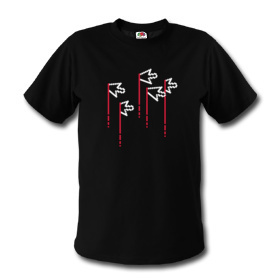
I think we've all been there at one time or other...
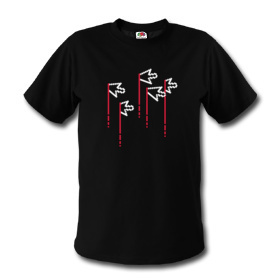
I think we've all been there at one time or other...
Wednesday, October 18, 2006
Burnin' for You--Not
Gizmodo, of all places, has a post about the Coca-Cola Company's new Enviga green tea soft drink that is apparently supposed to "burn calories." Uh huh. (I confess I had never heard of it, but I don't quite get the physics or the chemistry behind a soft drink that can burn calories unless you drink it while running on a treadmill, perhaps out of one of those hamster-cage bottle things.) The Consumerist rightly throws the BS flag on this one.

Friday, October 13, 2006
For Want of a Snail
Uh, OK...
RealSnailMail is a performance art piece in which the artists create snail mail with real snails. The intent is to harness the power of gastropods to deliver email messages across short distances using special waterproof RFID tags glued to their shells.Kind of like Roadrunner some days...
In the project, messenger snails are 'chipped' by using a waterproof glue to affix an RFID tag to its shell. The project will focus on a suitable snail environment (like a fish tank) with several RFID readers installed at different spots.
The project begins with a web site that accepts short messages from people on the Internet. These messages are placed into a queue for snail mail delivery.
Prison Cells
Yes, but:
OK, I'm better now.
Since incoming calls come out of my cell minutes (and I don't have a first-minute-free plan), I also rely on caller ID. I'm always amused when the same unknown people call over and over, obstinately refusing to leave a message. I always return messages (sometimes even promptly), should anyone ever actually leave one, but don't see any reason to maintain 24/7 telephonic availability--especially to "unknown" callers (who are usually only going to ask me for money).
YouMail is a free service that lets you change your cellphone's voicemail greeting according to who's calling. You could record a separate personalized voicemail announcement for every entry in your phonebook.Whilst I like this idea in theory, perhaps it's just me, but when people call my cellphone, no one ever leaves voice mail. I don't know if anyone bothers listening to the outgoing message or just gives up if I don't answer after two rings--which I never do because, well, cell reception in the house is virtually non-existent (why is why I had to get a landline), plus I hate talking on cellphones in public (it's rude and obnoxious, plus I get self-conscious) and of course I refuse to talk while driving (hey, someone's got to stay alert out there, given how idiotically everyone seems to be driving lately--lanes? what are they?).
OK, I'm better now.
Since incoming calls come out of my cell minutes (and I don't have a first-minute-free plan), I also rely on caller ID. I'm always amused when the same unknown people call over and over, obstinately refusing to leave a message. I always return messages (sometimes even promptly), should anyone ever actually leave one, but don't see any reason to maintain 24/7 telephonic availability--especially to "unknown" callers (who are usually only going to ask me for money).
Gross Domestic Product
Definitely the grossest I've seen (since, perhaps, the chocolate chip pancake-and-sausage-on-a-stick): deep-fried Coca-Cola. I kid you not:
There are fried Twinkies and even fried candy bars.I think I'd rather take my chances with E. coli-infused spinach.
Now, vendor Abel Gonzales Jr. has come up with a new artery-clogging concoction for the State Fair of Texas. It's fried Coke.
Gonzales deep-fries Coca-Cola-flavored batter. He then drizzles Coke fountain syrup on it. The fried Coke is topped with whipped cream, cinnamon sugar and a cherry. Gonzales said the fried Coke came about just from thinking aloud.
Introducng the Fall Collection
Get it now, just in time for the 31st. If you have a couple of grand to drop on your Halloween festoonery, be sure to visit this online catalog of haunted furniture. Personally, I'd use this stuff all year round, especially the chair that has a ghoul intermittently spring out of it. (The flailing "exorcist bed" is also kind of cool, but could get messy.) Breaks the ice at parties.
I Can't Believe It's Butter
With so much going on in today's high-tech world of iPods, cellphones, PlayStations, Google and YouTube, etc. etc. etc., we often lose sight of the fact that butter-spreading technology has also been proceeding apace.
For example, via mi hermano, the "One-Click Butter Cutter" for those who don't trust themselves alone with a full stick of butter. Now you can just squeeze out a small, healthy pat.
 You can also squeeze the butter pats right into your mouth, if you're into that.
And, via Marginal Revolution's link to a slideshow of strange Japanese inventions, the spreadable butter stick:
 Word of advice: if you have this butter stick, as well as a glue stick and/or any of those stain-removing sticks, you might not want to keep them all in the same drawer.
For example, via mi hermano, the "One-Click Butter Cutter" for those who don't trust themselves alone with a full stick of butter. Now you can just squeeze out a small, healthy pat.
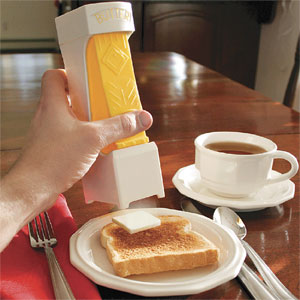 You can also squeeze the butter pats right into your mouth, if you're into that.
And, via Marginal Revolution's link to a slideshow of strange Japanese inventions, the spreadable butter stick:
 Word of advice: if you have this butter stick, as well as a glue stick and/or any of those stain-removing sticks, you might not want to keep them all in the same drawer.
Thursday, October 12, 2006
Battle of the Bands
Via Boing Boing and courtesy of "GooTube," an inspired bit of Terry Gilliam-esque animation featuring an all-out war among classic rock album covers. One of the funniest things I've seen in a while.
You know, some people just have way too much time on their hands.
Laserium
Some of you may recall a link to a video of a wry British guy--named Dr. Ashen, as it turns out--reviewing (quite hysterically) a piece of shite MP4 player. Now he's back with a look at a green laser pointer.
Back to the Future
So what was life like in the year 2000? Or, I should say, what did they predict life in the year 2000 would be like 50 years ago? This article from the February 1950 issue of Popular Mechanics, written by the then-science editor of the New York Times, does a spectacularly bad job of forecasting the future--but some things ultimately came to pass, although in a somewhat different way than had been envisioned. The article discusses the hypothetical Dobson family of 2000, living in their ultramodern city of Tottenville.
Some choice excerpts:
Of course, we shouldn't mock too much. As Ray Kurzweil has explained on numerous occasions, one of the hallmarks of the coming "singularity" is the fact that technological chnge that takes place exponentially will ultimately reach a point where progress happens faster than our ability to forecast it.
Some choice excerpts:
Tottenville [is] a hypothetical metropolitan suburb of 100,000....Tottenville is as clean as a whistle and quiet. It is a crime to burn raw coal and pollute air with smoke and soot. In the homes electricity is used to warm walls and to cook. Factories all burn gas, which is generated in sealed mines. The tars are removed and sold to the chemical industry for their values, and the gas thus laundered is piped to a thousand communities.They've got a point, there...
The highways that radiate from Tottenville are much like those of today, except that they are broader with hardly any curves. In some of the older cities, difficult to change because of the immense investment in real estate and buildings, the highways are double-decked. The upper deck is for fast nonstop traffic; the lower deck is much like our avenues, with brightly illuminated shops. Beneath the lower deck is the level reserved entirely for business vehicles.
...
It is a cheap house. With all its furnishings, Joe Dobson paid only $5000 for it. Though it is galeproof and weatherproof, it is built to last only about 25 years. Nobody in 2000 sees any sense in building a house that will last a century.
Everything about the Dobson house is synthetic in the best chemical sense of the term. When Joe Dobson awakens in the morning he uses a depilatory. No soap or safety razor for him. It takes him no longer than a minute to apply the chemical, wipe it off with the bristles and wash his face in plain water.I like this next idea...
There are no dish washing machines...because dishes are thrown away after they have been used once, or rather put into a sink where they are dissolved by superheated water. Two dozen soluble plastic plates cost a dollar. They dissolve at about 250 degrees Fahrenheit, so that boiling-hot soup and stews can be served in them without inviting a catastrophe.
...
When Jane Dobson cleans house she simply turns the hose on everything. Why not? Furniture (upholstery included), rugs, draperies, unscratchable floors — all are made of synthetic fabric or waterproof plastic. After the water has run down a drain in the middle of the floor (later concealed by a rug of synthetic fiber) Jane turns on a blast of hot air and dries everything. A detergent in the water dissolves any resistant dirt. Tablecloths and napkins are made of woven paper yarn so fine that the untutored eye mistakes it for linen. Jane Dobson throws soiled “linen” into the incinerator. Bed sheets are of more substantial stuff, but Jane Dobson has only to hang them up and wash them down with a hose when she puts the bedroom in order.Microwave ovens, anyone? And how about a big "oh, yuck" for this next bit:
Cooking as an art is only a memory in the minds of old people. A few die-hards still broil a chicken or roast a leg of lamb, but the experts have developed ways of deep-freezing partially baked cuts of meat. Even soup and milk are delivered in the form of frozen bricks.
This expansion of the frozen-food industry and the changing gastronomic habits of the nation have made it necessary to install in every home the electronic industrial stove which came out of World War II. Jane Dobson has one of these electronic stoves. In eight seconds a half-grilled frozen steak is thawed; in two minutes more it is ready to serve. It never takes Jane Dobson more than half an hour to prepare what Tottenville considers an elaborate meal of several courses.
By 2000, a vast amount of research has been conducted to exploit principles that were embryonic in the first quarter of the 20th century. Thus sawdust and wood pulp are converted into sugary foods. Discarded paper table “linen” and rayon underwear are bought by chemical factories to be converted into candy.However, does this next bit sound familiar?
Of course the Dobsons have a television set. But it is connected with the telephones as well as with the radio receiver, so that when Joe Dobson and a friend in a distant city talk over the telephone they also see each other. Businessmen have television conferences. Each man is surrounded by half a dozen television screens on which he sees those taking part in the discussion. Documents are held up for examination; samples of goods are displayed. In fact, Jane Dobson does much of her shopping by television. Department stores obligingly hold up for her inspection bolts of fabric or show her new styles of clothing.Anyway, go read the whole thing. Some of it will sound eerily prescient, some wishful thinking, some downright bizarre.
Of course, we shouldn't mock too much. As Ray Kurzweil has explained on numerous occasions, one of the hallmarks of the coming "singularity" is the fact that technological chnge that takes place exponentially will ultimately reach a point where progress happens faster than our ability to forecast it.
Monday, October 09, 2006
Delusions of Adequacy
For all those insultants (rather than consultants) out there, here is a link to a blog that collects famous insults. My favorites:
"He has all the virtues I dislike and none of the vices I admire."And perhaps the most relevant in my line of work:
Winston Churchill
"I've had a perfectly wonderful evening. But this wasn't it."
Groucho Marx
"He had delusions of adequacy."
Walter Kerr
"He uses statistics as a drunken man uses lamp-posts...for support rather than illumination."
Andrew Lang
Friday, October 06, 2006
Be Kind...
Via Version 1.0, useful as a gag gift or an accessory for the truly gullible:
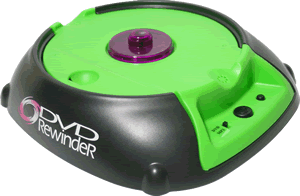 The idea of a "Centriptal Velocity Spindle" may have been (marginally) more convincing if they had spelled it correctly. You can bet, though, that there were some high-level meetings at Blockbuster about how they could charge people for un-rewound DVDs....
DVD Rewinder
Too many DVDs, and CDs and not enough time to rewind? Are your DVDs running a bit too slow? The DVD rewinder is the perfect solution! This novelty rewinder comes with the exclusive Centriptal Velocity Spindle providing the world’s fastest DVD rewind!
 The idea of a "Centriptal Velocity Spindle" may have been (marginally) more convincing if they had spelled it correctly. You can bet, though, that there were some high-level meetings at Blockbuster about how they could charge people for un-rewound DVDs....
Monday, October 02, 2006
To Serve Man
Sure, this seems harmless enough:
In Japan...[r]esearchers at NEC System Technologies and Mie University have designed a robot that can taste — an electromechanical sommelier able to identify dozens of different wines, cheeses and hors d'oeuvres.But, uh oh:
...
Last month, they unveiled the fruits of their two-year effort — a green-and-white prototype with eyes, a head that swivels and a mouth that lights up whenever the robot talks.
The "tasting" is done elsewhere, however.
At the end of the robot's left arm is an infrared spectrometer. When objects are placed up against the sensor, the robot fires off a beam of infrared light. The reflected light is then analyzed in real time to determine the object's chemical composition.
When a reporter's hand was placed against the robot's taste sensor, it was identified as prosciutto. A cameraman was mistaken for bacon.It's a cookbook!!
Saturday, September 30, 2006
Go Back to the Five and Dime, Jimmy Dean
Just when I thought that the Dominos' "brownies with chocolate dipping sauce" sounded like the most repulsive thing that could be consumed (aside from Dominos' pizza), if not the perfect way to end up in a diabetic coma, this new product from Jimmy Dean takes the cake (as it were): Chocolate Chip Pancakes & Sausage on a Stick.
 As if sausage and pancakes on a stick weren't bad enough, it's the chocolate chips that make it art. I can feel my waistline expanding just looking at the box. I'm waiting for the new Unhealthy Choice soup, Beef Bullion With Deep-Fried Lard Cubes and M&Ms.
 As if sausage and pancakes on a stick weren't bad enough, it's the chocolate chips that make it art. I can feel my waistline expanding just looking at the box. I'm waiting for the new Unhealthy Choice soup, Beef Bullion With Deep-Fried Lard Cubes and M&Ms.
Thursday, September 28, 2006
Seeing Double
Perhaps it was all the red wine, but sorry for the double post. Blogger has gone insane.
Red Red Wine
Here's some more good news from the world of health:
A new study finds that moderate red wine consumption, specifically Cabernet Sauvignon, might help reduce the incidence of Alzheimer's disease.The emphasis, of course, is on "moderate." But then with excessive red wine consumption you'll just not remember things anwyay.
Bugged By Google
Perhaps I have been wrong all along in my belief that humanity's end will come at the hands of evil robots, since there appears to be concrete proof that a giant, 120-foot-long insect is rampaging across Germany as we speak:
Then again, it could be a giant, evil robotic insect, which is a good compromise for resolving a variety of conflicting paranoid delusions.
A giant bug of an unknown type was discovered in a field in Germany during a recent Google Maps survey. The bug, which measures over 120 feet, was spotted in a field northeast of Arlesberg, halfway between Stuttgart and Numberg, and it is assumed that the bug intends to slowly devour all the people living in the nearby small towns.Or it could be that the "giant" insect is actually of normal size and was merely caught on the scanner during the imaging process. (I know all software has its bugs, but really!)
Then again, it could be a giant, evil robotic insect, which is a good compromise for resolving a variety of conflicting paranoid delusions.
Wednesday, September 27, 2006
Going to the Dogs
I think we're going to start seeing even more stories like this:
Dog starts car after eating chip
A breakdown patrol man who came to the rescue of a woman motorist has managed to get her car started using her dog.
Juliette Piesley, 39, had changed the battery in her electronic key fob but was then unable to start her car.
When AA patrolman Kevin Gorman arrived at the scene in Addlestone, Surrey, he found its immobiliser chip was missing.
Ms Piesley said her dog George had eaten something, and realising it was the chip, he put the dog in the front seat and started the car with the key.
Mr Gorman said: "I was glad to get the car started for the member.
"They will now have to take George [the dog] with them in the car until things take their natural course.
"It is the first time that I have had to get a dog to help me to start a car."
Friday, September 22, 2006
The O.C.[D.]
While, on an aesthetic level, I am quite fond of this SquidSoap soap dispenser:
 I wonder if the point of it might not go a long way toward creating the next generation of obsessive-compulsive disorder sufferers:
 I wonder if the point of it might not go a long way toward creating the next generation of obsessive-compulsive disorder sufferers:
SquidSoap is a fun soap dispenser designed for teaching children healthy hand washing habits.
SquidSoap works by applying a small ink mark on a person's hand when they press the pump to dispense the soap. The ink is designed to wash off after the hands are washed for about15-20 seconds, which is the time recommended by most doctors.
Thursday, September 21, 2006
Measure for Measure
Those of you who have some vague idea of what it is that I do for a living--and I would probably have to put myself in that category--may know that, among other things, I am a writer and analyst for TrendWatch Graphic Arts (TWGA), which conducts regular market research into the graphic arts industry. Well, TWGA has now changed its name (to The Industry Measure) and some of its basic focus. The Web site can now be found at www.theindustrymeasure.com.
If you've wondered why I rarely post on this blog anymore about media, print, communications, etc., well...the new IM site now has a blog, for which I will be the primary poster. So I have been holding all my "real" blog postings for The Industry Measure, so as not to have to end up writing about the same things twice (well, blog-wise, anyway). So be sure to visit here for my (hopefully) daily blog postings about the state of media and communications.
Blogito Ergo Sum will continue to provide news (or whatever you want to call it), jokes, puns, sarcastic remarks, general silliness, and other random comments about dorky new technologies and silly new gadgets, our imminent doom from rampaging robots, the ways that that society is going to hell in a hula hoop (i.e., cellphones), books and music, and other more creative approaches to blogging.
If you've wondered why I rarely post on this blog anymore about media, print, communications, etc., well...the new IM site now has a blog, for which I will be the primary poster. So I have been holding all my "real" blog postings for The Industry Measure, so as not to have to end up writing about the same things twice (well, blog-wise, anyway). So be sure to visit here for my (hopefully) daily blog postings about the state of media and communications.
Blogito Ergo Sum will continue to provide news (or whatever you want to call it), jokes, puns, sarcastic remarks, general silliness, and other random comments about dorky new technologies and silly new gadgets, our imminent doom from rampaging robots, the ways that that society is going to hell in a hula hoop (i.e., cellphones), books and music, and other more creative approaches to blogging.
Fish Out of Water
This is odd:
 Put some weapons on it, and the family fish can finally give the cat a little quid pro quo.
Kind of reminds me of Professor Wernstrom's "walking fish suit" from Futurama.

This Blood Parrot fish rolls the contraption around just by swimming around in its bowl. The sensors and the onboard computer detects [sic] which direction the fish is swimming in, then directs the wheels accordingly.
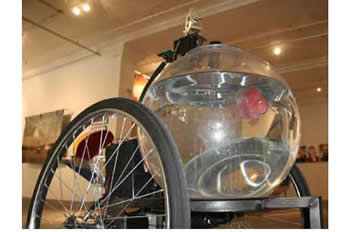 Put some weapons on it, and the family fish can finally give the cat a little quid pro quo.
Kind of reminds me of Professor Wernstrom's "walking fish suit" from Futurama.

Watch This
Via Gizmodo, we can now all emulate Dick Tracy:
This GSM cellphone wrist watch has a 1-inch OLED screen, and does triband GSM after you drop a SIM card inside. The phone has room for 99 speed dials, and has 40 ringtones built in. Its batteries will last for 80 minutes of standard calls, but the phone has SMS capabilities, and even has Bluetooth for a headset.Sure, it's dorky, but no dorkier than any other cellphone.
Charge of the Light Brigade
Now this is pretty cool, a giant anglepoise lamp:
 A bit pricey at 275 quid, though.
It reminds me of a Peter Gabriel concert I went to in 1986 where, at one point, as part of the stage show, Gabriel was attacked by what looked like a bunch of giant desk lamps. I don't remember what song it was--although it may even have been "I Don't Remember."
And let's not forget the 1979 Soft Boys song "(I Want to Be an) Anglepoise Lamp."
To Celebrate the 70th Birthday of the Original 1227 Anglepoise Lamp we have created a three times life size version of the lamp which is handmade in England.
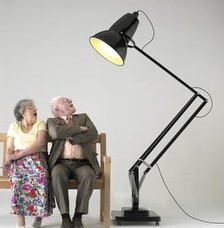 A bit pricey at 275 quid, though.
It reminds me of a Peter Gabriel concert I went to in 1986 where, at one point, as part of the stage show, Gabriel was attacked by what looked like a bunch of giant desk lamps. I don't remember what song it was--although it may even have been "I Don't Remember."
And let's not forget the 1979 Soft Boys song "(I Want to Be an) Anglepoise Lamp."
"No Wire Hangers!"
Maybe Joan Crawford was ahead of her time. Via Boing Boing:
How-To: Build a Robot from a Coat HangerAnd the problem with coathanger-based robots is that they can rise up against us--while wearing our own clothes! Insidious, eh?
In this project, we'll build a little critter out of surprisingly simple, minimal parts. We'll even make use of one of those coat hangers that seem to breed in the bedroom closet. This project is an ingenious little hardware hack dreamt up by a Canadian BEAM enthusiast named Jérôme Demers. It wonderfully illustrates a number of principles of bottom-up, BEAM-friendly robotics.
Wednesday, September 20, 2006
Genius in France?
From the "please kill me" file (via Gizmodo):

These French cases for your iPod may look like Domokun, but they're definitely French in origin. The felt cases are handmade, and retail for $40 to $50, but who can put a price on cuteness?Oh, I think I could.

Chairs and Jeers
You know, today's working life is so harried and busy that I find that even walking from one room to another is downtime I can ill-afford. And yet, sometimes I just need to get into another room, but all that lost productivity means...well, I'm sure it means something dire.
So I am happy to learn (via Boing Boing) that someone has invented the hand truck chair. This means I can hire someone to cart me from place to place and I dare not miss even a single nanosecond at the computer or talking on the phone. Ingenious, eh?

So I am happy to learn (via Boing Boing) that someone has invented the hand truck chair. This means I can hire someone to cart me from place to place and I dare not miss even a single nanosecond at the computer or talking on the phone. Ingenious, eh?

Bad Moon Rising
Um, OK...
Actually, I would be in favor of converting the entire Solar System into one big library, organized by planet. All the books on romance can be stored on Venus. All the books on warfare can be stored on Mars. All the books about the sea can be stored on Neptune. All the really big books can be stored on Jupiter. Books about being stiffed by the planetary commission can be stored on Pluto. Fast reads can be stored on Mercury. All the Lord of the Rings books can be stored on Saturn. And, of course, all the books that authors simply pulled out of their asses can be stored on Uranus.
There's one place you may not have thought to store your valuable computer information. Just look up.They've got a point, I certainly never would have thought of using the Moon as a library. I'm guessing they're probably going to have to be extremely lenient when it comes to late fees.
Hollow lava tubes on the Moon could be used as a giant digital library. That's one commercial possibility for the Moon put forth in a white paper by a NASA scientist.
In addition to being able to relay information to Earth like geosynchronous satellites, a lunar-based system could also process and store information, says David McKay.
The lunar computers could be buried in lunar soil, put at the bottom of craters or set into lava tubes, which are subsurface caves in which lava used to flow. Previously, scientists have suggested using lava tubes for human habitation.
Actually, I would be in favor of converting the entire Solar System into one big library, organized by planet. All the books on romance can be stored on Venus. All the books on warfare can be stored on Mars. All the books about the sea can be stored on Neptune. All the really big books can be stored on Jupiter. Books about being stiffed by the planetary commission can be stored on Pluto. Fast reads can be stored on Mercury. All the Lord of the Rings books can be stored on Saturn. And, of course, all the books that authors simply pulled out of their asses can be stored on Uranus.
Tuesday, September 19, 2006
Edward Fingerforks
An interesting idea--wearable finger forks, for those who simultaneously like and don't like eating with their hands.
 I'm waiting for finger spoons.
 I'm waiting for finger spoons.
Monday, September 18, 2006
Welcome to the Hellmouth
You know, I was wondering how cellphones could become even more annoying than they are now, and I think I've come across one:
BluScreen, an interactive advertising technology that identifies passers-by using their Bluetooth-enabled cellphones, is being tested at the school of Electronics and Computer Science at Southampton University in the UK.All I can say is, just try it. I will go out of my way to boycott any company that inflicts this kind of torture on me. I was told that there is a cellphone-throwing contest. I think this would be a good way to promote it.
At the school, the system will chose from different announcements about school events and scheduling. Once out in the real world, the system will present advertisements tailored to individuals.
The BluScreen system has a unique way of determining the ad shown; it holds a microsecond auction in which different advertisers can see the characteristics of the person and then bid on showing an ad. The "winner" of the auction selects the advertisement and pays accordingly.
Obviously, passers-by must have Bluetooth turned on, and profile information marked as available. Participants could influence ad content by the content of their profile.
Developers of the system are interested in having sensors in other parts of the building to build a profile of each individual, to better present them with information (ads) that are relevant to their recent experiences.
If you want to understand this in a more entertainment-oriented setting, take a look at the personalized graphic advertisements from the 2002 movie "Minority Report," directed by Steven Spielberg. The film, derived from the story "Minority Report" by science fiction writer Philip K. Dick, is set some years into the future. It also presents specific ads on screens to individuals after positive identification of the individual has been made.
It appears that the worldwide advertising machine is determined to implement this idea in real life. Another experiment similar to this one was conducted in France earlier this year; see French Billboards Call Your Cellphone for more information. For a look at other science-fictional technologies being implemented in the ad world, take a look at Ad Saturation Approaches 100 Percent. Find out more about BluScreen.
Friday, September 15, 2006
We Have the Technology
This is pretty neat. Says TechNewsWorld:
And, hey, the article has a quote from my former boss:
Claudia Mitchell this week became the first woman to be outfitted with a bionic arm developed by the Rehabilitation Institute of Chicago. Three men have previously been fitted with the arm, which features neuro-control technology that allows an amputee to move his or her prosthetic arm as if it is a real limb simply by thinking.Not to make light, of course, but I wonder if it makes that really cool Six Million Dollar Man noise.
And, hey, the article has a quote from my former boss:
"Sometimes there's an interesting convergence between science fiction and reality. Other times there's no similarity," James Cavuoto, editor of Neurotech Reports, told TechNewsWorld. "For quadriplegics, they don't need to be able to leap tall buildings in a single bound. They just want to be able to comb their own hair and feed themselves again."
The Spinach Armada
In case you missed this, a Blogito Ergo Sum public service announcement: do not buy (or, more importantly, do not eat) bagged spinach:
One person died and dozens of others were sickened in the 10-state outbreak, linked by Food and Drug Administration officials to bagged spinach.And when you see things like this...
...
The FDA warned people not to eat bagged spinach and said washing it wouldn't solve the problem because the bacteria are too tightly attached.
Sources of the bacterium include uncooked produce, raw milk, unpasteurized juice, contaminated water and meat, especially undercooked or raw hamburger, the agency says on its Web site.Funny, you never hear about recalled M&Ms, or E. coli warnings related to potato chips, or tainted Ben & Jerry's ice cream. I think I'm with Woody Allen's Sleeper: at some point it will be the case that the unhealthiest foods will turn out to actually be the healthiest for us.
Last October, the FDA warned people not to eat certain Dole prepackaged salads that were connected to an outbreak of E. coli infections in Minnesota. At least 11 people were sickened.
Pimp My Cam
Auric Goldfinger is alive and well and working for Minox:
The Minox DC1011 Carat...[is] a compact digital camera with 24-karat gold plating and ten 2-millimeter diamonds surrounding its lens.No indication of what it costs, but if you have to ask...
Discord, Dat Cord...
The "solar system object" (actually, I like that term better than "planet") formerly known as UB313 (or Xena), now has an official name, appropriately chosen:
A new name has been bestowed on the "dwarf planet" whose discovery in 2005 rocked the solar system, sparked debate over "What is a planet?" and ultimately led to Pluto's removal from the planetary family. The dwarf planet, formerly known as 2003 UB313, is now called Eris, after the Greek goddess of discord and strife.And since "Eris" turns up in crossword puzzles fairly often, I get the feeling that Will Shortz is on the planetary commission. If the next solar system object is named "Etui" or "Epee," I'll know that for certain...
L'eggo My Ego
Via Livescience, from the Society for the Exploration of the Blindingly Obvious:
a new study supports the widely held perception: Celebrities are more in love with themselves than the average person.Shocking, I know.
Wednesday, September 13, 2006
Tuesday, September 12, 2006
Roller Coaster
Just in time for Oktoberfest (or Septoberfest, if we were on Mars), a kit for turning those old CDs into coasters.
I used to use old CDs (such as demo or PR CDs given out at trade shows) as coasters--but that center hole used to cause trouble. Nice to know someone has solved that particular problem.
Back in the day, when CD burning wasn't quite as reliable as it is today, just walking heavily around a CD burner while it was chugging away was enough to render a CD coaster-worthy. Funny, kind of like DVD writing today...
CDs also make good mini-Frisbees. Back in the early 1990s, I took a multimedia course at NYU and worked on a project with a guy who worked for Atlantic Records. He gave me a bunch of promo CDs, one of which was Laura Branigan's Greatest Hits (you know, "Gloria"...and I think that's it, really). Not exactly my cup of tea. As a joke, I gave it to my friend Steven as a birthday gift. Some weeks later, he came over to my apartment and, after he left, I found it mingled into my CD collection. That meant war. So the next time I went over his apartment, I slipped it into his own CD collection. I forget how long we kept that up, until one day he and his wife threw a party and while they were in the kitchen, I put the disc into the CD player. As the strains of "Gloria" came out of the speakers, Steven charged out of the kitchen, pulled the disc from the player, and Frisbeed it out the window. Naturally, when he wasn't looking, I went out and retrieved it. It again got put on the player, again forcibly removed, and again Frisbeed out the window. It hit the ground at a strange angle and broke. At that point, a cab ran it over. Fun times.
Try that with an MP3.
I used to use old CDs (such as demo or PR CDs given out at trade shows) as coasters--but that center hole used to cause trouble. Nice to know someone has solved that particular problem.
Back in the day, when CD burning wasn't quite as reliable as it is today, just walking heavily around a CD burner while it was chugging away was enough to render a CD coaster-worthy. Funny, kind of like DVD writing today...
CDs also make good mini-Frisbees. Back in the early 1990s, I took a multimedia course at NYU and worked on a project with a guy who worked for Atlantic Records. He gave me a bunch of promo CDs, one of which was Laura Branigan's Greatest Hits (you know, "Gloria"...and I think that's it, really). Not exactly my cup of tea. As a joke, I gave it to my friend Steven as a birthday gift. Some weeks later, he came over to my apartment and, after he left, I found it mingled into my CD collection. That meant war. So the next time I went over his apartment, I slipped it into his own CD collection. I forget how long we kept that up, until one day he and his wife threw a party and while they were in the kitchen, I put the disc into the CD player. As the strains of "Gloria" came out of the speakers, Steven charged out of the kitchen, pulled the disc from the player, and Frisbeed it out the window. Naturally, when he wasn't looking, I went out and retrieved it. It again got put on the player, again forcibly removed, and again Frisbeed out the window. It hit the ground at a strange angle and broke. At that point, a cab ran it over. Fun times.
Try that with an MP3.
Wednesday, August 30, 2006
Eat the Peach
And now for what has become an annual tradition on this particular date. Please recite after me:
The Love Song of J. Alfred Prufrock
T.S. Eliot
S'io credesse che mia risposta fosse
A persona che mai tornasse al mondo,
Questa fiamma staria senza piu scosse.
Ma perciocche giammai di questo fondo
Non torno vivo alcun, s'i'odo il vero,
Senza tema d'infamia ti rispondo.
Let us go then, you and I,
When the evening is spread out against the sky
Like a patient etherized upon a table;
Let us go, through certain half-deserted streets,
The muttering retreats
Of restless nights in one-night cheap hotels
And sawdust restaurants with oyster-shells:
Streets that follow like a tedious argument
Of insidious intent
To lead you to an overwhelming question . . .
Oh, do not ask, "What is it?"
Let us go and make our visit.
In the room the women come and go
Talking of Michelangelo.
The yellow fog that rubs its back upon the window-panes,
The yellow smoke that rubs its muzzle on the window-panes
Licked its tongue into the corners of the evening,
Lingered upon the pools that stand in drains,
Let fall upon its back the soot that falls from chimneys,
Slipped by the terrace, made a sudden leap,
And seeing that it was a soft October night,
Curled once about the house, and fell asleep.
And indeed there will be time
For the yellow smoke that slides along the street,
Rubbing its back upon the window-panes;
There will be time, there will be time
To prepare a face to meet the faces that you meet;
There will be time to murder and create,
And time for all the works and days of hands
That lift and drop a question on your plate;
Time for you and time for me,
And time yet for a hundred indecisions,
And for a hundred visions and revisions,
Before the taking of a toast and tea.
In the room the women come and go
Talking of Michelangelo.
And indeed there will be time
To wonder, "Do I dare?" and, "Do I dare?"
Time to turn back and descend the stair,
With a bald spot in the middle of my hair--
[They will say: "How his hair is growing thin!"]
My morning coat, my collar mounting firmly to the chin,
My necktie rich and modest, but asserted by a simple pin--
[They will say: "But how his arms and legs are thin!"]
Do I dare
Disturb the universe?
In a minute there is time
For decisions and revisions which a minute will reverse.
For I have known them all already, known them all:--
Have known the evenings, mornings, afternoons,
I have measured out my life with coffee spoons;
I know the voices dying with a dying fall
Beneath the music from a farther room.
So how should I presume?
And I have known the eyes already, known them all--
The eyes that fix you in a formulated phrase,
And when I am formulated, sprawling on a pin,
When I am pinned and wriggling on the wall,
Then how should I begin
To spit out all the butt-ends of my days and ways?
And how should I presume?
And I have known the arms already, known them all--
Arms that are braceleted and white and bare
[But in the lamplight, downed with light brown hair!]
Is it perfume from a dress
That makes me so digress?
Arms that lie along a table, or wrap about a shawl.
And should I then presume?
And how should I begin?
. . . . .
Shall I say, I have gone at dusk through narrow streets
And watched the smoke that rises from the pipes
Of lonely men in shirt-sleeves, leaning out of windows? . . .
I should have been a pair of ragged claws
Scuttling across the floors of silent seas.
. . . . .
And the afternoon, the evening, sleeps so peacefully!
Smoothed by long fingers,
Asleep . . . tired . . . or it malingers,
Stretched on the floor, here beside you and me.
Should I, after tea and cakes and ices,
Have the strength to force the moment to its crisis?
But though I have wept and fasted, wept and prayed,
Though I have seen my head [grown slightly bald] brought in upon a platter,
I am no prophet--and here's no great matter;
I have seen the moment of my greatness flicker,
And I have seen the eternal Footman hold my coat, and snicker,
And in short, I was afraid.
And would it have been worth it, after all,
After the cups, the marmalade, the tea,
Among the porcelain, among some talk of you and me,
Would it have been worth while,
To have bitten off the matter with a smile,
To have squeezed the universe into a ball
To roll it toward some overwhelming question,
To say: "I am Lazarus, come from the dead
Come back to tell you all, I shall tell you all"--
If one, settling a pillow by her head,
Should say: "That is not what I meant at all.
That is not it, at all."
And would it have been worth it, after all,
Would it have been worth while,
After the sunsets and the dooryards and the sprinkled streets,
After the novels, after the teacups, after the skirts that trail along the
floor--
And this, and so much more?--
It is impossible to say just what I mean!
But as if a magic lantern threw the nerves in patterns on a screen:
Would it have been worth while
If one, settling a pillow or throwing off a shawl,
And turning toward the window, should say:
"That is not it at all,
That is not what I meant, at all."
. . . . .
No! I am not Prince Hamlet, nor was meant to be;
Am an attendant lord, one that will do
To swell a progress, start a scene or two,
Advise the prince; no doubt, an easy tool,
Deferential, glad to be of use,
Politic, cautious, and meticulous;
Full of high sentence, but a bit obtuse
At times, indeed, almost ridiculous--
Almost, at times, the Fool.
I grow old . . .I grow old . . .
I shall wear the bottoms of my trousers rolled.
Shall I part my hair behind? Do I dare to eat a peach?
I shall wear white flannel trousers, and walk upon the beach.
I have heard the mermaids singing, each to each.
I do not think that they will sing to me.
I have seen them riding seaward on the waves
Combing the white hair of the waves blown back
When the wind blows the water white and black.
We have lingered in the chambers of the sea
By sea-girls wreathed with seaweed red and brown
Till human voices wake us, and we drown.
Friday, August 25, 2006
My Kind of Review
Via Gizmodo, a link to a very funny video review of a new MP4 player. If I were British and still reviewed things, I expect this is how I would do it. The device is obviously terrible, but the nine-minute running commentary makes it worth watching. And what is it about the British accent that even the most extreme profanity sounds quite grand?
Thursday, August 24, 2006
E-Mail Goes to the Dogs
This is the most horrifying thing I've seen since the cellphone comfy bed:
 Still, depending what kind of mail you get, there could be some fun to be had...
The e-Puppy will read you your email and word documents! It also allows you to hear internet radio and music! The built in microphone allows you to record messages and notes. The e-Puppy also has a LED on its stomach for E-Mail notification. The e-Puppy is easy to operate, with its simple buttons and user interface.
 Still, depending what kind of mail you get, there could be some fun to be had...
Pluto Gets the Booto
It's official--astronomers have declared that Pluto is no longer a planet:
Still, astronomers say that Pluto aficionadoes should look on the bright side:
Much-maligned Pluto doesn't make the grade under the new rules for a planet: "a celestial body that is in orbit around the sun, has sufficient mass for its self-gravity to overcome rigid body forces so that it assumes a ... nearly round shape, and has cleared the neighborhood around its orbit.""Cleared the neighborhood around its orbit"? What that means, in the case of Pluto, is that Pluto's orbit overlaps Neptune's. Of course, under the new planet definition, after a hefty meal, I could be considered a planet.
Still, astronomers say that Pluto aficionadoes should look on the bright side:
"It could be argued that we are creating an umbrella called 'planet' under which the dwarf planets exist," ...said [Jocelyn Bell Burnell -- a specialist in neutron stars from Northern Ireland who oversaw the proceedings], drawing laughter by waving a stuffed Pluto of Walt Disney fame beneath a real umbrella.O-o-o-oka-a-a-a-ay-y-y-y...
Now That's a Knife
Here's something Freddy Krueger might enjoy:
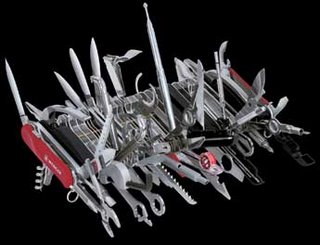 It looks like quite the death machine. Don't try slipping it in your pocket.
The Most Incredible Knife
Wenger wants you to do one thing: throw out your old knives. Actually, it wants you to do several things: throw out your bike tools, your toiletries, your laser pointer and so on, because you can find all of these instruments in a huge Swiss Army knife, which includes every tool the company makes. Wenger is calling the contraption “Giant Knife Version 1.0.” It debuted with all 85 features and can perform hundreds of functions.
 It looks like quite the death machine. Don't try slipping it in your pocket.
Fly; the Friendly Skies
Here's something Studebaker Hoch* might enjoy: instructions for making a fly-powered matchstick airplane. In part:
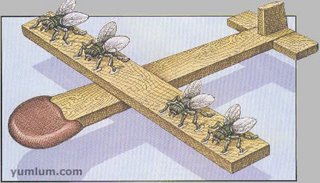 Ri-i-i-ight. I can't imagine this would work, but, hey, it might be a good way to pass the time.
*Easily the most obscure reference I have ever made here...perhaps.
Take the flies out of the freezer. Attach the abdomen of one frigid fly to each drop of glue. Make sure all the flies are facing the same direction.
Breathe life into the flies. A miracle: A gentle puff of your warm breath will resuscitate the flies.
Launch the aircraft. It should fly like a charm, and, far from being cruel to the flies, you'll be teaching them a new and valuable thing, one that brings us to the virtue of this exercise. For we see that while flies think a lot alike, have a great deal in common, share many of the same hopes and dreams, they never act in concert, as a team, with regard for the worth of other, neighboring flies until forced to by grim circumstance - as, for example, when they are harnessed to fly and either first experience the exhilaration of high-altitude cooperation or die.
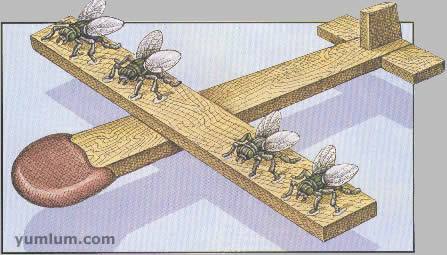 Ri-i-i-ight. I can't imagine this would work, but, hey, it might be a good way to pass the time.
*Easily the most obscure reference I have ever made here...perhaps.
Wednesday, August 23, 2006
Fast FAQs
Via Boing Boing, another great source of online distractions: Used FAQs, a collection of honest-to-goodness Frequently Asked Questions from sites all over the Internet, taken out of context. Some examples:
What is the cost of a Walk of Fame star ceremony?And so on. I don't want to give them all away here...
What is a fursuit?
Can I bring my favorite sword or knife?
How can I use a Barney Fife Impersonator at my next event?
Do I have to be naked all the time?
Dude, You're Getting a House Fire
Anyone else think this story sounds a bit fishy?
I always leave my laptop sitting on a stack of papers, but I make it a point to soak those papers in lighter fluid first. Usually, though, I keep my computer stored with my oily rag collection.
A fire that destroyed a South Venice house and left a family of five homeless early Thursday may have been sparked by a Dell computer model that was recalled by the company because its battery was a fire hazard.Hmmm...so they didn't know what kind of a computer they had, but they knew the precise number of DVDs they owned? Ver-r-r-r-ry interesting...
Homeowner Louis Minnear, 36, said his wife's Dell laptop was sitting on papers on the family's couch when the couch mysteriously caught fire.
Minnear, who was staying with his family at a nearby motel Thursday night, said he is "convinced" the fire was started by the computer's battery.
The State Fire Marshal's Office is investigating, and has not ruled on the cause of the fire.
...
Dezzi said he knew there was a computer on the couch when the house burned, but was not aware that the computer was a Dell. He said the fire marshal's office should issue a preliminary report on the cause today.
...
The family lost almost all of its possessions, including 843 DVDs.
The fire came three days after Dell recalled 4.1 million notebook computer batteries. The company warned consumers the batteries could erupt in flames.
I always leave my laptop sitting on a stack of papers, but I make it a point to soak those papers in lighter fluid first. Usually, though, I keep my computer stored with my oily rag collection.
Lost Verizons
The Onion actually reports a true story, or so it would seem:
Verizon Introduces New Charge-You-At-Whim Plan
NEW YORK—Verizon Communications, Inc. announced a new service package for its wireless and residential customers that would charge them widely varying, but always high, fees every month depending how the communications giant feels at the time. "Our Charge-At-Whim packages offer the same mediocre quality and insufferable level of customer service you’ve come to expect," a Verizon spokesman said Tuesday. "But it adds an unjustified, arbitrary and, if you’ll allow us to boast, frankly unjustifiable method of determining just how much you’ll pay for them." Packages start at "oh, $69.99 a month, let’s say?" and went into effect about three or four months ago.
Tuesday, August 22, 2006
Riff Raff
One of the funniest TV programs ever is the late great Mystery Science Theater 3000, a show in which really cheesy movies (usually grade Z sci-fi flicks like Attack of the Giant Leeches, Pod People, The Incredible Melting Man, Ed Wood's Bride of the Monster, etc.) are subjected to a non-stop barrage of hysterical comments from three silhouetted figures at the bottom of the screen. Rhino has been consistently releasing DVDs of the program (which ran from 1990 to 1995 on Comedy Central, and from 1997 to 2000 on The Sci-Fi Channel), but the show has been long off the air. One of the big problems that the show had was that obtaining the rights to the movies they busted on was quite expensive. You wouldn't think this would be the case for such awful films (where "paying for the rights" could just as easily be a euphemism for "paying the director's bail") but once distributors got hip to what MST3K was doing, they weren't all that eager to help out. So the cost of the program was one of the reasons why it was cancelled.
The program's host and head writer, Michael J. Nelson, has been making a name for himself as a film critic, author, speaker, commentator, etc., and has hit upon a way of producing a type of MST3K without the expense of buying the rights to the movie: Riff Trax. Riff Trax is essentially a podcast; Nelson (and the occasional guest) sit down, watch the movie, and record their comments, jokes, insults, etc., and sell them as downloadable MP3s for $1.99. You open the MP3 in iTunes (or the MP3 player of your choice), rent (or download) the movie yourself, cue it up as instructed, and you're off. There is some "drift"--the MP3 and DVD get gradually out of sync--but the Riff Trax producers occasionally have a voice speak a line of dialogue from the movie to help re-sync the video and audio. It works very well.
They have three movies available--Road House, The Fifth Element, and Star Trek V: Shatner Kills the Franchise, on the latter, Nelson is joined by former MST3K cast member Kevin Murphy. Last weekend we watched/listened to the Riff Trax for Star Trek V and it was hilarious. Highly recommended.
Also available are Riff Trax taken from the Legend Films DVD reissues of the infamous Plan 9 from Outer Space, Night of the Living Dead, and Reefer Madness. These Riff Trax are gleaned from the commentary tracks on these DVDs, which feature Nelson doing the MST3K thing. Some weeks ago, we had watched the Riffed version of the sublimely awful Plan 9 and, again, it was very very funny.
The ease of podcasting these days also means that just about anyone can produce their own "riff tracks." Hmm...
The program's host and head writer, Michael J. Nelson, has been making a name for himself as a film critic, author, speaker, commentator, etc., and has hit upon a way of producing a type of MST3K without the expense of buying the rights to the movie: Riff Trax. Riff Trax is essentially a podcast; Nelson (and the occasional guest) sit down, watch the movie, and record their comments, jokes, insults, etc., and sell them as downloadable MP3s for $1.99. You open the MP3 in iTunes (or the MP3 player of your choice), rent (or download) the movie yourself, cue it up as instructed, and you're off. There is some "drift"--the MP3 and DVD get gradually out of sync--but the Riff Trax producers occasionally have a voice speak a line of dialogue from the movie to help re-sync the video and audio. It works very well.
They have three movies available--Road House, The Fifth Element, and Star Trek V: Shatner Kills the Franchise, on the latter, Nelson is joined by former MST3K cast member Kevin Murphy. Last weekend we watched/listened to the Riff Trax for Star Trek V and it was hilarious. Highly recommended.
Also available are Riff Trax taken from the Legend Films DVD reissues of the infamous Plan 9 from Outer Space, Night of the Living Dead, and Reefer Madness. These Riff Trax are gleaned from the commentary tracks on these DVDs, which feature Nelson doing the MST3K thing. Some weeks ago, we had watched the Riffed version of the sublimely awful Plan 9 and, again, it was very very funny.
The ease of podcasting these days also means that just about anyone can produce their own "riff tracks." Hmm...
The Towering Inferno
It's all my fault:
The parent company of Tower Records, which filed for Chapter 11 bankruptcy protection on Sunday, is seeking to sell its assets through a court-supervised auction Oct. 5.Ever since I moved to a location that has no Tower Records, it's been downhill for them. For years I suspect I was keeping first the New York store(s) and then the Torrance, CA, store in business.
The company, which operates 89 stores in 20 states and is owned by the privately held MTS Inc., said yesterday that it needed to close the sale by mid-October to prepare for the holiday shopping season, when it has about 32 percent of its annual sales.
Tower said revenue fell to $430 million for the fiscal year ended July 31, from $476.1 million a year earlier. The company said intense competition had hurt its business and that of other music retailers.
Thursday, August 17, 2006
Reading with a Vingeance
I am almost finished the latest novel by one of the best sci-fi writers working today, Rainbows End by Vernor Vinge. It's not bad--but I like it more as a view of how society will be changed by technology in the next 20 years than as a gripping drama. Admittedly, there is not much plot in the book (and what there is seems kind of half-baked), so once the novelty of the "new world" wears off, it's kind of slow-going, but I think it's worthwhile just for Vinge's view of the future and the future of media.
I've only read one other book by Vinge (the space epic A Deepness in the Sky, which was fantastic and highly recommended--it won the Hugo for Best Novel), but he is one of the biggest proponents of the "singularity," or the notion that we are quickly reaching the point where technological progress and change occur faster than our ability to understand it. Vinge taught computer science for years at U.C. San Diego and he is a popular speaker and writer, both in the areas of science fact and science fiction.
More rambling below the fold.
In the 2025, says the book, most people (especially young people) are "wearing"; that is, their computers are woven into the clothes they wear and wirelessly connect to displays embedded in contact lenses. Subtle tics, body movements, and eye movements control menu items and commands as well as virtual keyboards. Thus, users can--and almost always do--create virtual environments for themselves, so you can give any physical space whatever characteristics you like. More importantly, wireless Internet connectivity is ubiquitous, and people don't so much hang out physically with each other, but appear to each other in a way that is like a cross between virtual reality and Instant Messaging. That is, people pop virtually into the rooms of others--and can have whatever physical appearance they like. (Surprisingly, the book is entirely unbawdy. Even Ray Kurzweil has speculated about naughty matters in the age of the singularity.) People communicate through silent messaging, or a way of using a virtual keyboard to tap out messages meant for only one person, and those messages appear in big yellow letters in the receiver's field of vision.
More importantly, there is little real privacy, at least for people who are wearing. Sure, you can "go offline"--that is, take off your wearable--but when you're on, you're open to everyone, depending on how you have your security set. People can and do keep tabs on each other, often without the other knowing it, and people often pose as other people. Malware is abundant, and sometimes a person has to "fry-clean" their wearable.
Anyway, there's a lot more to it, but that's the general gist. What I like about the book is that Vince doesn't think all of this is wonderful. The general plot of the book hinges on the "bad guys" taking advantage of modern technology for nefarious purposes.
Now, I don't agree with a lot of this vision, but I do think wearable computer technology will be available (very primitive versions already exist) and certainly the constant connectivity is coming--assuming it's not here already. It's amazing (and often frightening) how much of our working and non-working lives are already conducted through Instant Messaging--or at the very least through e-mail. Taking it one or two steps further really doesn't seem like much of a stretch to me. Picking a VR avatar really isn't all that different from having a personal icon in AIM or Skype or whatever. Whether things in the real world will actually be even further along by 2025 is a perfectly fair question.
However, one of the major points of the book is related to one that I always use when I write or give talks about media and the future: people of my generation (late 30s) and older are not the future, nor are we going to be the ones who decide how technology and media will change. It's the kids--with their hula hoops, and their rock-n'roll, and their fax machines. In the book, the main character is a 70-year-old poet (who thus would have been in his 40s in the year 2000) who is recovering from Alzheimer's (which was just recently curable at the time the book is set). As a result (and I think this is a good plot device to ease us into Vinge's world without a lot of tedious exposition), the world he remembers is pretty much our world and thus he has to go about getting caught up on with new technology. (Amusingly, his 13-year-old granddaughter makes fun of his electronic paper as old-fashioned.) As he takes adult classes at a local high school, he hangs out with the kids--and thus we see how they are immersed in all of this stuff while some of the older folks use what they have to, but treat it all rather tentatively (sound familiar?).
There's also a fair amount about a nefarious plot by a Google-like company to digitize then destroy all the print books, which had been rendered superfluous by all the online content. While I think there's a certain legitimacy to the basic idea, the way it was handled in the book just seemed really dorky to me. (Maybe it will make more sense when I finish it.)
Some readers have complained (at least in the Amazon comments) that the vision of the future isn't all that different from today--and there is a point there. But think about 20 years ago (1986), the technologies that existed at the time, and the level at which they were used. There were computers--almost all my friends had a Commodore 64 or something similar, and in college the computer center had PCs or PC clones that ran DOS (I had a Mac--I've never changed). The Internet and e-mail existed, but were only used in government and academia. A friend of mine in high school had a summer job (for a computer company) around that time that gave him access to online message boards and he used to "IM" or e-mail a small cadre of connected friends. The cellphone was proposed as long ago as 1947, and the FCC approved cellular communications in 1982. The first cellular network was launched in 1983. Car phones have existed for years (they were a status symbol in L.A. long before cellphones became popular). It's one thing to have a technology in place, but quite another to get it to the point where it is highly usable (the exception being cellphones--they've never become usable), commercializable, and, more importantly, widely accepted and popular.
Anyway, I recommend the book more as a think piece about how technology and culture change each other. Half the fun, actually, is quibbling over the details or envisioning an alternate future. Or blogging at great length about it...
I've only read one other book by Vinge (the space epic A Deepness in the Sky, which was fantastic and highly recommended--it won the Hugo for Best Novel), but he is one of the biggest proponents of the "singularity," or the notion that we are quickly reaching the point where technological progress and change occur faster than our ability to understand it. Vinge taught computer science for years at U.C. San Diego and he is a popular speaker and writer, both in the areas of science fact and science fiction.
More rambling below the fold.
In the 2025, says the book, most people (especially young people) are "wearing"; that is, their computers are woven into the clothes they wear and wirelessly connect to displays embedded in contact lenses. Subtle tics, body movements, and eye movements control menu items and commands as well as virtual keyboards. Thus, users can--and almost always do--create virtual environments for themselves, so you can give any physical space whatever characteristics you like. More importantly, wireless Internet connectivity is ubiquitous, and people don't so much hang out physically with each other, but appear to each other in a way that is like a cross between virtual reality and Instant Messaging. That is, people pop virtually into the rooms of others--and can have whatever physical appearance they like. (Surprisingly, the book is entirely unbawdy. Even Ray Kurzweil has speculated about naughty matters in the age of the singularity.) People communicate through silent messaging, or a way of using a virtual keyboard to tap out messages meant for only one person, and those messages appear in big yellow letters in the receiver's field of vision.
More importantly, there is little real privacy, at least for people who are wearing. Sure, you can "go offline"--that is, take off your wearable--but when you're on, you're open to everyone, depending on how you have your security set. People can and do keep tabs on each other, often without the other knowing it, and people often pose as other people. Malware is abundant, and sometimes a person has to "fry-clean" their wearable.
Anyway, there's a lot more to it, but that's the general gist. What I like about the book is that Vince doesn't think all of this is wonderful. The general plot of the book hinges on the "bad guys" taking advantage of modern technology for nefarious purposes.
Now, I don't agree with a lot of this vision, but I do think wearable computer technology will be available (very primitive versions already exist) and certainly the constant connectivity is coming--assuming it's not here already. It's amazing (and often frightening) how much of our working and non-working lives are already conducted through Instant Messaging--or at the very least through e-mail. Taking it one or two steps further really doesn't seem like much of a stretch to me. Picking a VR avatar really isn't all that different from having a personal icon in AIM or Skype or whatever. Whether things in the real world will actually be even further along by 2025 is a perfectly fair question.
However, one of the major points of the book is related to one that I always use when I write or give talks about media and the future: people of my generation (late 30s) and older are not the future, nor are we going to be the ones who decide how technology and media will change. It's the kids--with their hula hoops, and their rock-n'roll, and their fax machines. In the book, the main character is a 70-year-old poet (who thus would have been in his 40s in the year 2000) who is recovering from Alzheimer's (which was just recently curable at the time the book is set). As a result (and I think this is a good plot device to ease us into Vinge's world without a lot of tedious exposition), the world he remembers is pretty much our world and thus he has to go about getting caught up on with new technology. (Amusingly, his 13-year-old granddaughter makes fun of his electronic paper as old-fashioned.) As he takes adult classes at a local high school, he hangs out with the kids--and thus we see how they are immersed in all of this stuff while some of the older folks use what they have to, but treat it all rather tentatively (sound familiar?).
There's also a fair amount about a nefarious plot by a Google-like company to digitize then destroy all the print books, which had been rendered superfluous by all the online content. While I think there's a certain legitimacy to the basic idea, the way it was handled in the book just seemed really dorky to me. (Maybe it will make more sense when I finish it.)
Some readers have complained (at least in the Amazon comments) that the vision of the future isn't all that different from today--and there is a point there. But think about 20 years ago (1986), the technologies that existed at the time, and the level at which they were used. There were computers--almost all my friends had a Commodore 64 or something similar, and in college the computer center had PCs or PC clones that ran DOS (I had a Mac--I've never changed). The Internet and e-mail existed, but were only used in government and academia. A friend of mine in high school had a summer job (for a computer company) around that time that gave him access to online message boards and he used to "IM" or e-mail a small cadre of connected friends. The cellphone was proposed as long ago as 1947, and the FCC approved cellular communications in 1982. The first cellular network was launched in 1983. Car phones have existed for years (they were a status symbol in L.A. long before cellphones became popular). It's one thing to have a technology in place, but quite another to get it to the point where it is highly usable (the exception being cellphones--they've never become usable), commercializable, and, more importantly, widely accepted and popular.
Anyway, I recommend the book more as a think piece about how technology and culture change each other. Half the fun, actually, is quibbling over the details or envisioning an alternate future. Or blogging at great length about it...
Hi Def Jam
I have only paid marginal attention to the Sony Blu-ray vs. Toshiba HD DVD battle, but Sony thinks it has the upper hand:
Sony made its latest market move this week, with the introduction of its recordable Blu-ray discs.Big deal. In contrast, news out of Japan suggests that Toshiba may win this one:
GLAY'z...just released the world's first adult film on HD-DVDWhich do you think is bigger "killer app"? That's really not meant to be as facetious as it seems. Says Gizmodo:
It was the porn industry that helped decide the winner in the VHS/Beta wars 25 years ago. The porn industry helped make CD-ROMs ubiquitous and created the basis for online payment systems so prevalent today. And as a big-time electronics company executive told me a couple months ago, it will be the porn industry that decides the ultimate victor in the Blu-Ray/HD-DVD wars. So it's not surprising the industry decided to pioneer in the area of digital downloads.
Plutocrats
Yes, it's Pluto Week here at Blogito Ergo Sum. Yesterday's New York Times online has a good summary of the Pluto debate. One line stood out:
Lowell died in 1916, but his observatory continued the work. How? Far more laboriously than you would think. Clyde Tombaugh--a 24-year-old assisitant hired for the project--attached a camera to a telescope and took a series of photographic plates of the night sky in the general vicinity in which the object was believed to be, each taken one to two weeks apart. He would then place two separate plates into a device called a "blink comparometer" which essentially toggled between two different pictures. The goal was to see which of the many many white dots had moved (stars are fixed, while planets move about). It was a long, tedious, laborious process (they had a demonstration of the process when I took the tour--it kind of reminded me of analyzing TrendWatch's historical survey data...)--but on February 18, 1930, Tombaugh announced he had found it.
The new planet went nameless for a while, until a an 11-year-old British girl (whose father had connections in the astronomical community) suggested "Pluto." Cables were sent across the pond and to Arizona, where the directors of Lowell University rather liked the idea--especially in that the inital "Pl" are Percival Lowell's initials. Since they had naming rights, they chose "Pluto."
What's rather ironic about all this is that astronomers later discovered that Pluto was too small to have affected Neptune's orbit--and, in fact, the original "perturbations" were the result of an inaccurate estimate of Neptune's mass (19th-century astronomers were good but were working with pretty primitive resources). It's a good thing Tombaugh found something--imagine going on a wild goose chase of astronomical proportions!
The planet (if that is what it is) has been an oddball ever since Clyde Tombaugh spied it wandering in the outer reaches of the solar system beyond Neptune in 1930.This implies that Tombaugh--who was at Lowell Observatory and thus he is the only American to have discovered a planet (for the time being, of course)--looked in the telescope one night and spotted little Pluto out of the blue. Actually, the existence of a planet beyond the orbit of Neptune had been theorized for decades before it was actually found--Percival Lowell (founder of the observatory) being among them. The reason they suspected something being there was that there were certain eccentricities in the orbit of Neptune that could only be explained by another large object in the vicinity. In fact, this was exactly how Neptune had been discovered in 1846--thanks to perturbations in the orbit of Uranus. Some astronomers also simply felt that, "Hey, we found Neptune. Maybe there's another one out there." So the search was on.
Lowell died in 1916, but his observatory continued the work. How? Far more laboriously than you would think. Clyde Tombaugh--a 24-year-old assisitant hired for the project--attached a camera to a telescope and took a series of photographic plates of the night sky in the general vicinity in which the object was believed to be, each taken one to two weeks apart. He would then place two separate plates into a device called a "blink comparometer" which essentially toggled between two different pictures. The goal was to see which of the many many white dots had moved (stars are fixed, while planets move about). It was a long, tedious, laborious process (they had a demonstration of the process when I took the tour--it kind of reminded me of analyzing TrendWatch's historical survey data...)--but on February 18, 1930, Tombaugh announced he had found it.
The new planet went nameless for a while, until a an 11-year-old British girl (whose father had connections in the astronomical community) suggested "Pluto." Cables were sent across the pond and to Arizona, where the directors of Lowell University rather liked the idea--especially in that the inital "Pl" are Percival Lowell's initials. Since they had naming rights, they chose "Pluto."
What's rather ironic about all this is that astronomers later discovered that Pluto was too small to have affected Neptune's orbit--and, in fact, the original "perturbations" were the result of an inaccurate estimate of Neptune's mass (19th-century astronomers were good but were working with pretty primitive resources). It's a good thing Tombaugh found something--imagine going on a wild goose chase of astronomical proportions!
Check In Out
On the surface, this sounds like a good idea:
Marriott is...testing a system that lets you check in on the way to the hotel using your Windows Mobile smartphone.Like most things involving mobile phones, I expect this will function nightmarishly, if at all. And hopefully people won't try to do this while they are driving to the hotel.
Users have to download mobility software from Marriott which then lets them use their device to check in, change their room if they want, confirm their rates and receive welcome information. When they arrive at the hotel, an automated dispenser is waiting to spit out their keys and they are in business. The software even remembers the data that has been entered, so you don't have to start from scratch if your signal is interrupted.
Marriott is currently testing this system at just one hotel. By pure coincidence, the test of a system relying on Windows Mobile is happening in Redmond, Washington.
Dammit, Pomegranate
I didn't even know there was such a thing as pomegranate juice. From Science News Online:
Juice May Slow Prostate Cancer Growth (with recipe)The bar at Tiznow here in town has a pomegranate martini, which I'm led to understand is quite good. Would that be as effective?
Several studies have associated diets high in plant-derived polyphenols—principally, the deeply pigmented antioxidants in many fruits and vegetables—with lower risks of malignancies including prostate cancer. Because the blood-red juice of pomegranates is especially rich in such compounds, Allan J. Pantuck of the David Geffen School of Medicine at the University of California, Los Angeles and his colleagues decided to test it against metastatic prostate cancer.
...
The researchers calculated that the men's average doubling time in PSA concentrations—a rough gauge of cancer growth—was 15 months. After men drank a glass of juice a day, their average doubling time more than tripled. In nearly one-third of men, Pantuck notes, PSA values actually fell—in a few cases, dramatically.
Although this is just one study and the juice showed no sign of curing the disease, Pantuck says it shows that pomegranate juice might be a beneficial adjunct to other therapies in men with this potentially lethal disease.
Plutonic Relationships
From the "making lemons into lemonade" file, publishers and toymakers see an economic upside to the redefinition of "planet":
Not everyone is happy, though:
Under a proposal by astronomers, the lineup of the solar system's planets would grow from nine to 12. For people who make their living on books, toys and games based on the Mercury-through-Pluto system, a change in the planets means plenty of revisions are in store.McLynn adds, surprisingly free of hyperbole, "Wow, a whole new universe."
The idea that our nine-planet solar system may soon join the obsolete world of eight-track tapes and slide rule should send science teachers, textbook writers and toymakers back to the cosmic drawing board
"Does it make our products obsolete?" asked Kim McLynn, spokesperson for Illinois-based Learning Resources, which makes an inflatable solar system and a Planet Quest game.
Not everyone is happy, though:
Pity Jack Horkheimer, director of the Miami Space Transit Planetarium and host of PBS' "Star Gazer" show. His very first book, a full-length cartoon guide to naked-eye astronomy, features an entire chapter on the solar system -- the nine-planet version.Let's hope Horkheimer's text is more free of cliches than his comments.
It won't be out for four more weeks -- after the world's astronomers are likely to open the solar system doors to three new planets: Ceres, Charon, and one nicknamed Xena to be renamed later.
"My book is out-of-date before it even hits the bookstands," Horkheimer said. "It's kind of like buying a computer. By the time you get it out of the box and get it hooked up, it's already obsolete."
Wednesday, August 16, 2006
Dammit, Planet
So much for the notion that complexity doesn't increase over time. As per Sky & Telescope:
To make it even more confusing, there is this footnote:
Grammar school science classes (assuming there are any anymore; who knows these days?) are going to be a tad less festive, at least for a while.
This whole thing concerns certain people, who I guess are nostalgic for the old, original astronomical ennead and think that the name UB313 lacks poetry (unlike UB40, who at least had "Red Red Wine"). This is all well and good, and no one clings to the past like a barnacle as much as I do, but science is science, and the point of science is discover new information and refine definitions and theories. This disturbs those who like the idea of things being etched and stone and thus immutable and unchanging, but, sorry, that's not what science is or should ever be.
Besides, the definition of "planet" has itself changed over the centuries, and the "pantheon" has seen some objects come and go. In fact, I was actually surprised to find out that there has thus far never been any official definition of what a "planet" is, it being one of those things you know when you see. Before the advent of the telescope, planets were nothing more than "wandering stars" that moved with respect to the fixed stars of the constellations (no one knew they were big round chunks of rock and/or gas). When the telescope was invented in the 1600s, astronomers discovered that planets were actually large, round objects orbiting the Sun and, in fact, Ceres and other asteroids were called "planets" when they were discovered in the early 1800s. (They were downgraded to "asteroids" when a distinct population of similar small objects was found.)
I remember in the 1990s there was some contention over whether Pluto should be demoted from planet status--I think the term "trans-Neptunian object" was bandied about at one point. (In 2002, I visited Lowell Observatory in Arizona, which was the institution that had discovered Pluto in 1930, and they were having none of it. Pluto was a planet. Period. I detect a faint bias on their part....) The problem was that there were all these other objects in the Solar System (like 2003 UB313 and other Kuiper Belt objects) that were bigger than Pluto. So if Pluto was a planet, why not these objects? And if not these objects, then why Pluto?
Hence, the meeting this week to try to sort out all this mess.
Funnily enough:
I really don't think the definition is a bad one--it delinates the eight "big boys" and sub-categorizes the newer objects (and, yes, even beloved Pluto) as, essentially, "planet-like objects." The only thing I dislike is the term "pluton." But that's strictly an aesthetic point.
This week our solar system has nine planets. Next week, if astronomers approve a new definition of the word "planet," there will be 12 — with more to come. Newcomers to the list include Ceres, the largest asteroid; Charon, Pluto's largest moon; and 2003 UB313, an icy body more than twice as far from the Sun as Pluto and a little bigger (and not yet graced with an official name).Under the new system, the eight planets from Mercury through Neptune would be reclassified as "classical planets," while objects smaller than Mercury (including Ceres--now an asteroid--Pluto, Pluto's moon Charon, and 2003 UB313) would be classified as "dwarf planets" (or, perhaps more colloquially, "the Billy Barties"). At the same time, Pluto becomes the standard for a new type of an object called a "pluton" (I'm not wild about the name--it sounds like a subatomic particle) which is defined as "a small object with an orbital period longer than 200 years and a highly elongated path tipped steeply with respect to the ecliptic."
...
Here's the actual wording: "A planet is a celestial body that (a) has sufficient mass for its self-gravity to overcome rigid-body forces so that it assumes a hydrostatic equilibrium (nearly round) shape, and (b) is in orbit around a star, and is neither a star nor a satellite of a planet."
To make it even more confusing, there is this footnote:
"For two or more objects comprising a multiple-object system, the primary object is designated a planet if it independently satisfies the conditions above. A secondary object satisfying these conditions is also designated a planet if the system barycenter [center of mass] resides outside the primary. Secondary objects not satisfying these criteria are 'satellites.'"Thus, Charon's moon is a planet and the Pluto-Charon system becomes a "double-planet." In case you were wondering.
Grammar school science classes (assuming there are any anymore; who knows these days?) are going to be a tad less festive, at least for a while.
This whole thing concerns certain people, who I guess are nostalgic for the old, original astronomical ennead and think that the name UB313 lacks poetry (unlike UB40, who at least had "Red Red Wine"). This is all well and good, and no one clings to the past like a barnacle as much as I do, but science is science, and the point of science is discover new information and refine definitions and theories. This disturbs those who like the idea of things being etched and stone and thus immutable and unchanging, but, sorry, that's not what science is or should ever be.
Besides, the definition of "planet" has itself changed over the centuries, and the "pantheon" has seen some objects come and go. In fact, I was actually surprised to find out that there has thus far never been any official definition of what a "planet" is, it being one of those things you know when you see. Before the advent of the telescope, planets were nothing more than "wandering stars" that moved with respect to the fixed stars of the constellations (no one knew they were big round chunks of rock and/or gas). When the telescope was invented in the 1600s, astronomers discovered that planets were actually large, round objects orbiting the Sun and, in fact, Ceres and other asteroids were called "planets" when they were discovered in the early 1800s. (They were downgraded to "asteroids" when a distinct population of similar small objects was found.)
I remember in the 1990s there was some contention over whether Pluto should be demoted from planet status--I think the term "trans-Neptunian object" was bandied about at one point. (In 2002, I visited Lowell Observatory in Arizona, which was the institution that had discovered Pluto in 1930, and they were having none of it. Pluto was a planet. Period. I detect a faint bias on their part....) The problem was that there were all these other objects in the Solar System (like 2003 UB313 and other Kuiper Belt objects) that were bigger than Pluto. So if Pluto was a planet, why not these objects? And if not these objects, then why Pluto?
Hence, the meeting this week to try to sort out all this mess.
Funnily enough:
Michael Brown (Caltech), codiscoverer of 2003 UB313, argues similarly on his Web site, where he also worries that having potentially dozens of planets in our solar system might make sense to astronomers but will be confusing to everyone else.Like that's ever stopped anyone before! Heck, I've got five phone books; I think I can handle a few extra planets.
I really don't think the definition is a bad one--it delinates the eight "big boys" and sub-categorizes the newer objects (and, yes, even beloved Pluto) as, essentially, "planet-like objects." The only thing I dislike is the term "pluton." But that's strictly an aesthetic point.
My Fingers Did the Walking But Got Crushed by the Weight...
This conversation came up with some friends last night, and I started to dwell on it. Check this out: I have five phone books. All of them current. All of them different. I don't want five phone books. But there they are. And they are:
I can't wait until we start having multiple 411s to choose from.
I really don't know what it is with telephony these days, but just about every aspect of it is completely, utterly maddening. This is why I have decided to revert back to the days when people sent messages by carrier pigeon. I am installing a telegraph. I have purchased one of those operator-assisted phones so I can crank it up, pick up the little ear cup, and say, like Humphrey Bogart, "Operator, get me Murray Hill 5-2845." Gee, our old LaSalle ran great. Those were the days. Time to duet with Jean Stapleton....
Capital District Area (white and yellow pages) published by TransWestern Publishing which uses the original "walking finger" logo of the original Yellow Pages. It is valid through January 2007.Now, all of these are unsolicited and have magically appeared by my mailbox over the past several months. Occasionally, I attempt to look up businesses or individuals, and it can be quite the research project. Even though they all cover roughly the same area (the Venn diagram I could create for all my phone books would have Saratoga Springs as the darkest-shaded region--and how upsetting is it that I even have to draw a Venn diagram for my phone books?), not everyone is listed in all of them. I've done research papers in school that took less time than finding the phone number for a restaurant. The rebuke in those old commercials--"Why use directory assistance for numbers you could just as easily look up in the phone book?"--is no longer valid.
Verizon Yellow Pages (with White Pages) for the Saratoga Springs Area, dated July 2006.
The Verizon Yellow Pages Companion Directory for Saratoga/Glens Falls, dated July 2006. This differs from the one above in that it is much smaller and includes Glens Falls, but not Ballston Spa, Schuylerville, etc. I think. I'm not entirely certain why this exists.
The Talking Phone Book (which is remarkably silent) for the Saratoga/Glens Falls Area, published by Hearst Holdings and dated 2006-2007.
The Saratoga Springs Telephone Directory, dated 2006-2007, published by Easy Book Publishing and billed as "Your Local Yellow Pages.
I can't wait until we start having multiple 411s to choose from.
I really don't know what it is with telephony these days, but just about every aspect of it is completely, utterly maddening. This is why I have decided to revert back to the days when people sent messages by carrier pigeon. I am installing a telegraph. I have purchased one of those operator-assisted phones so I can crank it up, pick up the little ear cup, and say, like Humphrey Bogart, "Operator, get me Murray Hill 5-2845." Gee, our old LaSalle ran great. Those were the days. Time to duet with Jean Stapleton....
Does Anybody Really Know What Time It Is?
Not if they use this watch, they don't:
The EleeNo Bingo Watch has a series of tiny round windows laid out in a grid similar to a bingo game, where the outer dots show you the hours and the inner ones display the minutes. The only problem with that? There are just four minute indicators, forcing you to tell time in 15-minute increments.I wonder if they also make a calculator that rounds everything to the nearest multiple of 10.

Saturday, August 12, 2006
Wreaks Q. Blurt, We Hardly Knew Ye
Curses, someone beat me to it: via Boing Boing, a very funny site containing fake obituaries for those weird names that turn up in the "from" fields of spam messages.
Manitoba M. Parsnip 1953 - 2006
Manitoba came to fame in the great Canadian vegetable wars of the early seventies. Such was his dominance in the root vegetable section he won the right to change his surname to Parsnip in 1972. This was a great source of family pride as his grandfather had been King Carrot in the twenties. Being the seventies they were also pleased to move into another vegetable surname, with Jasper Carrot finding fame in the UK.
The vegetable wars started when people began enhancing their crops with banned chemicals to simply grow them as big as possible. Manitoba and his pals saw this as sacrilege and waged war on the freak show fairs, wrecking any veg that were just too big for their own good. On they went, wanging watermelon, chucking carrots and throwing turnips around with gay abandon. The GM growers fought back and boy were they strong. The chemicals have gotten in their blood streams and they had super human strength. One of them had three arms, but that may well have been because he was from Alabama. These fights happened on a regular basis over the intervening years, the stalemate apparent to everyone bar the two fighting sides.
Manitoba lost his way in 1999 after a particularly bad crop and hit the bottle. It started with beer, beer became whisky, whisky became toilet duck, before he eventually hit the hard stuff and overdosed on industrial strength fertiliser.
In Through the Out Box
Oh, good, just what we need, another daily task masquerading as a psychological test (or vice versa):
Let's not even talk about snail mail.
Take a clear-eyed look at how you answer or file each email. Notice what you choose to keep or delete. Consider your anxiety when your inbox is jammed with unanswered messages.I never read e-mail; I print out all messages and immediately eat them. It's safer that way. I reply randomly to to messages and calculate the odds that my response will be relevant to the original message. But then I only reply to messages that have the letter "q" in them. If the word "mackerel" appears in any message, I start clucking like a chicken. I sort all my mail by the fifth letter of the sender's middle name. If I don't know the sender's middle name, I have to stop work for the day and go out and walk aimlessly around the park for several hours, muttering the word "megaphone" to myself over and over. Any message marked "urgent" is printed on a large-format poster printer 36 x 72 inches and applied to the roof of my car so that it's readable from a circling helicopter, which is where I go to read it. I have separate e-mail accounts for every message I receive, and before I send a message I set up a separate e-mail account for it. I only save the messages that I receive from people's pets.
The makeup and tidiness of your inbox is a reflection of your habits, your mental health and, yes, even the way Mom and Dad raised you.
"If you keep your inbox full rather than empty, it may mean you keep your life cluttered in other ways," says psychologist Dave Greenfield, who founded the Center for Internet Behavior in West Hartford, Conn. "Do you cling to the past? Do you have a lot of unfinished business in your life?"
On the other hand, if you obsessively clean your inbox every 10 minutes, you may be so quick to move on that you miss opportunities and ignore nuances. Or your compulsion for order may be sapping your energy from other endeavors, such as your family.
Let's not even talk about snail mail.
Wednesday, August 09, 2006
Bat Boys
I just don't want to know:
Bats. Ugh. I was bitten by a bat once, and ever since then I do not register on film, CCD, or even in mirrors, which causes almost insurmountable problems (but not as many as you may think). Shaving requires a small army of portrait artists. Getting ready for a date requires an NEA grant. All I can say is, never trust an abstract expressionist. The time I hired Frank Frazetta was just weird.
Baby bats babble just like newborn human babes, a new study finds.If my brother and his wife discover their almost-seven-month-old daughter hanging upside-down from the ceiling, eating mosquitoes, and/or flapping about the house, another evolutionary fluke will have been discovered.
Babbling is thought to be a kind of vocal play that provides human infants a chance to train their vocal tract muscles in preparation for speech and to practice combining the syllables they will use as adults. Humans begin babbling at about 7 months of age.
Apart from a few other primates, like the pygmy marmoset, babbling has never been observed in any other mammals until now. However, certain species of songbirds are known to engage in a similar behavior, called "subsong."
Bats. Ugh. I was bitten by a bat once, and ever since then I do not register on film, CCD, or even in mirrors, which causes almost insurmountable problems (but not as many as you may think). Shaving requires a small army of portrait artists. Getting ready for a date requires an NEA grant. All I can say is, never trust an abstract expressionist. The time I hired Frank Frazetta was just weird.
On the Ball
OK, then:
Let's see a robot try that.
A new type of robot balances on a ball rather than relying on legs or wheels.Leaving aside for the moment the amusement to be had in the name "Ballbot," that's nothing. When I was in physical therapy last winter, there were patients there who could do a remarkable number of physiologically improbable things while balanced on balls (now cut that out). They had these giant, rubber orbs (there, that's less suggestive) that you had to balance on to regain some kind of muscular strength (I'm unclear on what the point of any physical therapy is, since I don't actually have muscles, but rather move my limbs via an intricate network of water-inflatable bladders--call it an evolutionary fluke like my prehensile tail). I had wanted to work out on the giant rubber orbs, but it was hard to figure out how you would exercise a shoulder on them, although I was keen to give it a go. As it is, my daily workout--which involves 900 situps and the regular hoisting of a live salmon--also involves balancing on a variety of geometric solids. I'm pretty good at maneuvering across the room while balanced on a dodecahedron. It doesn't have the consummate beauty of the sphere, but there's something cool about the word "dodecahedron."
The Ballbot, as it is called, can move in tight spots, making it potentially more useful than other designs for some uses.
Carnegie Mellon University robotics Professor and inventor Ralph Hollis first started fiddling with the thing at home. Then he got funding from the National Science Foundation.
"We wanted to create a robot that can maneuver easily and is tall enough to look you in the eye," Hollis said. "Ballbot is tall and skinny, with a much higher center of gravity than traditional wheeled robots. Because it is omnidirectional, it can move easily in any direction without having to turn first."
An onboard computer reads balance information from its internal sensors, activating rollers that mobilize the urethane-coated metal sphere on which it moves. At rest, Ballbot stands on three retractable legs.
Let's see a robot try that.
Jacks of All Trades
If the back of this new Yamaha 7.1 A/V receiver isn't the most terrifying thing I've ever seen, I don't know what is. By the time you get everything connected to it, entire media formats will have come and gone. I can't help but think of that sequence in George Pal's Time Machine-- while you're hooking up components, the decades, centuries, millennia are passing quickly by outside the window until finally the Morlocks break in and eat all the cabling. The first thing I would play on it would be "In the Year 2525" just for the sake of nostalgia.
 And that it uses two remotes is an added bonus.
 And that it uses two remotes is an added bonus.
The Far Side--The Reality Show
Via Roberto, I find that Gary Larson is alive and well and writing for CNN.com:
Twenty-one penguins were rescued on a hot east Texas highway Tuesday after a truck carrying the wildlife to a temporary home south of Houston overturned, said a state trooper. Four penguins and some exotic fish were killed in the accident......including the most unlikely line to appear in a news story:
The truck, also carrying an octopus that was uninjured, was bound for Moody Gardens, a tourist destination in Galveston...Whew! Thank heavens the octopus was OK. I expect Moody Gardens is going to be decidedly moodier for a time.
Subscribe to:
Posts (Atom)