The Netgear Skype WiFi phone SPH101 just popped up on Amazon, finally! You’ll still have to wait until June 30 to receive one, and it’s not cheap, either—even though the list price is $300, it’ll still cost you $249.99. The great thing is, you don’t need a PC to use it, you can call anyone in the world on Skype for free, and all you need is a WiFi hotspot to do it.In time, I expect at least two things to happen: 1) the price to come down and 2) support for web-based authentication.
Of course, it’s not all a bed of roses; if you want to use this Skype WiFi phone on your wireless network at home, you’ll have to open up that network to the rest of the world, because, of course, hotspots requiring web-based authentication are not supported. But still, it’s hard to compete with free, and that’s just what Skype is.
Friday, April 21, 2006
Big Skype
Hmm....this is not without its appeal...

Captain Video
Via Dr. Joe, a link to a USA Today article about YouTube, an increasingly popular site for sharing home videos:
Reading the USA Today article, though, did remind me of the top story in this week's Onion:
The site, which is like a virtual photo album that hosts millions of short videos, is simple to search.It sounds perfect for those who can't get enough of America's Goofiest Home Videos or whatever that show was (is still?) called.
As broadband penetration grows, and consumer appetite for on-demand entertainment swells, video-sharing sites such as YouTube are taking off. In December, when it formally launched, users watched 3 million videos daily. Now, it's about 40 million.
Reading the USA Today article, though, did remind me of the top story in this week's Onion:
iTunes To Sell You Your Home Videos For $1.99 Each
CUPERTINO, CA—Apple Computer, producer of the successful iPod MP3 player, is now offering consumers limited rights to buy their own home movies from the media store iTunes for $1.99 each.
Feed Me
Don't have an e-mail newsletter yet? I wouldn't worry. According to a recent Folio editorial, e-newsletters will be doomed in a year or two:
I read a posting on Paul Conley’s blog not too long ago about how e-mail newsletters are doomed. RSS feeds, he says, are too simple and too superior to e-mail. “RSS is a much, much better product for users,” Conley wrote. “It cuts down on my spam. It updates constantly. It saves me time. It’s more convenient. It’s more flexible. I don’t have to worry about unsubscribing hassles. And it seems to me that once you try RSS, it’s impossible to go back. So I’d guess that the majority of b-to-b readers will have no interest at all in e-mail newsletters in maybe a year? Two?”He has a point...
Thursday, April 20, 2006
Prelude to the Afternoon of a Robot Holocaust
Sure, go ahead, let's enshrine our future overlords--actual and fictional--in a museum (of sorts). We will come to regret it.
Portable Reading System?
The SonyStyle Web site now features the forthcoming e-book reader based on e-paper. But it's not an "e-book"--rather, it's a "Portable Reader System." Silly name. Calling something fundamentally simple a "system" makes it far goofier and less appealing than it would otherwise be. (Like those ads that promote "sleep systems." No--they're beds!) What, then, is a printed book--a "literary transmission system"? Is a writer simply "a delivery system for words"? (I feel that way sometimes...)
Interesting, you can't actually preorder it, but you can pre-preorder it.
Interesting, you can't actually preorder it, but you can pre-preorder it.
Another Air-Brained Scheme
Oh, for crying out loud. For those who aren't convinced that bottled water isn't the biggest scam ever perpetrated on the American consumer, and for those deluded enough to think that "oxygen therapy" is any such thing (see "O, Too" below), now there is--wait for it--bottled air. I kid you not:
Canned oxygen is the newest luxury item, and it’s available in flavors and essences that give you a variety of entirely new ways to throw away your money and think you’re feeling better because of it.You know, back when bottled water started turning up all over the place, I joked that, "what's next, bottled air?" Well, apparently, yes. I have no doubt it will sell very well.
That Was Easy?
Granted, I am no stranger to the trials and tribulations of attempting to lose weight, but doesn't this sound like a far more unpleasant alternative to just not eating that much and/or exercising?
Ear stapling is a new, popular weight-loss procedure that draws from ancient acupuncture and is cropping up throughout Mississippi, a state with one of the highest obesity rates in the nation.Ear stapling?! I think mouth stapling might work better...
Wednesday, April 19, 2006
A Clockwork Philips
Yeah, sign me up for this:
Royal Philips is being a royal pain in the arse with a new technology to make TV watchers unable to skip commercials. Their recent patent filing indicates that broadcast flags would be inserted into commercials in order to allow supported TVs to disable channel changing during breaks. In addition, the flags would also be recognized by digital video recorders so viewers can’t fast forward even if they’ve seen the ads already.I suspect their next step will be to patent a device that will imprison viewers in their chairs, preventing them from physically getting up, looking away, or even blinking (remember that scene in A Clockwork Orange?). I'm sure there will be a massive run on TVs that support this feature.
Robot Holocaust III-The Insect Alliance
This can't be good:
Robots Learn Navigation Trick from AntsI guess our inevitable robot overlords will soon be allying themselves with the insect world to help enslave humanity. Sad, really.
Imagine while walking to the grocery, every few streets you have to go back home to reset your navigation system in order to avoid getting lost.
That's what ants have to do. Now and then they must visit their nest to avoid losing their way on foraging trips. Now scientists are using this understanding to make better robots.
O, Too!
I've always thought the concept of the "oxygen bar" and "oxygenated water" were the silliest things ever to come out of the "alternative medicine" field (which is no mean feat, given how many silly things there are in the alternative medicine field to choose from) and I recall not long ago seeing a sign on Broadway here in Saratoga for some kind of "oxygen therapy" and convulsing with laughter (I love this town, but it has its nuttiness). But as LiveScience reminds us, despite the fact that we need it to breathe, too much oxygen is actually very bad:
The notion that we need extra oxygen is ludicrous. The human body has adapted quite well to this lower atmosphere of ours that is roughly 21 percent oxygen, 78 percent nitrogen and 1 percent trace gases. Blood cells, on exiting the lungs, are nearly saturated with about 97 percent oxygen bound molecularly to hemoglobin. Getting more oxygen serves no purpose. In fact, it's a bad thing.I've always thought this whole "alternative medicine" nonsense is just a knee-jerk reaction to the not-entirely-unfounded cynicism engendered by the current state of the health and medicine profession. But even given the ills that occasionally afflict mainstream modern medicine (I do like alliteration), it is still far more scientifically sound and efficacious than the generally unproven or downright spurious claims of the alternative folks. Sure, alternative medicine is cute and funny when it's just about proving the old adage "a fool and his money are soon parted," but when it starts becoming physically harmful, then it becomes less amusing.
Deep in the lungs, tiny and fragile sacs called alveoli are the site where inhaled oxygen enters the bloodstream and carbon dioxide leaves to be exhaled. With a surplus of oxygen in the lungs, the carbon dioxide can't leave the body. Worse, the build up of oxygen in the lungs can collapse the alveoli and cause permanent lung damage. Adults with emphysema, chronic asthma or chronic bronchitis, in particular, will stop breathing if they inhale pure oxygen for too long. Premature babies, given extra oxygen because their lungs aren't sufficiently mature to transfer oxygen into the blood, can go blind if the concentration gets too high, a malady called retinopathy of prematurity; that's likely what happened to Stevie Wonder.
Also, oxygen may be what ultimately kills you, rusting your body from the inside in a process called oxidation and free-radical production. Breathing pure oxygen creates an abundance of free radicals.
Well, Duh
From AdAge, the world's most self-evident headline:
Under-30 Crowd Will Drive Media FutureWhen has that ever not been the case? And in another news-breaking headline, "Today's Children Will Be the Adults of Tomorrow."
Either That Furniture Goes or I Do
Or both, it would appear. Granted, Uncle Death stalks us at every turn, but now, from what would appear to be the Charles Addams collection, we can be reminded of this every day:

Why buy a casket for just one day? At CasketFurniture.com, our products can last you a lifetime, and still be the perfect vehicle to carry you to the great beyond. Whether it’s a couch, shelf, or end table, our products are designed to blend effortlessly into most contemporary interior designs. Every product can also be transformed into a high-quality casket at your time of need.The "Eternaltainment Center" will run you a mere $4495--but you can always spend more for fancier woods and designs. It's perfect for goth parties, I guess, but it does beg the question: who keeps the same furniture for their entire life?

Monday, April 17, 2006
The Easter Bunny Hates You
Ever wonder what the Easter Bunny does on his 364 days off? This video--a bit violent, but, IMO, hysterical--gives us a peek.
Having an Episode
At Marginal Revolution, economist Tyler Cowan muses on what moving to the Web will do to TV programs:
One consequence of the Webization of TV shows is that producers may at some point not be beholden to the time constraints imposed by network or cable channels--which is 44 minutes sans commercials for a one-hour show and 21 minutes for a 1/2 hour show. Just about every TV show's DVD commentary at some point mentions how much they had to pare down the script or the film episode to fit in those time frames. If the "time slot" ultimately disappears, and all shows are standalone episodes that are downloaded independent of any other program, there is no reason for it to be any particular length. Episodes can therefore be as long as they need to be--although I suspect many will stick to conventional lengthts just to keep from freaking too many viewers out, at least at first.
I expect that DVD extras will ultimately become more important to make them marketable, but I really don't see much difference from the way things are done now. For example, in the past I've (and others have, too) methodically videotaped (what we used to do before Tivo) programs that I wanted to watch over and over, and those I really liked I would buy on VHS or DVD when they were officially released, for reasons of picture quality, better editing out of commercials, etc. I have every Mystery Science Theater 3000 episode (well, almost every episode--damn you, Gorgo!) that I taped from Comedy Central/Sci-Fi over the years, but I still buy the DVD sets when they come out.
Ultimately, what I expect to happen is the increased merging of the Internet, computers, and home entertainment systems--which is happening quickly already. At the same time, with the pressure on studios/producers to provide Webcast programming, compression quality will get better, and at some point in the future, the Internet will simply be the way programs are delivered, just like cable is now. Yes, cablecasting will continue to exist, just like some people still receive programs over the air using aerials. But we can kiss the "time slot" goodbye. And good riddance. It was always too much trouble to figure out when something was on anyway--especially when they used to move shows all over the place.
The trouble is, it may make "flipping around" that much harder. Which may or may not be a bad thing.
1. Individual episodes are more complex and less likely to be self-contained. To watch only one show of Lost or [Battlestar Galactica] leaves you baffled. But who can make sure he catches every episode? What if you want to leave the country for a while? Now if you have missed a show, you can use the Web to keep in touch with the longer and more integrated story. You will do this even if you, like I, find web viewing distasteful and inconvenient. Not everyone can afford TiVo, and some of us still need Yana to operate the remote and indeed the service itself.As regular readers of this blog (if there are any) know, I have been downloading Lost every so often, but most every other TV show I watch I rent via Netflix (or, less frequently, from my local video rental store). I absolutely love the new Battlestar Galactica, but I would rather watch it on DVD than as a download because I like the surround sound mix (geeky me saw the original Battlestar Galactica movie in 1978 in the theater in Sensurround--remember that?), plus I am not wild about the picture quality of downloaded shows. Depending how much I like the show, that's not a big deal (and the picture quality is better than pre-cable TV reception I used to get at various times in the dim and distant past--or even Time warbner cable on certain days).
This mechanism will raise the intellectual quality of TV.
2. Perhaps the time lengths of programs will vary more. Has The Sopranos gone on a nearly two-year hiatus? How about a fifteen-minute web shortie to keep us interested?
3. (Some) webcasts will be reproducible on iPods. You will show the highlights of episodes to your friends. Perhaps many producers will make episodes to stress "the best two minute stretch or skit" rather than the show as a whole. Just as the song is outliving the album, perhaps the skit will outlive the show.
4. Might it, as Mark Cuban suggests, support soap operas in real time? What better to watch on your work computer, during work hours? In the longer run, the more entertaining your computer becomes, the more people will be paid by commission; blame blogs for that too.
5. TV on the web, in essence, shortens the release window for ancillary products. How big a deal is the DVD in six months' time if a web version exists now? And what does shortening the release window do? It will be harder to figure out what is a hit. It will lower movie budgets. It will increase the relative advantage that low-cost drama has over special effects spectaculars. Surely you can think of more effects on this count.
One consequence of the Webization of TV shows is that producers may at some point not be beholden to the time constraints imposed by network or cable channels--which is 44 minutes sans commercials for a one-hour show and 21 minutes for a 1/2 hour show. Just about every TV show's DVD commentary at some point mentions how much they had to pare down the script or the film episode to fit in those time frames. If the "time slot" ultimately disappears, and all shows are standalone episodes that are downloaded independent of any other program, there is no reason for it to be any particular length. Episodes can therefore be as long as they need to be--although I suspect many will stick to conventional lengthts just to keep from freaking too many viewers out, at least at first.
I expect that DVD extras will ultimately become more important to make them marketable, but I really don't see much difference from the way things are done now. For example, in the past I've (and others have, too) methodically videotaped (what we used to do before Tivo) programs that I wanted to watch over and over, and those I really liked I would buy on VHS or DVD when they were officially released, for reasons of picture quality, better editing out of commercials, etc. I have every Mystery Science Theater 3000 episode (well, almost every episode--damn you, Gorgo!) that I taped from Comedy Central/Sci-Fi over the years, but I still buy the DVD sets when they come out.
Ultimately, what I expect to happen is the increased merging of the Internet, computers, and home entertainment systems--which is happening quickly already. At the same time, with the pressure on studios/producers to provide Webcast programming, compression quality will get better, and at some point in the future, the Internet will simply be the way programs are delivered, just like cable is now. Yes, cablecasting will continue to exist, just like some people still receive programs over the air using aerials. But we can kiss the "time slot" goodbye. And good riddance. It was always too much trouble to figure out when something was on anyway--especially when they used to move shows all over the place.
The trouble is, it may make "flipping around" that much harder. Which may or may not be a bad thing.
Get Your Game On
Oh, please kill me:
Professional video gaming is set to debut on cable television later this year, potentially paving the way for the kings and queens of game controllers to become as familiar to American households as the faces of Johnny Chan or Annie Duke in televised poker.
Trash Talk
Funny that no one has pursued this before (yes, funny that...):
Technologically impossible, you say? Heck, if they can make a goddamn umbrella that can forecast the weather (see below)--or any of the other useless technocrap that turns up on Gizmodo and other gadget blogs--surely someone can come up with something?
Uprooting and decimating entire industries because of a shift in technology? Heck, I spend my days writing about the fracking printing industry, which is bring dramatically transformed (read: killed) because of new technology. Why should anyone else be exempt?
A graduate student at Babson College's School of Business, Eten has developed a business plan around large-scale composting of organic solid waste. His company, Feed Resource Recovery, is one of 10 to be chosen this year for MIT's Ignite Clean Energy competition for aspiring entrepreneurs.It's funny how this discussion is always presented in an "environmental" context, but it seems that environmentalism is really irrelevant. It seems to me to be just basic logic: we as a nation (and, by extension, as a planet) have ever-growing energy needs. After all, we're all buying new cars, an infinite array of consumer electronics, and of course those electric pepper mills, so it seems sensible to me to pursue ways of producing said energy using resources which are vastly renewable (like garbage). (I have always said that inventing a car that ran on urine would simultaneously solve the two biggest problems of long car trips.) I mean, do we really want to rely on an energy source that is a) staggeringly finite (depending on whose peak oil production numbers you care to believe) and, b) is located predominantly in the most politically unpleasant part of the world? Coming up with an alternative seems like a no-brainer. Again, it's funny how no one has pursued that vigorously. (The sarcasm is intended.)
The technology behind Feed Resource Recovery is anaerobic digestion, the breakdown of organic material by bacteria, creating methane in the process. Industrial-scale digesters, which treat the waste, are already in commercial use, including on farms where cow manure generates "biogas."
Eten envisions using the same equipment in urban settings: His plans call for collecting organic waste from supermarkets and processing it at a nearby site. The trash can be any compostable material, including food waste and paper products.
Technologically impossible, you say? Heck, if they can make a goddamn umbrella that can forecast the weather (see below)--or any of the other useless technocrap that turns up on Gizmodo and other gadget blogs--surely someone can come up with something?
Uprooting and decimating entire industries because of a shift in technology? Heck, I spend my days writing about the fracking printing industry, which is bring dramatically transformed (read: killed) because of new technology. Why should anyone else be exempt?
Getting a Handle on the Weather--Or Vice Versa
An intriguing idea, but:
This umbrella uses Wi-Fi technology to retrieve forecast predictions. The handle will glow with intensity depending on the likelihood of rain occurring.I guess this means you should always have the umbrella with you--which means that there's no point in its having the forecasting ability since, well, you'll always have the umbrella with you.
Donner, Party of 5
While there is a value to blogs (not in evidence here, I hasten to add), I really can't fathom why people who have committed (or plan to commit) serious crimes blog about it. Sure, I don't get this whole MySpace thing as it is, and while following the daily (or nightly) exploits of certain people can often be a case of "way too much information" (you know who you are), it's mind-boggling to me that people who commit (or plan to commit) serious crimes share this information with, essentially, the world. (Hmm...maybe Dostoyevsky was right. Perhaps it's time to update Crime and Punishment.)
Specifically, if you're going to indulge in cannibalism, it might not be a good idea to blog about it!
Specifically, if you're going to indulge in cannibalism, it might not be a good idea to blog about it!
Saturday, April 15, 2006
Situation: Vacant
Forget Monster.com: the best resume is posted at McSweeney's--a one-time print-only eclectic literary anthology published whenever-the-heck-they-felt-like-it and founded by David Eggers (A Heartbreaking Work of Staggering Genius). It is now an eclectic literary anthology Web site, which I haven't been to in years, but which I now recommend, if only to check out one of the funniest things I've read in a while: "The Nihilist Job Resume." It could have been mine!
Friday, April 14, 2006
Prehensile Utensils
The "Intelligent Spoon"?! Um...no:
This project aims to introduce computing into traditional culinary utensils. It seeks to provide information, in an integrated manner, about any food the spoon is in contact with, and to offer suggestions to improve the food. The spoon is equipped with sensors that measure temperature, acidity, salinity, and viscosity, and is connected to a computer via a cable. The sensors evaluate the different properties of the food, and send them to the computer for further processing. Apart from consolidating measurements that are normally done by an array of equipments into a single spoon, the information obtained can be used to advise the users what their next step should be; for example, it tells the user if there is not enough salt in the brine prepared to make pickles.If they develop an "Intelligent Spork," I'll consider it.
Wednesday, April 12, 2006
Kiss Kiss Bang Bang
Someone told me last weekend about "MiniKISS," an all-dwarf band that dresses like, and performs the songs of, Kiss. Naturally, I assumed it was a joke, but was assured that it was not.
But now, as I read in the L.A. Times, I find myself asking the question: why on god's green Earth would there be two all-dwarf Kiss cover bands?
But now, as I read in the L.A. Times, I find myself asking the question: why on god's green Earth would there be two all-dwarf Kiss cover bands?
Tuesday, April 11, 2006
Robot Holocaust--Phase 2
Oh, I have my doubts about this: Robotic Cookware.
Introducing the new Smart Range system: intelligent cooking technology that helps you create healthier, easier meals – safely, efficiently, every time. Vita Craft cookware matches superior-quality, multi-ply steel pans with a smooth-surface, computerized cooktop. The two work together to generate heat with no exposed flame or heating coils.A recipe for disaster, I should think. Besides, I think it's only a matter of time before we all end up cooking for our robotic overlords, not the other way aroud.
An RFID computer chip is built into each pan handle to communicate with cooktop and recipe cards.
"Lost" in Cyberspace
Hooray, I get to save $1.99 a week:
Walt Disney Co.'s ABC Television will offer some of its most popular shows, such as "Desperate Housewives" and "Lost," for free on the Internet in a two-month trial, the company said Monday.Expect other networks to follow suit, if they haven't done so already. The business model isn't a million miles removed from what they've been doing since time immemorial:
Advertising revenue will support the trial run on ABC.com, with advertisers AT&T Inc. (Research), Ford Motor Co. (Research), Procter & Gamble Co. (Research) and Universal Pictures already signed up.Doh! And for those keeping track of these things:
"Commander in Chief" and "Alias" along with "Lost" and "Desperate Housewives" will be available on the Web in May and June, starting the day after they are first broadcast.
Viewers will be able to pause and move between "chapters" in an episode but will not be able to skip embedded ads.
This year CBS' March Madness on Demand offering, live streams of games from the NCAA college basketball tournament, put live entertainment online.
And it was a big success.
According to figures from CBS SportsLine, the online sports news site of CBS, more than 1.3 million people signed up for the free service. These users visited the on-demand site about 5 million times during the first three weeks of the NCAA tournament and watched over 15 million live video streams.
By way of comparison, CBS SportsLine said that it had only between 20,000 and 25,000 users for a similar product during last year's tournament, when it charged $19.99.
Monday, April 10, 2006
Them Blu-Ray Blues
Finally, someone sensible (and even more sarcastic than me) has put the whole Blu-ray DVD nonsense into something approaching proper perspective: Mystery Science Theater 3000's Kevin Murphy.
Sony, the self-styled "one and only," will introduce its high-definition Blu-ray digital video format on May 23rd to us, here in the US of A, a nattering, Neanderthal, heretofore unwittingly blu-ray-starved populace, rooting around as we are in the dim glow of conventional DVD-based home theaters, wondering how in the name of all that is holy we ever made it this far as a civilization without fifty gigabytes of dual-layer capacity and 3:2 pulldown compensation.Go read the rest.
Not to be outdone, Toshiba will introduce their own gift from the gods, called HD DVD, in March, with its own equally impressive set of technical specifications and, of course, 3:2 pulldown. These two technologies, each with their own army of media giants behind them, are about to engage in a struggle to become the one that replaces the now-ubiquitous and perfectly adequate DVD format.
DVDs as we know them deliver to most of us a better quality of sound and image than we ever dreamed would make it into our homes. It has caused the makers of movies to radically shift the way they present their product, from title acquisition all the way to release and advertising. It has simultaneously allowed a meteoric market for home movie makers, who now can present the lavish imagery and nuanced editing of Brady's 1st Poopies on the Toi-Toi in High Definition with Dolby AC-3 sound.
But no, DVDs are no longer good enough. Over the next few years we'll watch these formats duke it out, and eventually we'll have to trash what we have and invest in the winner.
Why are they doing this? That's a damned silly question. Better to ask: what the hell is 3:2 pulldown? I've been working in television for twenty-five years, I have no idea.
Treehouse of Goofiness
For those who've always wanted to live like an Ewok, here is your big chance: treehouse spheres. Coming soon: a separate bathroom sphere, plumbing, electricity and other amenities. This isn't your daddy's treehouse!


Friday, April 07, 2006
See How They Run
In other science news, much to the consternation of farmer's wives, scientists have restored the visual response in blind mice. No news, however, on the successful reattachment of tails that had been cut off with a carving knife.
Chugito Ergo Sum (I Drink, Therefore I Am?)
Now here's scientific progress--what is essentially a computer printer that outputs drinks: the Lazy Drinker:
The Lazy Drinker quite simply is a computer controlled mixed cocktail dispensing device. It's designed to hold 16 ingredients and multiple units can be chained together to get more. By using a series of pressurized valves, the ingredients are mixed automatically by your computer perfectly every time. With a database of over 5000 drinks, you'll have plenty to choose from.Too bad they couldn't train those viruses (see below) to make drinks. It would make the impending robot holocaust that much more bearable.
The Lazy Drinker comes assembled in a cooler or as a do-it-yourself kit which can be installed in any manner you desire. Requiring only a Co2 tank and a PC with a serial port, the Lazydrinker can be set up anywhere: from a portable dispensing unit, to a bartop installed unit, to a refrigerator mounted unit, the possibilities are endless.

Assault and Batteries
Now, goodness knows I'm not one to stand in the way of scientific and technologcial progress, but I feel obliged to ask: Is this really a good idea?:
Viruses "trained" to build tiny batteriesGreat. I can see a terrible symbiosis coming. Not only is there an impending robot insurrection on the horizon, but now we have to worry about trained viruses getting unleashed and enslaving humanity. For whom do you think the viruses will be making those batteries? Yep, our robotic overlords. Doh!
Researchers trying to make tiny machines have turned to the power of nature, engineering a virus to attract metals and then using it to build minute wires for microscopic batteries.
The resulting nanowires can be used in minuscule lithium ion battery electrodes, which in turn would be used to power very small machines.
On a Roll
Looking to snazz up your interior decor to reflect your inner geek? Why not give the PixelRoller a shot:
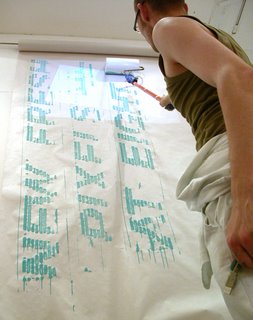
PixelRoller is a paint roller that paints pixels, designed as a rapid response printing tool specifically to print digital information such as imagery or text onto a great range of surfaces. The content is applied in continuous strokes by the user. PixelRoller can be seen as a handheld “printer”, based around the ergonomics of a paintroller, that lets you create the images by your own hand.Basically, it's a handheld dot-matrix printer (remember those?). At the link, check out the video demonstration, which only begs the question of why you would want to paint Woody Allen on your wall.

Ad Nauseam
I'm shocked, shocked, to discover that TV viewership declines during commercial breaks. (I always thought that was why commercials were louder than the programs--so they could be heard from the kitchen or bathroom.) Who doesn't take commercial time to click around or surf the Web--or do anything else but watch commercials?
Elsewhere in the above link, Nielsen's 2005 ad growth/decline numbers are out. Ad spending for 2005 was up 4.2% over 2004--three guesses what the top growth medium was (yep, the Internet, with 23.3% spending growth--but again such high growth rates are easy when you're starting from a low base compared to other, more entrenched media, but still...). Spanish-language TV was up 16.9%, cable TV up 11.0%. National magazines were up 6.7 and B-to-B magazines were up 3.5%. What declined? National newspaper spending (-4.7%), local newspapers (-0.9%), and network TV (-1.5%).
Elsewhere in the above link, Nielsen's 2005 ad growth/decline numbers are out. Ad spending for 2005 was up 4.2% over 2004--three guesses what the top growth medium was (yep, the Internet, with 23.3% spending growth--but again such high growth rates are easy when you're starting from a low base compared to other, more entrenched media, but still...). Spanish-language TV was up 16.9%, cable TV up 11.0%. National magazines were up 6.7 and B-to-B magazines were up 3.5%. What declined? National newspaper spending (-4.7%), local newspapers (-0.9%), and network TV (-1.5%).
Thursday, April 06, 2006
Gorilla, You're a Desperado
Oh, the jokes that could be made:
The Daily Mail is reporting that a troop of squirrel monkeys at the London Zoo have had to be retrained after showing too much interest in cell phones. Evidently the monkeys, in a new "non-barrier enclosure," were attempting to snatch phones from visitors who held them out to take videos or photos, the story said.Kind of reminds me of an old Warren Zevon song:
Big gorilla at the L.A. zoo
Snatched the glasses right off my face
Took the keys to my BMW
Left me here to take his place
I wish the ape a lot of success
I'm sorry my apartment's a mess
Most of all I'm sorry if I made you blue
I'm guessing the gorilla will, too
You Want Freakish? I Got Your Freakish...Right Here
Via mi hermano, Roberto, here are the top 20 strangest gadgets and accessories. #9 would be vaguely useful, #8 reminds me of a really upsetting scene from The Island of Dr. Moreau featuring Marlon Brando, #3 has been featured here before, and if #1 doesn't make your skin crawl (literally) there's something wrong with you.
A Keyboard...How Quaint
Still using a keyboard, huh? Well, until voice wreck ignition gets better, and implantable brain chips are invented, we're stuck with it. But that doesn't mean they can't be weird, and CNet has a link to the weirdest keyboards ever. Personally, I like the idea of #9 (the wrist keyboard), and #7 looks like it would be M.C. Escher's keyboard. I've seen pictures of #6 (the virtual laser keyboard) before, and it's really just a concept for the time being, and actually has an accompanying virtual display that is beamed out the other side--way cool). For my money, though, #1 is the way to go.
Chips Ahoy!
I may or may not have known this all along, but as far as I know, I just found out that the potato chip was invented here in Saratoga Springs. A story from today's Saratogian discusses the topic, in connection with a German documentarian who was in town taping footage for an upcoming program on accidental inventions. (I've often had Saratoga Chips at the Stadium Cafe--usually by accident--and they are the best chips, actually). Wikipedia confirms the story, although the Saratogian story gets its centuries a little confused, and doesn't mention that the cranky customer whose dissatisfaction with thick, soggy fried potatoes was, in some accounts, Cornelius Vanderbilt.
Barnes & Noble to Sony: "Drop Dead"
Barnes and Noble has said "no thanks" to the forthcoming Sony e-book reader:
On the subject of e-books, let me weigh in with my two cents (adjusted for inflation).
Back in the late 1990s, I covered the "e-book beat" for Micro Publishing News and got to try out firsthand all (or most) of the myriad e-book readers that had proliferated at the time--including the Microsoft Reader, the Adobe eBook Reader, and the Gemstar eBook, among others. The first two were basically applications that allowed for (supposedly) comfortable book reading on a laptop computer. It didn't entirely live up to its billing, and I never got into them because a laptop computer is still a bulky thing to lug around when all one wants to do is read a book. The Gemstar eBook was an electronic e-book reader about the size of a large hardcover book and was unimpressive on many levels.
I also had one of the second-generation Handspring Visor PDAs (remember them?) which ran the Palm OS. Palm had a software-based e-book reader (cleverly called the Palm Reader) which I kind of liked--reading books on it wasn't a bad experience, but my real beef was with the Visor itself: the batteries were always dying--even when the thing wasn't turned on. I would go to turn it on, the batteries would be dead, and I'd have to reinstall everything from the installation CD, meaning that any e-books I bought (if I had not backed them up to a PC) were gone. The Visor now sits in a trunk in the basement, along with other ghosts of technology past, like my vast collection of SCSI cables, VGA monitor adapters, a 28.8Kbps modem dating from 1994, a 2X external CD burner, the antenna that came with the TV I bought in 1997, and a variety of other objects whose exact purpose has been lost to the mists of time.
I am dubious that the Sony reader will the "killer app" for e-books, for the simple reason that the book-reading market is changing such that books are increasingly being bought and read by people who really like books and find electronic alternatives anathema. It's a tactile, "look and feel" thing which I share in part (but words are words and I'm more concerned with the content itselt than the mechanism by which that content is delivered), but the essential point is that the kinds of people who readily adopt electronic gizmos and gadgets--particularly younger people--are not big book readers (that's a vast generalization but is borne out in part by empirical observation). And when you consider the extent to which people multitask media--surfing the net while listing to an iPod while IMing while watching TV, etc.--it's hard to incorporate a book into that media mix, because books arguably require a greater level of undivided attention than other media. (I've tried--while watching sports or other TV programs that are not on DVD or recorded I usually read during commercials and it's not always easy. One ends up reading the same sentence 20 times.) Magazines and other "bite-size" content delivery mechanisms are better-suited to the kinds of media multitasking that people increasingly engage in. This is why I say that the biggest threat to printed books is not any kind of electronic alternative but rather the decline in the reading of book-length documents. Like most media shifts, this won't happen today or tomorrow, but will be generational in nature. I've been saying this for about a decade now and I remain ever more convinced this will be the case.
As for e-books themselves, I will probably check out the Sony Reader. But it's funny: there is always the sense that if e-books come on ther market, people think that there will eventually be no other alternative, and that they will only have to read printed books or e-books. The printed book or the e-book is not an either/or proposition, but rather both serve important purposes, just like the audio book hasn't completely replaced the printed book and serves an important purpose for those who want to "read" while driving (and if it keeps them off a goddamn cellphone while driving, I say it serves an immeasurably useful purpose). In fact, the reason I liked the PDA-based e-book was that it made it easy to carry books around when I traveled. (As someone who has read the hardcover edition of David McCulloch's Truman while straphanging on the NYC subway--which was great for building upper-body strength--I can't emphasize the weight advantage of the e-book enough.) In fact, the e-book is simply the extention of a decision I already make when choosing which book(s) to read: when I travel or otherwise go out (I often read a book while waiting for people in bars or restaurants), do I want to lug around a thick hardcover tome or a small, mass market paperback? Particularly when traveling by train or plane, luggage space is at a premium, so the smaller the book, the better. I'm not alone in this; people I've come across who favored the e-book did so for the exact same reason.
However, this works against the dedicated e-book reader, like the Sony Reader. What I liked about the PDA approach to e-book reading was that it was a device I was carrying around with me already--including as it did phone numbers, appointments, and other data I needed.
What I'm waiting for is a PDA-like device that can leverage e-paper/flexible displays to provide a true multifunction device-cellphone, PDA, iPod, e-book reader, e-magazine reader--basically a complete media center in one device. Once electronic documents become as easy to read as paper documents (like the E Ink/Sony approach to e-paper), I'm there. And this doesn't mean that I'm going to abandon print books--after all, despite readability, electronic devices are still often pretty annoying.
Barnes & Noble Inc., the nation's largest bookstore chain, is spurning the Sony Reader, a new electronic device cited as a potential turning point for the tiny e-book market.I really can't blame them; they got a bit burned during the first wave of e-book hoopla, so it's easy to forgive them for being a bit gun-shy this time around.
On the subject of e-books, let me weigh in with my two cents (adjusted for inflation).
Back in the late 1990s, I covered the "e-book beat" for Micro Publishing News and got to try out firsthand all (or most) of the myriad e-book readers that had proliferated at the time--including the Microsoft Reader, the Adobe eBook Reader, and the Gemstar eBook, among others. The first two were basically applications that allowed for (supposedly) comfortable book reading on a laptop computer. It didn't entirely live up to its billing, and I never got into them because a laptop computer is still a bulky thing to lug around when all one wants to do is read a book. The Gemstar eBook was an electronic e-book reader about the size of a large hardcover book and was unimpressive on many levels.
I also had one of the second-generation Handspring Visor PDAs (remember them?) which ran the Palm OS. Palm had a software-based e-book reader (cleverly called the Palm Reader) which I kind of liked--reading books on it wasn't a bad experience, but my real beef was with the Visor itself: the batteries were always dying--even when the thing wasn't turned on. I would go to turn it on, the batteries would be dead, and I'd have to reinstall everything from the installation CD, meaning that any e-books I bought (if I had not backed them up to a PC) were gone. The Visor now sits in a trunk in the basement, along with other ghosts of technology past, like my vast collection of SCSI cables, VGA monitor adapters, a 28.8Kbps modem dating from 1994, a 2X external CD burner, the antenna that came with the TV I bought in 1997, and a variety of other objects whose exact purpose has been lost to the mists of time.
I am dubious that the Sony reader will the "killer app" for e-books, for the simple reason that the book-reading market is changing such that books are increasingly being bought and read by people who really like books and find electronic alternatives anathema. It's a tactile, "look and feel" thing which I share in part (but words are words and I'm more concerned with the content itselt than the mechanism by which that content is delivered), but the essential point is that the kinds of people who readily adopt electronic gizmos and gadgets--particularly younger people--are not big book readers (that's a vast generalization but is borne out in part by empirical observation). And when you consider the extent to which people multitask media--surfing the net while listing to an iPod while IMing while watching TV, etc.--it's hard to incorporate a book into that media mix, because books arguably require a greater level of undivided attention than other media. (I've tried--while watching sports or other TV programs that are not on DVD or recorded I usually read during commercials and it's not always easy. One ends up reading the same sentence 20 times.) Magazines and other "bite-size" content delivery mechanisms are better-suited to the kinds of media multitasking that people increasingly engage in. This is why I say that the biggest threat to printed books is not any kind of electronic alternative but rather the decline in the reading of book-length documents. Like most media shifts, this won't happen today or tomorrow, but will be generational in nature. I've been saying this for about a decade now and I remain ever more convinced this will be the case.
As for e-books themselves, I will probably check out the Sony Reader. But it's funny: there is always the sense that if e-books come on ther market, people think that there will eventually be no other alternative, and that they will only have to read printed books or e-books. The printed book or the e-book is not an either/or proposition, but rather both serve important purposes, just like the audio book hasn't completely replaced the printed book and serves an important purpose for those who want to "read" while driving (and if it keeps them off a goddamn cellphone while driving, I say it serves an immeasurably useful purpose). In fact, the reason I liked the PDA-based e-book was that it made it easy to carry books around when I traveled. (As someone who has read the hardcover edition of David McCulloch's Truman while straphanging on the NYC subway--which was great for building upper-body strength--I can't emphasize the weight advantage of the e-book enough.) In fact, the e-book is simply the extention of a decision I already make when choosing which book(s) to read: when I travel or otherwise go out (I often read a book while waiting for people in bars or restaurants), do I want to lug around a thick hardcover tome or a small, mass market paperback? Particularly when traveling by train or plane, luggage space is at a premium, so the smaller the book, the better. I'm not alone in this; people I've come across who favored the e-book did so for the exact same reason.
However, this works against the dedicated e-book reader, like the Sony Reader. What I liked about the PDA approach to e-book reading was that it was a device I was carrying around with me already--including as it did phone numbers, appointments, and other data I needed.
What I'm waiting for is a PDA-like device that can leverage e-paper/flexible displays to provide a true multifunction device-cellphone, PDA, iPod, e-book reader, e-magazine reader--basically a complete media center in one device. Once electronic documents become as easy to read as paper documents (like the E Ink/Sony approach to e-paper), I'm there. And this doesn't mean that I'm going to abandon print books--after all, despite readability, electronic devices are still often pretty annoying.
Wednesday, April 05, 2006
The Hottest Chili Pepper
No, not Anthony Kiedis. Rather:
Dorset Naga, an exceptionally hot variety that we developed from a Bangladeshi chilli known as Naga Morich. In 2005 we collected a sample of this chilli, and had it tested for heat by two laboratories in the USA. The result, measured in Scoville Heat Units (SHU), were astounding: taking an average of the two, Dorset Naga came in at 923,000 SHU.Sign me up for that!
To put this figure in context, the Guinness world record for the hottest chilli is currently held by Red Savina, which was once measured at 577,000 SHU (see: Guinness World Records).
You Know the Drill
Ouch. From LiveScience:
If you dread going to the dentist, be thankful you didn't live in the Stone Age.Don't laugh; the dental plan I had at Micro Publishing wasn't too far removed from this.
Roughly 8,000 years before Novocaine and some 7,300 years before they could even swig whiskey to dull the pain, prehistoric patients were having holes drilled into their teeth with drill bits carved from stone.
Hot Hot Hot
My life is so-o-o-o busy. I'm just so busy and important, in fact, that I have no time to wait for water to boil. Even the 1:48 it takes my microwave to make water hot enough to make tea is too long. I have things to do! And don't get me started on the carnage and bloodshed that ensue when I have to get out a tea kettle.
Happily, technology is there to complicate every simple thing. To wit:
Happily, technology is there to complicate every simple thing. To wit:
While the Zip Hydrotap may look like an ordinary water faucet, don’t be so easily mistaken. What sets the Hydrotap apart from other faucets is that it can dispense boiling water at the touch of a [child-proof] button. Of course, it’ll give you plain old cold water for those hot summer days spent on a lake in the Heartland. It’s easy to install as well, either free-standing or mounted on a sink. As long as there’s plumbing nearby, the Hydrotap will go to work, making fiddling with kettles a thing of the past.
Robot Holocaust--Phase One
Get ready. Here comes a robotic noodge:
This little robot [acts] as a personal assistant that keeps tabs on the things you take with you in the morning. You can tag your essentials like wallet, keys, cellphone, etc. with tiny RFID tags which provide communication range of a few inches. A pressure sensor detects your presence and the robot will ask you for a quick check of your bag. It will check for the tagged items once you bring your bag close to the reader. In case anything is missing the Robot [will alert] you [by] saying “You forgot the keys,” and so on. This device has proven to be extremely effective in the normal living environment.It would last about five minutes around here before getting the Charles I treatment.
Gee, That's a Shame
Sexists of the world were dealt a setback today:
After a three-year run, Myrtle Beach's homegrown airline, Hooters Air, is bowing out of regularly scheduled air service.A little-known fact was that, in the event of a water landing, your flight attendant could be used as a flotation device.
Tuesday, April 04, 2006
Sorry Spectacles?
I'm not quite ready for bifocals yet, but when I get there (what's today, Tuesday...), hopefully this idea will be a bit further along:
Now researchers have created liquid crystal lenses that can change between long-distance and reading modes with the flick of a switch.Given what researchers are starting to do with implantable brain chips (etc.) it would be great if they could invent autofocusing liquid crystal bifocals. Then I could really make a spectacle of myself.
Guoqiang Li of the University of Arizona and his colleagues sandwiched a thin layer of liquid crystal between two layers of glass and laced it with concentric rings of electrodes. When turned on, the electrodes reconfigure the focusing power of the lens for either near or far vision, allowing the entire lens to promote the desired effect in less than a second.
The Heat Is On
Ah, USB: is there anything it can't do--or warm? First there were USB slippers to keep your feet warm. Then there were freakish-looking USB gloves to keep your hands warm while you type:
 Now there is a USB coffee warmer:
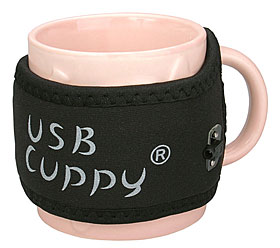 I see a burgeoning market for USB hubs, though I wonder what the simultaneous use of all these USB heating devices would do to one's PC.
Then again, not living in the Arctic, I can't say that I have a great deal of use for these.
 Now there is a USB coffee warmer:
 I see a burgeoning market for USB hubs, though I wonder what the simultaneous use of all these USB heating devices would do to one's PC.
Then again, not living in the Arctic, I can't say that I have a great deal of use for these.
Make a Break for the Borders
Speaking of e-paper-based reading devices, coming this summer to a Borders near you:
The Sony Reader, a new text-reading device that lets you have the Bible or the entire works of Tolstoy on hand but carry around the physical equivalent of a paperback, will be sold at Borders bookstores.I've seen a prototype of the Sony Reader and it is impressive--and highly readable. The device is kind of pricey ($299 to $399), but no more so than an iPod. Electronic books themselves will be downloadable from Sony's Web site. It will all hinge on number of titles available (look for all the public domain classics to be available), the variety thereof, and how annoying the digital rights management (DRM) ends up being. Sony (they of the CD rootkit fiasco) isn't known for making life easy for its customers (and they absolutely adore proprietary formats that are completely incompatible with anyone else's hardware), so hopefully they won't end up killing the market before it even takes off.
The gadget, which debuted at the Consumer Electronics Show earlier this year, evokes the visual stability of something printed on overlay. It resembles actual paper and ink, with little flickering.
The high-resolution (SVGA 800x600) electronic-paper display screen supports BBeB Book, PDF and MP3 formats and can also display JPEG images.
The device measures 6.9 inches by 4.9 inches by 0.5 inches and weighs in at just more than half a pound. The Sony Reader takes Memory Sticks or SD flash memory cards to augment 64MB of internal memory, creating the potential to travel with hundreds of books.
The Sony Reader also has "a seemingly limitless battery life equivalent of 7,500 pages turns," according to a Stony statement. That's because there is no rundown on the battery over time. Power is only consumed when a reader turns the page.
Stop the Presses
Sez an NAA study:
In fact, now that I have a wireless network set up in the house, I have been known to take my Powerbook to the kitchen table and replace my print newspaper reading with Internet newspaper reading. Think of how convenient a Wi-Fi-enabled e-paper reader would be.
In fact, the only time I ever missed having printed newspapers was when I had to paint my kitchen...
one in three internet users — 55 million — visit a newspaper website every month.I've never been of the opinion that newspaper publishing was doomed, just the print component thereof. If my own behavior is any indication of larger cultural trends (and there's a terrifying thought, on so many levels), I haven't read a print newspaper in a long time, but I check out a half dozen or so Internet newspapers' sites on a regular basis, both national and local (and even international).
Also, unique visitors to newspaper websites jumped 21 percent from January to December 2005, while the number of page views soared by 43 percent over the same period.
In fact, now that I have a wireless network set up in the house, I have been known to take my Powerbook to the kitchen table and replace my print newspaper reading with Internet newspaper reading. Think of how convenient a Wi-Fi-enabled e-paper reader would be.
In fact, the only time I ever missed having printed newspapers was when I had to paint my kitchen...
Monday, April 03, 2006
A Thoreauly Appealing Idea
Henry David Thoreau, eat your heart out. A PC magazine editor plans to go native:
There always seems to be the assumption that "technology" is something new, and while it surely includes new "gadgets and gizmos," it also includes old gadgets and gizmos--and basically anything that has helped create Western civilization. The word "technology" itself comes from the Greek technologia ("systematic treatment") and was coined in the 17th century (so much for it being some new thing). I would argue that anything that has been invented is technology, no matter how old it is, going back to the beginning of human civilization--heck, the invention of the plow was (literally) cutting-edge technology at the time.
So let's look at what this guy is going to have with him. How is a flashlight not technology? Is a flashlight found growing wild in nature? Unless his "flashlight" is some kind of Flintstones-like jar of fireflies, he's not escaping technology. (But even then--the jar: glass manufacture would be, technically, technology.)
Notebooks--ever been to a paper mill? The modern papermaking process may date from the early 19th century (and papermaking from wood pulp even more recently), but is indeed technology. After all, someone had to invent paper. (This also applies to, ahem, any other kind of paper he may need to take along on this adventure.)
Pens: The ballpoint pen (invented in 1938) is a more recent invention than the typewriter--or even the computer. And "modern" ballpoint pens utililize highly advanced design, engineering, and manufacturing processes. Just because something isn't electronic doesn't mean it's not "technology."
The food and rations he's got: since he's not hunting (with a gun? Hmmm...sounds like technology of a sort) or farming, the food was produced by some kind of modern food manufacturing process--utilizing, no doubt, the latest technology. If it doesn't go bad in a day or two, it's probably got some kind of preservatives. I dare say, technology yet again.
I could go on and on--what kind of bedding? Presumably it was manufactured. And I also assume that this guy has been inoculated against a variety of illnesses--technology. Does he wear glasses? Any dental work? Any dental hygiene at all? Is he in general good health otherwise? Thank advances in medicine and water and sewage treatment and public utilities that developed over the course of the 20th century. (The science-fiction author Charles Stross once commented that, when asked what period other than now he would like to live, he replied "none," since given that he has a certain congenital medical condition that has only recently been combatted successfully, he'd be dead in any era other than the current one. Food for thought when we rail against "technology.")
Look, no one gets more annoyed by computers and cellphones and iPods and MS Office and all the other trappings of "modern technology" than I do, but people have cursed "technology" in just about every era, and there have always been those who dreamed of escaping it and living a "simpler" life. People reacted adversely to the technological advances that led to the Industrial Revolution (whence the original Luddites), and I would imagine that thousands of years ago, you could probably just as easily find some farmer out in his field, cursing his plow, wishing he could go back to the simple days of being a hunter-gatherer. And so it goes.
But I would argue that living in a cabin in the woods and having to hunt, fish, grow things, and deal with nature, is hardly simpler. (And, hey, I've been camping.) I suppose it could be argued that there is a kind of purity in that kind of life, but if you're going to live that way, then you'll need to throw off all the conveniences of modern life, like plumbing, electricity, clean water, medicine, etc. Say what you will about modern technology, it does keep most of us from dying by age 40. Or smelling really bad.
And say what you will about cellphones, but on 9/11, wasn't it passengers with cellphones who found out what was happening and ultimately prevented Flight 93 from hitting a fourth target? I grudgingly score 1 for cellphones.
If we're that worried about being so reliant on gadgets and gizmos, why do we have to go live in the woods? All we have to do is just shut the damn things off once in a while! I find nothing so pleasant on a sunny Sunday afternoon than to turn off the computer, turn off the iPod, turn off the TV and CD player, deactivate all my robotic manservants, and just sit on the couch and read a book. Yes, the book was produced using the latest desktop publishing and printing technology, but I think I can handle that.
I'm writing this quickly because I'm about to embark on an experiment. At the urging of my editor-in-chief, Jim Louderback, and Vicki Jacobson, the executive editor who regularly edits this column, I'm going wild—literally. Beginning today at 5 p.m. (it's around 3:30 as I write this), I will leave all technology behind and head north to spend four weeks in a remote cabin in upstate New York.While we've all fantasized about this idea (some of of still do, obessively)--and the idea has had no small amount of appeal for basically the same reasons since the 1960s (at least)--I do have to throw a flag here and raise the question: what exactly is "technology"? And is it even possible for one live without "technology"? Or is it only some technologies he's trying to live without?
Jim and Vicki cooked up the idea a few weeks ago and are convinced that my experiences, which I'll record with pen and paper, will make a great series of columns about "Learning to Live Without Technology." The concept sounds crazy, but apparently, the thought is high on the minds of many deep thinkers. Sudden changes in our global climate and the looming bird-flu pandemic have some believing that chaos is around the corner, and that figuring out how to function without technology may soon be just as important as learning how to live with it.
Preparing to go tech-free is not as easy as it sounds. First of all, I've had to prepare family, friends, and coworkers and make sure they have all they need from me before I go. Consumer Electronics Senior Editor Dan Costa has agreed to drive me upstate to Cranberry Lake. He'll be leaving me at the cabin with simple bedding, a flashlight, a week's worth of food rations and water, 60 notebooks, and 40 pens. The cabin is outfitted with a cot and desk. That's it!
There always seems to be the assumption that "technology" is something new, and while it surely includes new "gadgets and gizmos," it also includes old gadgets and gizmos--and basically anything that has helped create Western civilization. The word "technology" itself comes from the Greek technologia ("systematic treatment") and was coined in the 17th century (so much for it being some new thing). I would argue that anything that has been invented is technology, no matter how old it is, going back to the beginning of human civilization--heck, the invention of the plow was (literally) cutting-edge technology at the time.
So let's look at what this guy is going to have with him. How is a flashlight not technology? Is a flashlight found growing wild in nature? Unless his "flashlight" is some kind of Flintstones-like jar of fireflies, he's not escaping technology. (But even then--the jar: glass manufacture would be, technically, technology.)
Notebooks--ever been to a paper mill? The modern papermaking process may date from the early 19th century (and papermaking from wood pulp even more recently), but is indeed technology. After all, someone had to invent paper. (This also applies to, ahem, any other kind of paper he may need to take along on this adventure.)
Pens: The ballpoint pen (invented in 1938) is a more recent invention than the typewriter--or even the computer. And "modern" ballpoint pens utililize highly advanced design, engineering, and manufacturing processes. Just because something isn't electronic doesn't mean it's not "technology."
The food and rations he's got: since he's not hunting (with a gun? Hmmm...sounds like technology of a sort) or farming, the food was produced by some kind of modern food manufacturing process--utilizing, no doubt, the latest technology. If it doesn't go bad in a day or two, it's probably got some kind of preservatives. I dare say, technology yet again.
I could go on and on--what kind of bedding? Presumably it was manufactured. And I also assume that this guy has been inoculated against a variety of illnesses--technology. Does he wear glasses? Any dental work? Any dental hygiene at all? Is he in general good health otherwise? Thank advances in medicine and water and sewage treatment and public utilities that developed over the course of the 20th century. (The science-fiction author Charles Stross once commented that, when asked what period other than now he would like to live, he replied "none," since given that he has a certain congenital medical condition that has only recently been combatted successfully, he'd be dead in any era other than the current one. Food for thought when we rail against "technology.")
Look, no one gets more annoyed by computers and cellphones and iPods and MS Office and all the other trappings of "modern technology" than I do, but people have cursed "technology" in just about every era, and there have always been those who dreamed of escaping it and living a "simpler" life. People reacted adversely to the technological advances that led to the Industrial Revolution (whence the original Luddites), and I would imagine that thousands of years ago, you could probably just as easily find some farmer out in his field, cursing his plow, wishing he could go back to the simple days of being a hunter-gatherer. And so it goes.
But I would argue that living in a cabin in the woods and having to hunt, fish, grow things, and deal with nature, is hardly simpler. (And, hey, I've been camping.) I suppose it could be argued that there is a kind of purity in that kind of life, but if you're going to live that way, then you'll need to throw off all the conveniences of modern life, like plumbing, electricity, clean water, medicine, etc. Say what you will about modern technology, it does keep most of us from dying by age 40. Or smelling really bad.
And say what you will about cellphones, but on 9/11, wasn't it passengers with cellphones who found out what was happening and ultimately prevented Flight 93 from hitting a fourth target? I grudgingly score 1 for cellphones.
If we're that worried about being so reliant on gadgets and gizmos, why do we have to go live in the woods? All we have to do is just shut the damn things off once in a while! I find nothing so pleasant on a sunny Sunday afternoon than to turn off the computer, turn off the iPod, turn off the TV and CD player, deactivate all my robotic manservants, and just sit on the couch and read a book. Yes, the book was produced using the latest desktop publishing and printing technology, but I think I can handle that.
What's In a Name?
Some more spam "sent from" names that I suspect are not real:
Resonantly F. DisembodyingHmm...Maybe I should write a Samuel Beckett/Eugene Ionesco-esque play and feature all of these as characters.
Gunrunning G. Lithograph
Trimmers S. Launderer
Blower Q. Drudges
Dissenter E. Kudzu
Cashed A. Plagiarizing
Gale H. Vibration
Tinderbox O. Spadework
Postmodern M. Chairperson
Chills U. Victim
Friday, March 31, 2006
Must-Avoid TV
At one time, my friend Ken and I were hooked on a goofy Japanese show usually shown on Spike TV (the only time I would ever watch Spike TV, I hasten to add) called MXC (Most Extreme Challenge or something like that) that subjects inexplicably enthusiastic contestants to a series of horribly painful and humiliating physical activities, such as running as fast as you can into a closed and locked door, jumping off a ramp onto a giant spinning mushroom, leaping onto a rotating surfboard and then being knocked into filthy water by a giant pink dolphin (a metaphor for life, it is our contention), and trying to run across giant rotating cylinders, among many many others that defy easy description. As long as you turn the sound on the TV off, it's very funny, in a twisted sort of way (the Spike people felt the need to add a staggeringly unfunny, extremely lewd play-by-play voiceover). It's actually a Japanese program called Takeshi's Castle, and I would like to someday see it without the stupid voiceovers (the dialog in the original is actually supposed to be fairly witty).
I mention this because I had not been aware of the depths of Japanese television until I was watching Wednesday night's Colbert Report and they showed a brief clip of what looked like a Japanese show featuring a Komodo dragon trapped in a plastic dome. For some reason, Japanese women would poke their heads into the dome--with a piece of raw meat strapped to their foreheads--and have to duck out of the way when the dragon charged at them. Sort of a disturbing version of Whack-a-Mole. I was intensely curious as to what this was, so I Googled "Japanese TV Komodo dragon" and, yes, apparently it is a real program, mentioned here.
I also came across several videos of Japanese programs that are even more upsetting. Check them out here, if you dare.
Jeez, and I thought American TV was bad!
I mention this because I had not been aware of the depths of Japanese television until I was watching Wednesday night's Colbert Report and they showed a brief clip of what looked like a Japanese show featuring a Komodo dragon trapped in a plastic dome. For some reason, Japanese women would poke their heads into the dome--with a piece of raw meat strapped to their foreheads--and have to duck out of the way when the dragon charged at them. Sort of a disturbing version of Whack-a-Mole. I was intensely curious as to what this was, so I Googled "Japanese TV Komodo dragon" and, yes, apparently it is a real program, mentioned here.
I also came across several videos of Japanese programs that are even more upsetting. Check them out here, if you dare.
Jeez, and I thought American TV was bad!
To Sleep, Perchance To...Get Really Annoyed
I can only assume this is an April Fool's joke a day early (there is some evidence in the article to suggest that it is), or an homage to a funny scene from an episode of Futurama. But these days, one never knows... From today's eMarketer:
You have heard of product placement in movies and video games but scientists and marketers have now cracked the code for entering a new channel: advertising in your dreams.Oh, sign me up for that.
Coca Cola, Speedo and Nike are just three of the many mega-brands that are exploring this new medium called in-sleep advertising. While still in its infancy, eMarketer forecasts in-sleep advertising spending in the US to grow to over $3 billion by 2020, up from less than one million in 2005.
...
For the layperson, this is how in-sleep advertising works. All in-sleep subjects have a procedure to implant a nanobot (a tiny robot about the size of a blood cell) into that part of the brain where dreams originate — the pons in the brainstem. Once the chip is in place, it acts something like a wireless base-station, sending and receiving signals from other nanobots.
Before an in-sleep subject goes to bed they put a small device in their ear, not dissimilar to a cochlear implant. When the subject moves into REM (rapid eye movement) sleep, the implant is triggered (by the increase in delta waves) and a nanobot containing the appropriate advertising message is released into the spiral artery of the ear and down through to the cochlear canal. Once it reaches the blood brain barrier, it is programmed to wirelessly send an electrical signal (the advertisement) to the nanobot located in the pons. That nanobot receives the signal, sources the appropriate neuroreceptor and implants the ad.
Wednesday, March 29, 2006
Limitless Vistas! Well, Maybe Not...
Via Dr. Joe, a funny article from Forbes about how Microsoft is becoming increasingly clueless. My favorite 'graph:
Even more ironic is that Microsoft has ginned up a new slogan, "People Ready," which apparently is meant to describe its software, or maybe it describes companies that use its software, or whatever. Who knows? It's one of those phrases that means anything, and so means nothing. Who makes this stuff up? Do they actually pay this person? And is Microsoft just figuring out now that its programs are used by--gasp--people?Then again, I've never encountered a slogan for anything that had any actual meaning.
Lemme Entertain You
It is with great shame and embarrassment that I admit that I have never read Stanislaw Lem (though he's on my short list of sci-fi authors to investigate). Sadly, he died this week. I shall have to pick up Solaris* toute de suite.
*There were two film versions--Andrei Tarkovsky did a definitive version in 1972, while Steven Soderbergh did one that starred George Clooney in 2002 which tanked at the box office but which was supposed to be not bad.
*There were two film versions--Andrei Tarkovsky did a definitive version in 1972, while Steven Soderbergh did one that starred George Clooney in 2002 which tanked at the box office but which was supposed to be not bad.
A Well-Respected Man
I had the opportunity last night to see one of my absolute favorite singer/songwriters from one of my absolute favorite bands of all time in concert: Ray Davies, formerly of The Kinks, at the Orpheum Theater in Boston. (The Kinks and I date from when I was 13 in 1981 and Give the People What They Want came out and never left my tape deck. In the late 1990s, all 22 of The Kinks albums from 1964 to 1984 were remastered and reissued on CD and the record companies that did them did a great job.) Last month, Ray released his first ever solo album called Other People's Lives and it is a terrific album. It hasn't left my CD player (or iPod, depending where I am) in about a month.
Last night, he did a good mix of old chestnuts and tracks from the new record (which sound great live). The highlight for me was a set of acoustic versions of songs from my favorite Kinks album (which, as Ray pointed out, was the most unsuccessful album ever released)--1968's Village Green Preservation Society). The inclusion of "20th Century Man"--though a favorite song of mine--was a bit odd, what with it being the 21st century and all, but then again many of the lines from the song ("This is the age of machinery/A mechanical nightmare/The wonderful world of technology/...This is the 20th century/Too much aggravation/This is the age of insanity...") ring even more true now than in the last century.
In terms of performance and my enjoyment thereof, it's one of the best concerts I've been to--even if the audience was massively annoying, even by rock concert standards.
A Boston Globe review can be found here. There's very little in the review I disagree with, although I am more charitable to the new songs--particularly "After the Fall" and "The Morning After," even if "Next Door Neighbour" doesn't quite rise to the level of Ray's past character portraits/satires like "A Well Respected Man" or "Dedicated Follower of Fashion" (and raises the question of how you can have three next door neighbors--a minor, picayune point, I suppose...).
The set list as I recall it was as follows:
I'm Not Like Everybody Else (B side to the "Sunny Afternoon" single, 1966)
Where Have all the Good Times Gone? (The Kink Kontroversy, 1965)
'Till the End of the Day (The Kink Kontroversy, 1965)
After the Fall (Other People's Lives, 2006)
Next Door Neighbour (Other People's Lives, 2006)
Creatures of Little Faith (Other People's Lives, 2006)
20th Century Man (Muswell Hillbillies, 1971)
Oklahoma USA (Muswell Hillbillies, 1971)
Village Green (Village Green Preservation Society, 1968)
Animal Farm (Village Green Preservation Society, 1968)
Picture Book (Village Green Preservation Society, 1968)
Johnny Thunder (Village Green Preservation Society, 1968)
Sunny Afternoon (Face to Face, 1966)
Dead End Street (1966 single)
Over My Head (Other People's Lives, 2006)
The Tourist (Other People's Lives, 2006)
Low Budget (Low Budget, 1979)
That's That (The Stand Up Comic) (Other People's Lives, 2006)
The Morning After (Things Are Gonna Change) (Other People's Lives, 2006)
A Long Way From Home (Lola vs. Powerman and the Money-Go-Round, 1970)
The Getaway (Lonesome Train) (Other People's Lives, 2006)
Tired of Waiting for You (Kinda Kinks, 1965)
Set Me Free (Kinda Kinks, 1965)
All Day and All of the Night (1964 single)
You Really Got Me (1964 single)
Lola (Lola vs. Powerman and the Money-Go-Round, 1970)
Last night, he did a good mix of old chestnuts and tracks from the new record (which sound great live). The highlight for me was a set of acoustic versions of songs from my favorite Kinks album (which, as Ray pointed out, was the most unsuccessful album ever released)--1968's Village Green Preservation Society). The inclusion of "20th Century Man"--though a favorite song of mine--was a bit odd, what with it being the 21st century and all, but then again many of the lines from the song ("This is the age of machinery/A mechanical nightmare/The wonderful world of technology/...This is the 20th century/Too much aggravation/This is the age of insanity...") ring even more true now than in the last century.
In terms of performance and my enjoyment thereof, it's one of the best concerts I've been to--even if the audience was massively annoying, even by rock concert standards.
A Boston Globe review can be found here. There's very little in the review I disagree with, although I am more charitable to the new songs--particularly "After the Fall" and "The Morning After," even if "Next Door Neighbour" doesn't quite rise to the level of Ray's past character portraits/satires like "A Well Respected Man" or "Dedicated Follower of Fashion" (and raises the question of how you can have three next door neighbors--a minor, picayune point, I suppose...).
The set list as I recall it was as follows:
I'm Not Like Everybody Else (B side to the "Sunny Afternoon" single, 1966)
Where Have all the Good Times Gone? (The Kink Kontroversy, 1965)
'Till the End of the Day (The Kink Kontroversy, 1965)
After the Fall (Other People's Lives, 2006)
Next Door Neighbour (Other People's Lives, 2006)
Creatures of Little Faith (Other People's Lives, 2006)
20th Century Man (Muswell Hillbillies, 1971)
Oklahoma USA (Muswell Hillbillies, 1971)
Village Green (Village Green Preservation Society, 1968)
Animal Farm (Village Green Preservation Society, 1968)
Picture Book (Village Green Preservation Society, 1968)
Johnny Thunder (Village Green Preservation Society, 1968)
Sunny Afternoon (Face to Face, 1966)
Dead End Street (1966 single)
Over My Head (Other People's Lives, 2006)
The Tourist (Other People's Lives, 2006)
Low Budget (Low Budget, 1979)
That's That (The Stand Up Comic) (Other People's Lives, 2006)
The Morning After (Things Are Gonna Change) (Other People's Lives, 2006)
A Long Way From Home (Lola vs. Powerman and the Money-Go-Round, 1970)
The Getaway (Lonesome Train) (Other People's Lives, 2006)
Tired of Waiting for You (Kinda Kinks, 1965)
Set Me Free (Kinda Kinks, 1965)
All Day and All of the Night (1964 single)
You Really Got Me (1964 single)
Lola (Lola vs. Powerman and the Money-Go-Round, 1970)
Tuesday, March 28, 2006
Resistance is Futile
Here's a preview of the impending Borg-ization of mankind:
The line between living organisms and machines has just become a whole lot blurrier. European researchers have developed "neuro-chips" in which living brain cells and silicon circuits are coupled together.This is why I am going to get a head start and change my name to Ernest Borg-9. But wait, there's more:
The achievement could one day enable the creation of sophisticated neural prostheses to treat neurological disorders or the development of organic computers that crunch numbers using living neurons.
To create the neuro-chip, researchers squeezed more than 16,000 electronic transistors and hundreds of capacitors onto a silicon chip just 1 millimeter square in size.
They used special proteins found in the brain to glue brain cells, called neurons, onto the chip. However, the proteins acted as more than just a simple adhesive.
...
The proteins allowed the neuro-chip's electronic components and its living cells to communicate with each other. Electrical signals from neurons were recorded using the chip's transistors, while the chip's capacitors were used to stimulate the neurons.
Fully merging microbe and machine for the first time, scientists have created gold-plated bacteria that can sense humidity.All this trouble for that? Heck, if you want to sense humidity all you need is my hair.
The breakthrough is the first "cellborg" in what might become an array of devices that could sense dangerous gases or other hazardous substances.
The bioelectronic device swells and contracts in response to how much water vapor is in the air. It’s called a cellborg humidity sensor, and it is at least four times more sensitive than those that are solely electronic. It even works even when its biological parts are long dead.
Smells Like a Telemarketer
This has to win the award for the absolute worst idea in the history of technology (worse even than the cellphone itself):
Samsung has done the unthinkable and is actually developing a smell-o-phone. This phone will release “smell tones” upon incoming calls.
Why Fi?
It's amazing how quickly we have become spoiled by WiFi (and free WiFi at that) in hotels when we travel. I remember being really annoyed staying at the Hyatt McCormick Place for Print 05 and having to pay $10 a day for Internet access--and wireful Internet access at that.
So for those who can't travel without their WiFi, here is a link to articles on the best and worst hotels and hotel chains for WiFi connectivity.
So for those who can't travel without their WiFi, here is a link to articles on the best and worst hotels and hotel chains for WiFi connectivity.
Slippery Slippers
Is there a new crime wave on the rise that I had been unaware of? Or enough of one to warrant the need for antitheft slippers:
 Nah, I still prefer the USB slippers.
Slippers with antitheft rings make alarm sounds if the rings are pulled out. The rings are put through the legs of a table.I presume you don't do this while you're wearing them or, if you do, don't get up abruptly. I foound it easier just to secure my slippers with The Club.
 Nah, I still prefer the USB slippers.
Friday, March 24, 2006
The Savannah Book Club
Helene, Judy, Amanda, et alia--the books I recommended are by Bill Bryson--A Walk in the Woods (about his attempts to walk the Appalachian Trail), I'm a Stranger Here Myself (hilarious essays about returning to the U.S. after many years living abroad), and In a Sunburned Country (the travelog about Australia that Dan Shea had also recommended).
Since you just walked over here and read this on screen I'm not sure why I need to post this, but since I've come this far...
Since you just walked over here and read this on screen I'm not sure why I need to post this, but since I've come this far...
Monday, March 20, 2006
I Can't Believe It's Not...Well, You Know
And if you thought my peppering experience was bad, I can't even begin the describe the carnage that results when I attempt to butter bread. It's good to know that all that bloodshed can be avoided:
The ButterWizard is THE must-have kitchen innovation….It's good to know it's portable; have a compulsive need to constantly butter bread when I travel, drive, attend business meetings...
The ButterWizard is the world’s first fully portable Temperature Controlled Butter Dish, which both heats and cools regardless of ambient temperature, ensuring your butter stays at the perfect temperature for spreading – anytime, anywhere.
Dr. Pepper
Hummm....
Eliminate the pain and hassle of having freshly-ground pepper with this electric and automatic pepper grinder. Designed by Frank Kaltenbach, it can be operated one-handed, and there it even has a light to provide proper visuals with the item being peppered and prevent over-peppering.I can't tell you how often I have to be rushed to the emergency room with a dislocated wrist because a manual pepper grinder is too much for my delicate, fine-porcelain-like body. And I always miss the food I am trying to pepper because I never know from what part of my pepper grinder the pepper is going to come--and I end up with pepper all over the kitchen because the thing is like an out-of-control garden hose. Oh, and when I do hit the food I just keep grinding, never knowing when to stop until there is a huge mound of pepper, rendering the food inedible. I'm so glad that technology can come to my rescue, because I want everything in my home to be electrically powered, because electricity is free!
Blade Runner
You have to love economists, if not The Economist. Who else would note Gilette's recent announcement of a five-blade razor and then try to determine if there is a Moore's Law for razor blades (with a chart!)? By their reckoning, we'll be shaving with 14 blades by 2100. Word of advice: invest in Band Aids. But itg's possible we'll all look like ZZ Top by then.
This relationship (see chart) suggests shavers are going to get more blades whether they need them or not. However, just like Moore's law—the observation that computer chips double in power every 18 months or so—it seems that technology as well as marketing determines the rate at which new blades are introduced.
It is simply not possible to add a new blade whenever the marketing department wants one. Every additional blade, explains Michele Szynal, a spokeswoman at Gillette, adds weight and size to a razor. Firms must therefore find ways of making both razor and blades lighter, which means thinner blades, more closely spaced, made of special materials, with new coatings.
So what does the future hold? With only five data-points, it is hard to be sure exactly which mathematical curve is being followed. If it is what is known as a power law, then the 14-bladed razor should arrive in 2100. The spate of recent innovation, however, suggests it may be a hyperbola. In that case, blade hyperdrive will be reached in the next few years and those who choose not to sport beards might be advised to start exercising their shaving arms now.
Saturday, March 18, 2006
Whatte the Swyve?
Only a really dorky former English major (like me) would find this blog as hysterical as I do.
Friday, March 17, 2006

Not-So-Local News
This morning, I noticed that Yahoo! News has debuted a beta of a new featured called Local News, wherein you can enter your ZIP code and it will purportedly aggregate local news stories. However, upon entering 12866, I was given the message:
"To see news for Saratoga Springs, NY, please select a metro area: Buffalo, Burlington, New York."
Um, guys? Neither of those cities are within a 100-mile radius of here. Albany would have been acceptable. Heck, even Syracuse is closer.
And, hey, I get the same message when I change the location to "Albany, NY."
So I'm not impressed with Yahoo! Local News.
"To see news for Saratoga Springs, NY, please select a metro area: Buffalo, Burlington, New York."
Um, guys? Neither of those cities are within a 100-mile radius of here. Albany would have been acceptable. Heck, even Syracuse is closer.
And, hey, I get the same message when I change the location to "Albany, NY."
So I'm not impressed with Yahoo! Local News.
Wednesday, March 15, 2006
Taking Stock [Out] of Print
Financial page readers with bad eyes rejoice:
Beginning April 4, The New York Times will stop publishing daily stock listings on Tuesdays through Saturdays and will offer a new package of interactive tools and market information on its Web site, the paper announced yesterday.I'm surprised it took them this long. With CNBC and the Web, does anyone even read the printed stock tables anymore?
In announcing the change, The Times joins other newspapers that have cut stock listings to reduce newsprint costs as more readers monitor investments using the Internet.
The Times will replace the tables in the newspaper with two pages of market and economic information, including performance listings of the top 100 stocks in the Standard & Poor's 500-stock index, market analysis, mutual fund information, charts tracking individual company performance and lists of foreign currency exchange rates.
The newspaper said that the features to be added to its Web site would include investment tools, breaking financial news and individual portfolio information.
...
The Tribune Company has cut back on stock listings in many of its newspapers, including The Chicago Tribune, The Los Angeles Times, Newsday and The Orlando Sentinel.
On Monday, The Los Angeles Times announced that it would condense its tables to a one-page listing of the 1,300 most heavily traded stocks and a list of companies based in Southern California.
In January, The Chicago Tribune eliminated its tables from Tuesdays through Fridays, substituting a condensed list of stocks, mutual funds, heavily traded stocks and companies of local interest. The Atlanta Journal-Constitution stopped running its complete stock tables this month.
Tuesday, March 14, 2006
Pi a la Mode
I had no idea, but Happy Pi Day:
March 14 is Pi Day. The event, though rarely observed outside math class, is so named because the U.S. date abbreviation of 3/14 resembles the first digits of the famed transcendental number.And I love Kate Bush, and the song "Pi" is one of my favorite tracks from her long-awaited new album, but someone has too much time on their hands:
I got hold of the lyrics and checked them against an online version of Pi. All was well for the first 53 decimal places but then Kate sang "threeeeee oneeeee" when she should have sang "zeeeeeeerooo" instead. She recovered for the next 24 digits but then it went to hell in a handbasket when she missed out the next 22 digits completely before finishing with a precise rendition of her final 37 digits.
Gunky Buildup
ZDNet UK has an article about one of the often unavoidable hazards of the computer age--having one's keyboard consume as much food as the computer user. The writer provides a list of foods that should not be eaten while computing, given their capacity for leaping keyboard-ward. Recommended reading, if only for the delightful Britishness of the writing.
I have even better, more American examples:
Bagels should not be eaten over one's computer (unless they do not have toppings). Sesame and poppy seeds and those hardened chunks of garlic have some kind of magnetic attraction to keyboards. Oh, and it's not easy to scrape dried cream cheese off the keys, so toasting bagels is to be avoided as it makes the cream cheese more gloopy.
A certain editorial director I once worked for destroyed not one but two keyboards thanks to love of first teriyaki sauce and then soy sauce. So Chinese/Japanese foods should not be eaten over one's keyboard. (Plus rice can cause trouble.)
Buffalo wings--nuff said.
Soups and chowdahs are bad juju.
A certain colleague of mine likes to have business meetings in Appleby's or similar restaurants. I've found that it saves a lot of time to avoid plates and just carry my laptop up to the salad bar and pile all the salad fixings on it.
This one is unavoidable, but just a couple days ago I accidentally sent the contents of a partially filled mug of coffee flying into my Powerbook. No damage, but it was tense for a while there.
While there are many reasons to not drink beer while at the computer (especially if one has a blog...), I have found that it poses no hazards to one's keyboard. After all, who spills beer?
In a nutshell (oh, and I'd avoid nutshells, too), I look for high-viscosity substances to eat while computing. Straight molasses is good. Maybe they should add viscometer measurements to the nutritional information on the backs of food packages.
I have even better, more American examples:
Bagels should not be eaten over one's computer (unless they do not have toppings). Sesame and poppy seeds and those hardened chunks of garlic have some kind of magnetic attraction to keyboards. Oh, and it's not easy to scrape dried cream cheese off the keys, so toasting bagels is to be avoided as it makes the cream cheese more gloopy.
A certain editorial director I once worked for destroyed not one but two keyboards thanks to love of first teriyaki sauce and then soy sauce. So Chinese/Japanese foods should not be eaten over one's keyboard. (Plus rice can cause trouble.)
Buffalo wings--nuff said.
Soups and chowdahs are bad juju.
A certain colleague of mine likes to have business meetings in Appleby's or similar restaurants. I've found that it saves a lot of time to avoid plates and just carry my laptop up to the salad bar and pile all the salad fixings on it.
This one is unavoidable, but just a couple days ago I accidentally sent the contents of a partially filled mug of coffee flying into my Powerbook. No damage, but it was tense for a while there.
While there are many reasons to not drink beer while at the computer (especially if one has a blog...), I have found that it poses no hazards to one's keyboard. After all, who spills beer?
In a nutshell (oh, and I'd avoid nutshells, too), I look for high-viscosity substances to eat while computing. Straight molasses is good. Maybe they should add viscometer measurements to the nutritional information on the backs of food packages.
No, Mr. Bond, I Expect You to Snip!
Not an altogether bad idea (and for only $20), but I suppose it goes without saying that you really shouldn't run with them:

Laser Scissors You can cut a straight line! Just aim the pin-point laser and follow the line.
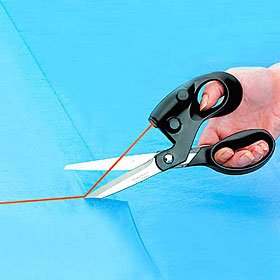
Sunday, March 12, 2006
Beware the Madness of March
Holy crap--less than a week ago, I was ready to write off Syracuse's post-season, but then they swept all four games to win the Big East championship (for the second year in a row). And now, not only are they not NIT-bound, but they are a number 5 seed in the NCAA championship.
Still, regardless of how many rounds they make it through, you gotta love March Madness!
Still, regardless of how many rounds they make it through, you gotta love March Madness!
Friday, March 10, 2006
Classified Information
eMarketer has not at all good things to say about print--or even online--classified ad sales:
[N]ewspapers need to replace every lost reader with between 20 and 100 Web site readers to recover lost income. "We need to make the revenues we earn from online readers equal or more than what we earned from the people who no longer read us in print," he said.The trouble is that "online classifieds" is a very vague term; no, newspapers' own online classified are not growing hugely, but look at eBay and Craigslist--they're the real destinations for all the former print classified advertisers. And let's not forget, from what I've seen in my own circles, simple e-mailings to friends, acquaintances, colleagues, etc., are replacing classified ads--"I'm selling a [thing]. Anybody know somebody in the market for one?" "I'm looking for [another thing]. Anybody know someone who has it?" I suspect this is becoming more and more common, from my own anecdotal (and sadly data-less) evidence.
Mr. Crosbie maintained that the US is "the epicenter of a seismic shift in the newspaper business from print to online" and that "speed is of the essence in this shift. Newspapers must serve online advertisers as soon as possible, or forever lose the classified advertising business, plus other forms of online advertising, to 'pure play' Internet competitors."
eMarketer's own projections confirm fears that online classified ad spending does not measure up to other, more vibrant online ad spending formats such as rich media and sponsorships. Although total spending on online classified advertising will continue to grow for several years, it is likely to do no more than match the growth in total spending. Rich media and sponsorships, on the other hand, will grow much more rapidly.
Fear of a Bot Planet
Required reading for the future, perhaps: How to Survive a Robot Uprising

In this uncomfortably humorous survival guide, Wilson, a Ph.D. candidate at the Robotics Institute of Carnegie Mellon University, reminds readers that "any machine could rebel, from a toaster to a Terminator," and though the forms our future robot enemies may take are manifold, they each have exploitable weaknesses that, fortuitously, match our natural human strengths. So, if a two-legged android gives chase, seek out a body of water, as "most robots will sink in water or mud and fall through ice." It also may be a good idea to carry around a pair of welder's goggles, as lasers will likely be robot attackers' weapons of choice, and even a weak laser can cause blindness. Options for fighting back are plentiful, though not everyone will be relieved to learn the standard kitchen microwave can be retrofitted into a radiation gun that can destroy electronics and "cook human flesh."I hope there won't be a test!

Thursday, March 09, 2006
In One's Cups
Speaking of glasses, this is even more freakish and disturbing than the cellphone snuggle bed I'm ashamed to admit I posted about some time ago:
Jackie Lee and Hyemin Chung of MIT Media Lab have a great [sic!] project called Lover’s Cups, a wireless-enabled pair of drinking glasses. Each cup can tell when someone is drinking from the other; when both are being used they glow to “celebrate this virtual kiss”.
Feed Me, Seymour
Oh, I don't know:
If you have a really hard time seeing your beer mug through the fog to determine when it’s almost empty, the Never Empty Beer Mug has a sensor that tells you it’s time for more. “Your beer is running dangerously low,” cries the mug. Obeying the mug, you fill it up, take a few gulps and minutes later it’s telling you, “Refill immediately—danger of sobering up.” You’ll never forget to refill that schooner again. It’s available now for $21.Trust me: I never have a problem determining when it's time for a refill.
Voodoo Chile
If the human head knife holder I posted about some months ago was too much for you, try this: the Voodoo Doll Toothpick Holder. If only it really worked; there are a few people right now I'd like to try it on.

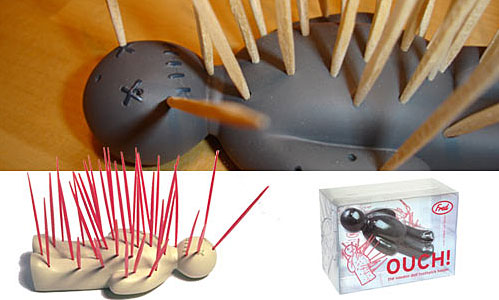
Wednesday, March 08, 2006
Just Think of It
I have seen the future--and it is keyboardless. Dig this:
Researchers in Berlin have come a step closer to developing a device that will enable people to write and manipulate objects by reading their mind.I'm not sure my computers would want to read my mind. They'd never talk to me again. But I digress...
The so-called mental typewriter that translates thoughts into cursor movements on a computer screen will be on display at the computer technology fair CeBIT, which opens in the German city of Hanover on March 9.
...
The teams led by professors Klaus-Robert Mueller and Gabriel Curio have spent several years working on the Brain Computer Interface -- a system which allows for a direct dialogue between man and machine.
Signals from the brain are measured by 128 electrodes affixed to the subject's scalp, similar to an electroencephalogram (EEG). With the help of a software programme, specific signals are picked out among the nebulous mass of information.Insert own joke here.
The computer's self-learning capacity allows it to identify individual brain patters and constantly improve its performance, says Mueller.
"It's like being at a cocktail party when you have to absorb what the person opposite you is saying above the din of music, the clinking of glasses and the sound of other voices," Mueller told Deutsche Presse-Agentur.
By analysing neural signals it is possible to determine before the actual movement takes place whether a person intends to move his or her right or left hand, for example.Well, OK, so it still has a few kinks (and I don't mean Ray and Dave Davies):
"In one session the subject has different groups of letters to his left and right, which he picks out in his mind. After several more steps, he can choose a single letter," says Kaplow.
Another variation allows the thought process on the right side to move an arrow in a circle and that on the left side to click on individual letters.
"This way it takes five to 10 minutes to write a sentence," according to Kaplow.
A lot of time is taken up affixing the electrodes to the volunteer's scalp, a procedure which usually last for about one hour.
Tuesday, March 07, 2006
Houston, We Have an Entree
Get Red Lobster on the phone:
Divers have discovered a new crustacean in the South Pacific that resembles a lobster and is covered with what looks like silky, blonde fur, French researchers said Tuesday.It sounds delicious. I always felt that there were severe limitations to the Linnean system for classifying organisms. I think plant and animal species should be organized by how they taste.
Scientists said the animal, which they named Kiwa hirsuta, was so distinct from other species that they created a new genus and new family for it.
A team of American-led divers found the animal in waters 7,540 feet deep at a site 900 miles south of Easter Island last year, according to Michel Segonzac of the French Institute for Sea Exploration, or IFREMER.
The new crustacean is described in the journal of the National Museum of Natural History in Paris. The animal is white and 5.9 inches long, about the size of a salad plate.
Monday, March 06, 2006
RFID Bites
While I'm not prepared (like one recent author is) to think of RFID as the "mark of the beast" foretold (if that's the right word to use) in the Book of Revelations, I do have to say that I find this to be a tad creepy:
Some scientists at the Catholic University of Leuven have semi-succesfully accomplished an interesting feat—embedding ID information in human teeth.
The ID tags would be used to store personal information about individuals and would enable forensic teams to identify bodies in catastrophic events.
The ID tag being used is an adapted RFID tag, similar to the ones used in animals for tracking purposes. The tag is able to withstand the repetetive biting force, along with resistance to extreme heat and cold, but there are still concerns with the tag being able to withstand the expansion and contraction of tooth due to sporadic heating and cooling.
Thursday, March 02, 2006
So Bee It
Some more totally gratuitous pictures of Miz Lucy:
"Have these parents no sense of propriety?"
 "I feel pensive."
 "Are you talkin' to me?"

"Have these parents no sense of propriety?"
 "I feel pensive."
 "Are you talkin' to me?"
Revoking Editorial License
Yes, this is an Onion story, but, um, in some of my more bizarrely passive-aggressive moments, those of us in the editorial profession do things like this. Or maybe it's just me.
Copy Editor's Revenge Takes Form Of Unhyphenated Word
BOSTON—Bruce Huntoon, a copy editor at Pilot magazine, intentionally did not correct the copy of columnist Justin Mann Monday. "I am tired of that insufferable asshole's mean-spirited jokes," Huntoon said. "So, when he described the carburetor warmer as a 'twentieth century' invention, I decided to leave the copy untouched and let him deal with the consequences of his actions. The fucker." Huntoon said the unhyphenated compound modifier is the most extreme step he has ever taken, adding that he drafted a resignation notice that he will hand in should his superiors notice the omission.
Nanu, Nano
I like this idea. Now if they could only paint cars with the stuff:
NaturalNano has used nanotechnology to develop a type of paint that stops cellphone signals. It’s done by blending particles of copper that are inserted into nanotubes, and then mixing and suspending these tiny particles into a can of paint.
NaturalNano’s idea is to completely block cellphone signals with this paint, and then provide a radio filtering device that will allow wireless signals to pass through only when they’re appropriate. Using this system, a theater owner could allow cellphone signals before the show or during an intermission, but completely block them during the movie.
Preaching to the Quire
So I'm leafing through the print edition of Adweek magazine while snarfing down my 15-second breakfast this morning, and I notice an ad taken out by the Magazine Publishing Association (MPA) purportedly touting the effectiveness of print magazine advertising. It was an insert, two sided, full-color, nicely printed. I had a hunch about something, so I went to the Adweek Web site, poked around a bit and, sure enough, there was no sign of a banner ad or anything from the MPA touting the benefits of print magazine advertising.
This struck me as odd because why on earth do you need to promote the benefits of magazine advertising...in a magazine? It reminded me of a microwave oven I once had whose readout would occasionally flash "Sharp...Simply the Best." They don't have to keep selling me: I already bought the damn thing. (And, truth be told, it simply wasn't.)
If I were the MPA, I would be advertising the benefits of print magazine advertising in many non-print media. After all, it's not the people who read a print magazine that you have to convince--it's the people who avoid print magazines.
This struck me as odd because why on earth do you need to promote the benefits of magazine advertising...in a magazine? It reminded me of a microwave oven I once had whose readout would occasionally flash "Sharp...Simply the Best." They don't have to keep selling me: I already bought the damn thing. (And, truth be told, it simply wasn't.)
If I were the MPA, I would be advertising the benefits of print magazine advertising in many non-print media. After all, it's not the people who read a print magazine that you have to convince--it's the people who avoid print magazines.
Subscribe to:
Posts (Atom)