Friday, November 18, 2005

Talkin' 'Bout Their Generation

These kids today. I have seen the future, and it sounds terrifying. Meet "the millennials."
"Millennials" is one term sociologists use to designate those youths raised in the sensory-inundated environment of digital technology and mass media at the millennium. Unlike Gen X, which referred generally to people born in the 1960s and 1970s, this generation has yet to carry a name popularized by mainstream culture. Also known as "Echo Boomers," as the children of Baby Boomers, millennials were born from the 1980s on.
Members of this generation are thought to be adept with computers, creative with technology and, above all, are highly skilled at multitasking in a world where always-on connections are assumed. Their everyday lives are often characterized by immediate communication, via instant messenger, cellular conversations or text messaging. No member of this generation, it can be assumed, would ever wait on a street corner for a late friend.

The changing ways that members of this generation can learn, communicate and entertain themselves are a primary reason behind the viral popularity of socially oriented technologies such as blogs, wikis, tagging and instant messaging. Children who were born when Netscape Communications went public are now 10 years old and have been raised on a steady diet of digital technologies that have fundamentally shaped their notions of literacy, intelligence, friendship and even the anxious adolescent process of learning who they are.

For their grandparents, the bicycle was a symbol of childhood independence. Today, for many kids and young adults, it is the Internet.

"It consumes my life," said Andrea Thomas, a senior at Miami University. "If I'm not texting my friends over the cell phone, I have my laptop with me and I'm IM'ing them. Or I'm doing research on Google. Honestly, the only reason any one of my college friends use the library is for group meetings."

Thursday, November 17, 2005

This, Too, Is Just Wrong

Granted, I hate "texting" to begin with (and the fact that the word "text" has become a verb), but this is just vile:
Project reduces classic works to text messages

"Romeo, Romeo -- wher4 Rt thou Romeo?"

It could be the future of Shakespeare.

Dot mobile, a British mobile phone service aimed at students, says it plans to condense classic works of literature into SMS text messages. The company claims the service will be a valuable resource for studying for exams.

Academic purists will be horrified. Hamlet's famous query, "To be or not to be, that is the question," becomes "2b? Nt2b? ???"

John Milton's epic poem "Paradise Lost" begins "devl kikd outa hevn coz jelus of jesus&strts war." ("The devil is kicked out of heaven because he is jealous of Jesus and starts a war.")
Look, if you can't be bothered reading classic literature (or anything) the way it was meant to be read, then just don't.

Finally--A Compelling Top 10 List

You can keep your "Greatest TV Moments" or your "10 Sexiest Men," but for my money (even though it's free), a really compelling Top 10 list is LiveScience's "Top 10 Useless Limbs and Vestigial Organs."

This is Just Wrong

Grrrr...
Reaching beyond the grave, and "The Twilight Zone," to hype one of its hits for this month's ratings "sweep," NBC has enlisted the late Rod Serling to introduce a 3-D episode of its supernatural drama "Medium."
I've only heard of "Medium" through articles in The Skeptical Inquirer, because:
The drama is based on the experiences of real-life forensic psychic Allison DuBois, played by Arquette, who helps police solve crimes through her ability to commune with the dead.
"Real-life forensic psychic." So I'm guessing the show involves the "psychic" not actually solving any crimes, just like the "real-life" counterparts.

Tuesday, November 15, 2005

To Mars, Alice!

Sez Wired:
Inside a chamber about the size of a small fridge in Greenville, Indiana, scientists are taking the first steps toward creating human settlements on Mars.

The chamber, called the Martian Environment Simulator, was put together by scientific engineering company SHOT and NASA's Institute for Advanced Concepts. Scientists are using it to determine how to grow plants in greenhouses on other planets, and hope it will eventually aid people living and working on Mars, as well as provide insight to the evolution of planetary life.
Terraforming, it's called. If anyone is even remotely interested, the process (and politics) of Martian terraforming was explored in great (at times laborious) detail in Kim Stanley Robinson's great early 1990s "Mars trilogy" of sci-fi novels--Red Mars, Green Mars, and Blue Mars. They're weighty tomes, and Robinson can get a bit bogged down in technical jargon and minutiae, but it's a dynamite series.

To the Moon, Alice!

Gotta love it when a real estate scheme is shut down on charges of "profiteering and lunacy." I wonder if the pun was intentional, since the real estate in question was on the Moon. Said the company in question (which is a Chinese company): "There is not a law or regulation in China that prohibits the selling of land on the moon." A fair point, perhaps....

It Was Murder--And I Can Prove It (But Only Online)

I confess I've never watched "CSI: Miami" (I used to watch the original "CSI" every once in a while but haven't seen it in a few years--it always struck me as basically "Quincy" only really disgusting and without the saving grace of Jack Klugman) but this seems like the way things are headed, entertainmentwise:
Fans watching "CSI: Miami" on Monday will learn a secret destined to affect a major plotline in CBS' hit drama series. But it will not be broadcast -- the pivotal development will be shown only on CBS.com.

Do You Sudoku?

Maybe I'm behind the times, but I had never heard of "sudoku" until literally one week ago when Judy R. showed me a book of sudoku puzzles. (To the uninitiated like me, sudoku--sort of Japanese for "only single numbers allowed"--is a type of number puzzle in which you enter digits in a grid so that they add up evenly in all directions.) Funny, in the week since, I have suddenly seen sudoku everywhere. New York Times Crossword editor Will Shortz has an essay about sudoku here.

Is this a new thing? I seem to remember these types of puzzles (I think they were called "magic squares") back when I worked for You Know Who and readers would send them in all the time. I could never do them, being somewhat innumerate at the time (I was--and am--far better at crossword puzzles and other word games). Maybe it's time to revisit this sudoku thing.

Sudoku should not be confused with the word "soduku," which is a bacterial disease, and a type of Rat Bite Fever. (And Rat Bite Fever should not be confused with Cat Scratch Fever.)

Please Kill Me

Curious how much caffeine it would take to kill you? Well, check out this handy Death By Caffeine calculator (organized by beverage) and find out. I found out that 114.28 cups of coffee would do me in (hmm...better turn the coffeemaker off). It would also take 361.62 cans of Coke, 204.75 cups of tea, 223.36 cans of Mountain Dew, and/or 390.00 bottles of Snapple Lemon Tea.

It's not just liquids, either. How many Kit Kat bars would be my very real limit? 2,047.50. How many Hershey's Kisses would be the kiss of death? 12,285.00.

There are hours of fun to be had here.

Paper Late

Study: Online newspapers flourish
By Dinesh C. Sharma
http://news.com.com/Study+Online+newspapers+flourish/2100-1025_3-5953393.html

Story last modified Tue Nov 15 09:14:00 PST 2005

Circulation of daily print newspapers may be declining, but Web sites of top newspapers are going strong, according to a new study.

Newspaper Web sites have grown 11 percent year over year to 39.3 million visitors. That increase surpasses the growth in number of total active Internet users, which grew 3 percent, according to data released Tuesday by research firm Nielsen/NetRatings.

Furthermore, almost one out of four U.S. Internet users reads online versions of newspapers, the study said.

Nearly 22 percent of newspaper readers prefer online sources, while 7 percent divide their time between print and online. The majority of readers, 71 percent, still prefer print newspapers, Nielsen/NetRatings said.

Among online newspapers surveyed, NYTimes.com was the top site, with 11.4 million visitors in October 2005. The paper recently reported that subscribers for its fee-based site have reached 270,000 since its introduction less than two months ago.

USAToday.com and WashingtonPost.com came in at No. 2 and No. 3 with 10.4 million and 8.1 million visitors, respectively. LATimes.com and SFGate.com rounded out the top five with 3.9 million visitors each.

"The growth among newspaper Web sites demonstrates that these entities offer unique incentives to visitors," Gerry Davison, senior media analyst at Nielsen/NetRatings, said in a statement.

"Most, if not all of the top newspaper sites offer interactivity such as blogs, podcasts and streaming video and audio. These interactive features, combined with Internet users' thirst for up-to-date information, make newspaper Web sites an increasingly appealing choice for news."

Growth in online newspaper readership comes at the expense of of print editions. The Audit Bureau of Circulations last week reported that newspaper circulation fell 2.6 percent among the top 20 largest newspapers in the U.S. in the six months that ended in September. That's a larger drop than in any comparable six-month period since 1991.

Now With the Great Taste of Fish

Yuck:
For beverage connoisseurs tired of turkey-and-gravy or green-beans-and-casserole-flavored sodas, there's a new choice being offered this year by specialty U.S. soda manufacturer Jones Soda Co.: salmon.

Friday, November 11, 2005

Talk About Multitasking!

Clever strategem or yet another cellphone-obsessed looney? You decide:
These days it seems that some people just can't go anywhere or do anything without a cell phone in their ear

In northern Virginia the police say they're looking for a woman who's been holding up banks while chatting on her phone.

"This is the first time that I can recall where we've had a crime committed while the person was using a cell phone," Loudoun County sheriff's spokesman Kraig Troxell told The Washington Post in a story published today. "The question would be whether anyone is on the other end of the line or not."

Free Virus With Every CD

Thanks, Sony:
A controversial copy-protection program that automatically installs when some Sony BMG audio CDs are played on personal computers is now being exploited by malicious software that takes advantage of the antipiracy technology's ability to hide files.

The Trojan horse programs — three have so far been identified by antivirus companies — are named so as to trigger the cloaking feature of Sony's XCP2 antipiracy technology. By piggybacking on that function, the malicious programs can enter undetected, security experts said Thursday.
What does Sony say? Well, on NPR, an executive said, “Most people, I think, don’t even know what a rootkit is, so why should they care about it?” The Electronic Frontier Foundation has more informtion and a list of CDs that use this copy protection scheme at http://www.eff.org/deeplinks/archives/004144.php. (Whew! I've never heard of 99% of the people on that list.) Y'know, we never had this problem with vinyl records...

Uh Oh: I Smell Spam

This is interesting:
It may sound nuts today, but a San Diego company called Nethercomm is developing a way to use ultra wideband wireless signals to transmit data at broadband speeds through natural-gas pipes. The company claims its technology will be able to offer 100 megabits per second to every home, which is more than enough to provide voice, video and high-speed Internet access.
How will this work?
Nethercomm is adapting ultra wideband radio transmitters and receivers to send wireless signals through the natural-gas pipe at the same time the pipe is delivering gas fuel. Ultra wideband, or UWB, is a developing communication technology that delivers very high-speed network data rates, but at higher power levels it can interfere with other wireless signals.
You have to be careful when sending or receiving flamemail. Ah, but there's one small catch:
These claims have yet to be tested. Nethercomm has no working products and has not tried the technology in the field.
Aside from that, it sounds great! But, nah, I think before this ever takes off, we're likely to see some kind of BPL (no, not Boston Public Library, but rather Broadband over Power Lines), which has at least been implemented in Japan and a few other countries. Not that it's not without its problems, of course (its use of radio waves can interfere with fire, police, and other radio systems).

Now, if they could deliver broadband access via the plumbing, that would be the best solution. You could literally flush spam away.

Where Are the Scalpers When You Need Them?

Truly, the hardest seats to get.
Former Beatle Paul McCartney is planning to broadcast live into space from a U.S. concert to two astronauts circling the globe.

Tiny Envelopes

Hollywood loves giving itself awards:
The National Academy of Television Arts and Sciences, best known for handing out the Daytime Emmy Awards, is expected to announce on Tuesday that it has created an award category to recognize original video content for computers, cellphones and other hand-held devices, like the video iPod and PlayStation Portable.
What's next, the Awards for Programming on a Medium Not Yet Invented?

Thursday, November 10, 2005

The Demon Barber of Fleet Street?

The Guardian says:
Former Financial Times editor Andrew Gowers has poured scorn on newspapers, claiming they will become as obsolete in the future as vinyl records.
Why would he say this? Oh:
Mr Gowers...left the newspaper last week following a dispute with the Pearson chief executive....Mr Gowers, who was editor of the Financial Times for four years, refused to explain what "strategic differences" led to his departure from Pearson.

Mr Gowers went on to accuse "at least half of what used to be called Fleet St" being in denial about the impact of the internet.
The thing is, I don't really disagree with him, but there are less bitchy ways of expressing this. One quote jumped out at me, though:
"The future lies with the internet, and those newspapers that survive will be those that produce truly original content and learn fastest how to translate it into the all-encompassing, all-singing, all-dancing new medium of the web."
"New medium"? Uh, buddy, the Web is a decade old. But he misses the point. What will really put the nail in the coffin for printed newspapers is when, thanks to ubiquitous Wi-Fi, Web-based content becomes as portable as print and, if/when e-paper takes off, you have a portable electronic device that has the same basic form factor of a printed newspaper (for those who want that), but can display current information accessed wirelessly.

And this is not because we're becoming a gizmo-obsessed culture (although we are), but rather because by the time a newspaper is printed, what's in it is largely old news (except for features), and in today's--and especially tomorrow's--world, we need/want information/content immediately.

Now, what may very well happen is that someone may leverage the power of digital, on-demand printing, so that "newsstands" become kiosks that download the latest news and print a newspaper one at a time, as needed. This isn't science-fiction; many books are printed this way.

I say this all as someone who always used to either read or subscribe to a daily newspaper (the Boston Globe when I lived at home, the Daily Orange when I was at Syracuse, the New York Times when I lived in New York, the L.A. Times when I lived in L.A., and the Albany Times-Union when I moved to Saratoga. I occasionally picked up the Saratogian, but the typos drive me crazy, and there was one week a couple years ago when every issue was plagued with font substitutions (I could make a newspaper Courier joke but I doubt anyone would get it). Now, I very rarely get a print newspaper; I check out a whole slew of national/international news sites and blogs and the (lame) Web sites of the Times Union and Saratogian for what meager local news they decide to post. It's just more convenient to check out CNN.com or Yahoo News, and the news is fresher and more current. The only vestige of my previous subscriptions is that I still subscribe to the New York Times Crossword Puzzle--oh, and which I print.

I Think, Therefore IM

Ah, these kids today, with their rock and roll, their hula hoops, and their fax machines:
Instant messaging is emerging as a favorite communication tool among teenagers and young adults, with a good number of them sending more IMs than e-mails, a new survey says.
Nearly 66 percent of 13- to 21-year-olds say they send more IMs than e-mails, compared with 49 percent last year, according to an America Online-commissioned study of instant messaging trends.

Overall, 38 percent of users say they send as many or more IMs than e-mails.

One-fourth of users would like to see entertainment content within IM, while 20 percent want to make phone calls from their messaging service. Already, 33 percent of users send mobile IMs from their cell phones at least once a week. Another 12 percent say they would be interested in an IM-based VoIP service that could replace their primary household phone line, the survey said.

The study is based on a poll of more than 4,000 users, conducted in partnership with Opinion Research Corporation during the last week of September. About 80 million people in the U.S. regularly use IM, AOL said, quoting data from ComScore Media Metrix.

IM is getting popular at work as well, with 58 percent of people using it to communicate with colleagues; 49 percent for getting answers and making business decisions. And some are also using it to deal with clients or "to avoid a difficult in-person conversation." A majority of users at work, 77 percent, feel instant messaging has had a positive effect on their work lives. About 13 percent say they have their IM screen name printed on their business card.

"Instant messaging is a part of everyday life, with more and more people using their IM service as a starting point for all communications," Chamath Palihapitiya, vice president of AIM and ICQ at America Online, said in a statement. "Usage is spiking, and not just among teens. Parents, grandparents and professionals are all using instant messaging to stay in touch and enhance their day-to-day communications."

"No, Mr. Bond, I Expect You to Quit!"

Sounds like an updated version of the Stephen King story "Quitters Inc.":
Quit smoking with lasers?
A smoking cessation center in Wuhan, China, is using laser beams to treat smokers' physiologic dependency on nicotine.

New News

The plot thickens:
Microsoft is teaming with The Associated Press to offer an advertising-supported online video news network in the first quarter of 2006, the companies announced yesterday.

Microsoft will supply the technology, video player and advertising support to the network, while AP's broadcast division will provide the video, which will feature about 50 different stories per day. AP, the world's oldest and largest newsgathering organization, originally announced plans to develop the venture after a board meeting in July.

Good Resource

In addition to the Publishers Information Bureau, I came across a service called Magazine Health Watch, which tracks consumer and B-to-B magazine advertising, updated daily.

Hearst So Good

Folio.com has a good interview with the director of editorial operations for Hearst magazines, discussing, among other things, the insourcing of prepress work. Funny, we were doing that at Micro Publishing News eight years ago.

Wednesday, November 09, 2005

Perfect for That Billy Barty Film Festival

Or perhaps The Terror of Tiny Town.

The 22nd annual Flat Information Displays conference in San Francisco this week showcased the latest advancements in LCD, plasma and projection technology. Among those on hand was video display maker eMagin, which has created microdisplays smaller than a quarter to power stereovision goggles for viewing movies, games and other content in 3D.

This is a Reach

I've never liked those "greatest moments" countdowns that cable channels love to run, but even sillier is the Webby Awards' "10 Web moments that changed the world." Can the Web be said to really have "moments"? I mean, you can make the argument that "a great TV moment" is something that can exist (at least in the past) because you had lots of people all tuned in at one time, watching something more or less live, like the Moon landing, the M*A*S*H final episode, or the premiere episode of Manimal. You know, some event that bonds us all together in some transient facsimile of a community, and thus these "great moments" become communal events. But the Web doesn't operate like that (and TV may not operate like that for much longer either); it's a serial medium in which people access it piecemeal at random times.

Anyway, the list really is a set of colossal reaches. The dot-com boom and bust? Can something that took place over six years really be considered a "moment"? "September 11th"? "Millions of Americans Turn to the Internet for Information About the Tragedies." Millions more turned to TV and even newspapers. So what? "Asian Tsunami"--"Citizens Journalists Are the First on the Scene to Document the Tsunami." Huh?

And if these are truly the greatest Web moments, then I'm getting offline now and moving to the Unabomber's cabin.

When in Rome...

Don't be mean to goldfish:
[T]he plight of the little goldfish is especially harsh. The tiny creatures are scooped into plastic bags and awarded at carnivals and fairs. They are confined to bowls where they can do nothing but swim around and around. Some (it has been claimed) go blind.

No more. The municipal government of Rome has entered waters where few city halls dare tread. Under a new ordinance, the city's goldfish are entitled to a proper, full-sized aquarium, and they can no longer be given out as contest prizes.

The rules were drafted by the city of Rome's Office for Animal Rights. The 59-point statute ordering better treatment for all pets, from cats and dogs to birds and lizards, was approved by the City Council last month and will go into effect today.
I really don't want to know how they're going to enforce this. And, yes, PETA has such a thing called the "Fish Empathy Project." I'm sure it's well-meaning, but it sounds a tad silly, doesn't it? They were also the ones who tried to get the town of Fishkill, NY, to change their name, not realizing that "kill" is actually the Dutch word for "creek."

Mind you, it's not that I have any propensity for abusing or harming animals; after all, one should have respect and empathy for all living things (the hornets in the front bushes are on their own, however). Still, I'd like to see more efforts to prevent cruelty to other humans. Once we can get that figured out, then we can worry about the animals.

Looking for Humans in All the Wrong Places

It's funny: everyone has a cellphone and is so obsessed with being reachable anywhere and everywhere they go, and whenever they go there, and yet I can't remember the last time I called someone--anyone, cell or landline--and didn't get voice mail. It's a paradox: everyone is obessed with being reachable and yet by constantly being on the phone they make themselves even more unreachable to everyone trying to call them. So it sounds like cellphones don't really solve the problem everything thinks they're solving.

I don't really know what that all means, but it was just something that occurred to me when I read on Dr. Joe's blog about a Web site for those sick of voice mail hell: "Find a Human," which compiles detailed instructions for getting a human being at a variety of different companies, organized by industry. Most impressive is the listing for Amazon.com; it once took me 45 minutes of Googling to even get a phone number for Amazon.

JPF

Or "Just Plain Freakish," from the Japan International Cycle Show.

Eek!

Male mice may serenade prospective mates at pitches about two octaves higher than the shrillest sounds audible to people.
Ah, so that explains why female mice get aroused when I play my old Rush albums.

Funny Business

This is interesting:
Women and men are often perceived as having differences in their senses of humour but, until now, there had been no neurological evidence for such suspicions. The new brain scanning study showed that although men and women tended to agree on which of the single-panel cartoons they were shown were funny, they processed the humour differently in their brains.
...
[M]en and women shared many similarities: they mostly found the same cartoons funny or unfunny; they activated the same semantic and language processing regions of the brain; and the response times for finding a cartoon funny was the same.

However, they were surprised to find differences in the part of the brain known as the reward centre. The nucleus accumbens, part of the mesolimbic reward centre, is a dopamine-rich area that is most strongly activated when a reward – in this case, a funny joke – is unexpected.

The team discovered that when women found a cartoon funny, their reward centre was more active than for men, suggesting the females’ expectation of being amused was lower. But when men found a cartoon unfunny, they showed de-activation in their reward centre, suggesting disappointment.

Azim suggests the differences may be the result of the genders having different ways of processing emotional information, and that better understanding of these differences could provide insight into mental illnesses that affect one gender more than the other, such as depression.
But what's keeping neurologists from that all-important "Three Stooges" study?

Silent But Deadly

Insert own joke here.
The traditional way the army delivers orders to soldiers is by shouting at them. But researchers at the University of Southern California in Los Angeles think the US Army Research Office should consider an alternative – coded smells.

These can be delivered silently, in the dark and when loud noise is drowning out speech. Furthermore, says the USCLA patent, the immediate reaction to a smell is emotional, rather than rational, so an odour trigger may encourage people to carry out orders without question.

Pictures filed with the patent show how the researchers used a collar, like a gun belt, which hangs round a soldier’s neck. The collar has a dozen cartridges, each containing a wick soaked in smelly liquid, a valve and a small propeller fan. Remote radio signals open selected valves and kick fans into life.

A soldier could be trained to associate specific actions with unmistakable odours. This would allow the smells to be used to jog memory – if you smell this, do that.

The system could also make training more realistic, with soldiers getting whiffs of desert dust, sea water or mud that are synchronised with audio and visual cues. The collar is close to the wearer's nose, so the effect is immediate, and rapidly fades when the valve is closed.

The same technology can be used to enhance audio-visual entertainment, the patent suggests. Smellivision, anyone?

Lead Astray

I knew eating a lot of chocolate could make you gain weight, but I thought it was due to calories. But, no:
Chocolates are among the more lead-contaminated foods. A new study has probed the source of chocolate's lead and concludes it's not the cocoa bean.
...
Even after completion of the study, however, the major source remains unidentified, notes study leader Charley W. Rankin of the University of California, Santa Cruz. That's too bad, the environmental chemist says, because since it's nevertheless obvious that most of chocolate's lead isn't from cocoa beans when they're picked, the contaminant should be easy to eliminate—once scientists pin down at what stage of chocolate production it originates.

How serious is the lead problem? "I'm not going to suggest that you curb your chocolate consumption," says Rankin. For most people, he says, the amount of lead in even the more-tainted chocolates isn't high enough to cause health problems. However, he worries, for young children or elderly individuals living with lead-tainted pipes or paint, eating lots of chocolate could aggravate health risks by offering an unnecessary additional source of the metal.

Most other people, he says, can take heart in the many research studies suggesting that the constituents of chocolate offer a host of health benefits. Indeed, Rankin concludes, unless taken in excess, "chocolate may actually be pretty good for you."

Gunn Control

Uh, oh. I sense an impending family emergency:
Amtrak's board called a meeting for Wednesday and plans to fire President David Gunn.

Auto Autos

The optimistically named 12th Annual World Congress on Intelligent Transport Systems has some glimpses of the future of driving (or, at the least, parking):
cars are communicating with each other, parallel parking themselves and employing automatic, radar-based braking.
I like the automatic parallel parking idea; my parallel parking is decidedly non-Euclidean.
Another technology, which may take a few more years to fully deploy, is vehicle-to-vehicle communication. Using the upcoming 802.11p wireless standard, General Motors equipped two cars with wireless transponders that broadcast various pieces of information such as speed and braking status to nearby cars. When one car brakes in front of another, even one down the road and out of sight, a small icon on the dashboard of the trailing vehicle indicates a stopped automobile up ahead.
In New York City, they are going to implement communication technology that automatically transmits profanity from car-to-car. When one car cuts another off, a dashboard light in the shape of an extended middle finger illuminates.

Tuesday, November 08, 2005

Convergence Diverges

Spent the day at ad:tech in NYC today, a 10-year-old trade show/seminar/expo/human anthill dedicated to the latest trends and technologies in advertising, marketing, and media. I sat in on only two sessions (including the future of media) and prowled the show floor(s)--the number of Search Marketing companies has got to have hit critical mass by now. As I was looking through the show guide and reading about all the sessions held during the three days of the show, not a single mention was made of print. Granted, the focus of the show is "digital media marketing," but one of the big themes is also convergence and multichannel marketing (and print is a channel), and yet the only mention made of print was in a session on e-mail marketing in which e-mail marketers can use postcard mailings to get people to update their e-mail addresses (apparently in one case this reduced the number of bouncebacks from 19% to 1.4%). And even then it wasn't called "print" but rather "offline marketing."

Funny thing, though: in printing industry shows and other commentary, customized, personalized, and variable-data printing is supposedly gaining such huge traction among advertisers and marketers, and yet the premier show dedicated to the advertising and marketing industry had absolutely nothing to say about it. The big topics in the industry now are e-mail marketing, search marketing, and metrics--codifying new ways of measuring ad hits (yep, electronic ads).

There was a ton of info in the Future of Media session and I'll blog about that in the coming days. So consider yourself warned.

For lunch, I had a corned beef sandwich the size of a throw pillow at the Stage Deli. I feel like that python that burst after eating that alligator (which I blogged about a month or so ago).

Autoresponder Madness

Is there any reason why an e-mail server would allow someone to enable two different autoresponders simultaneously?

Christmas is Coming

Don't know what to get that special someone for Christmas? Have an extra fifty grand burning a hole in your pocket? Why not try a talking, life-size Robby the Robot, co-star of the 1956 sci-fi classic Forbidden Planet, only $49,999 from Hammacher-Schlemmer. For an extra $1,000, they'll even throw in the secrets of the Krell (monsters of the id sold separately).

Monday, November 07, 2005

Even More Convergence

Business Week Online has a whole special section devoted to the emerging "broadband television." I haven't been through it all yet, but it provides a nice foretaste of what we can look forward to (or dread, as the case may be) in the coming years as television undergoes the most dramatic makeover in its history.

Let the Convergence Begin

Yahoo Inc. and TiVo Inc. are teaming up to blend some of their services, a move that further fades the lines between offices and living rooms, TVs and PCs.

Under a partnership announced Monday, the two will collaborate to offer Yahoo's Internet-based content and services through TiVo's digital video recording devices.

Users of Yahoo's TV page will be able to click on a record-to-TiVo button directly from a television program listing to remotely schedule recordings.

And in the coming months, possibly before the end of the year, Yahoo's traffic and weather content, as well as its users' photos will be viewable on televisions via TiVo's broadband service and easy-to-use screen menu.

Venus Envy

Europe's Venus Express spacecraft blasts off this week, and will rendezvous with our nearest planetary neighbour next year to study it from orbit.

The mission aims to shed light on an enduring mystery about this world: how a planet so similar to our own in size, mass, and composition has evolved so differently over the last 4.6 billion years.
Say what you want about NASA, but they sure know how to name things. Apollo, Gemini, Mercury, Voyager, Viking. I would have thought that Europe would have had more of a touch of the poetic and grand about them. But "Venus Express?" It sounds like a subway line. And I can't take the express; I have to take the "Venus Local" so I can get off at 49th Street.

"I'm a Naughty Boy!"

After having worked with Forrester Research on a project, I think I know who their founder was...

Beep Beep

From today's LATimes.com:
Within about two years, the first car able to autonomously drive on freeways will be a reality, predicts Sebastian Thrun, Stanford University's guru of robotic cars and the winner of the Pentagon's Grand Challenge race in October.
...

At one time, futurists envisioned massive networks of computers running society, but they missed foreseeing the personal computer and the Internet. The ability of individual cars to drive themselves without an intelligent highway network may represent the same conceptual mistake.

The Grand Challenge results this year were a real breakthrough, demonstrating that individual cars could successfully use satellite guidance, artificial vision and complex software to navigate around obstacles, away from ruts and through tunnels.
...
The car, named Stanley, was equipped with a global positioning system, a series of laser range finders and a video camera, all connected to a computer that made decisions about how to navigate the course.
...
No doubt a human driver could have beaten the car's time, because people can still handle a steering wheel more adeptly than a computer can. But perhaps not for much longer. For decades, the best chess players could beat computers, but no more.
...
Nonetheless, Thrun hopes that within two years his team will be able to build a car capable of autonomously navigating a moderately crowded freeway in the Bay Area.

Stability control systems and adaptive cruise control systems already show that car computers can make critical decisions.

But complex tasks such as merging onto a freeway or making left turns in traffic are significant challenges, Thrun admits.

If they ever do get on the road, such cars could transform society. Imagine a commute where you were free to work, read or perform other useful activities as your car drove you to work. [emphasis added]
Wait--people do that already!

I like the idea of a robotic car, being much more sanguine about artifical intelligence than natural stupidity, but given how flaky computers can be, I'm not sure I trust them to drive millions of cars. Sure, computers successfully fly jet planes--but they're extremely sophisticated and far more reliable than anything that would be cost-effective to mass produce for automobiles.

Besides, with my luck I think the end result would be more like the 1977 movie The Car.

Extra Extra

This is not good news for the newspaper industry--which has been beset with little more than bad news for quite some time:
Average weekday circulation at U.S. newspapers fell 2.6 percent during the six month-period ending in September in the latest sign of trouble in the newspaper business, an industry group reported Monday.

Sunday circulation also fell 3.1 percent at newspapers reporting to the Audit Bureau of Circulations, according to an analysis of the data by the Newspaper Association of America.

The declines from the same period a year ago show an acceleration of a years-long trend of falling circulation at daily newspapers as more people, especially young adults, turn to the Internet for news and as newspapers cut back on less profitable circulation.
It's not all the Internet. Newspaper circulation actually peaked back in 1988--and it's been nothing but downhill ever since. Blame the one-two punch of cable news and the Internet, combined with generational changes in how people get news and other content. Expect circulation numbers toget even worse.

Oh, and I meant to blog about this last week, but was swamped with Project From Hell:

Newspaper Ad Circulars Find Their Way Online
Gannett, one of the nation's biggest newspaper publishers, said it would introduce a new service on its newspaper Web sites next month that displays banner ads that readers can expand into a virtual version of the weekly local circulars so familiar to offline newspaper readers.

Industry executives said the service, called PaperBoy, devised by a unit of Gannett called PointRoll, would give national advertisers a way to reach online readers in local markets with promotions tied to neighborhood stores.

Newspapers are trying to protecting their turf from Google, Yahoo and other Internet companies that have moved more aggressively to serve local information and ads to readers.
This isn't that surprising. Even Clipper Magazine and those Val-Pac coupons that come in the mail have URLs that drive coupon clippers online to get even more coupons. And I'm told the venerable Entertainment book has an online component, too.

It must be a sign of getting older: I have actually started clipping coupons from those Val-Pac mailings. My problem, though, is that they come addressed to "Smart Shopper" and it took me a while to stop writing "Addressee Unknown" on them and putting them back in the mailbox.

Floored by Electronic Displays

Oh, the jokes one could make:
Technology firm Intellimat has patented a computer mat less than an inch thick that will turn retailers’ floors into yet another space for brands to advertise.
A floormat computer display. A nice idea for the office. Hmm. I just stepped in something unpleasant. Let me open Microsoft Word...

Seriously, though, in the past (even the present), floor graphics were a hot application for large-format printing, and now--like other types of signage--there is increased competition from electronic alternatives. Wait until vehicle graphics go electronic; I guess that day will see the end of my dreams for a drive-through large-format printer.

Radio, Radio

Uh huh:

Terrestrial broadcasters insist they’re not nervous about satellite radio’s 7 million subscribers, but they’ve successfully stalled Arbitron’s plan to add satellite and online radio listening to its diary measurement system.

Arbitron was originally scheduled to instruct its diary keepers to record their satellite and online radio listening in the fall 2005 book. Instead, Arbitron now plans a 25-market test of the process in February and will delay full implementation until summer 2006, at the earliest.
Arbitron said the change is a response to the concerns of the National Association of Broadcasters’ Local Radio Audience Measurement Committee and the Arbitron Radio Advisory Council.
In 2003, I was tapped by Arbitron to keep a radio-listening diary for a week and aside from the occasional SU game radio broadcast, the only listening I recorded were a few Internet radio stations (I don't know if I was supposed to list them, but no one came and frog-marched me into the street for doing so).

Actively preventing companies from developing metrics for new media (or even new media derivatives of old media like new firms of "radio") seems like a really short-sighted, almost Sgt. Schultz-like approach ("I know nothink!"). I expect this will come back and bite broadcasters in the butt. (Arbitron has already developed a means of measuring podcast listenership--I'd love to see that data.)

It's funny; every few months (when I occasionally make the mistake of answering a call that reads "Unknown" on my caller ID) I get a call from some research company that wants to survey me about my radio listenership. I always tell them before beginning that I do not listen to terrestrial radio, preferring Internet radio. They thank me, and hang up. While I'm thankful for this, it also seems really short-sighted. Granted, these are just hired script-reading interviewers and not the constructors of the survey, but I think it would be immensely useful to those developing these surveys to ask questions about the extent to which--and why--certain respondents may not listen to terrestrial radio. Of course, this presumes that the survey commissioners have any real interest in finding out these things.

Fowl Threats

With hysteria over the avian flu on the rise, KFC has sprung into action:
Amid rising fears of a bird flu pandemic, Kentucky Fried Chicken is preparing a consumer education plan to reassure customers that it’s safe to eat chicken.
In particular, I like the idea of a Tamiflu dipping sauce.

Sunday, November 06, 2005

Saw This One a Mile Away

Purveyors of porn and entrepreneurs who spied a niche when Apple Computer Inc. unveiled its video-playing iPod are proving that sex even sells in tiny packages — especially when it is portable.

One online social network of amateur pinup girls said it logged 500,000 downloads of the sexy "featurettes" — three- to five-minute video clips — in the first 24 hours targeting the new iPod-toting crowd.

Sticky Wickets

Two headlines on Yahoo! News stood out this morning:

Man glued to toilet seat, sues store

Jury Rules Against Woman in Genital Gluing

Is there an epidemic of gluing going on? Will it be long before we see proposed bans on SuperGlue?

The Swarm

So I come home from Syracuse last weekend (yet another loss--don't even get me started; apparently you can't spell "suck" without "SU") and I find the front of the house teeming with ladybugs. Now, my life has been a never-ending battle with creatures of all kinds, be they ants, bats, etc., but ladybugs have never usually bugged me (as it were). While I acknowledge that ladybugs are "helpful" insects in that they feed on other insects that are considered pests (notably aphids), and that they are completely harmless to humans, I still have a hard time with swarms of things.

So what was up with the ladybugs? I went to the Internet and found out that at this time of year, ladybugs (or ladybirds, as they have more historically been called) seek out warm places in which to hibernate for the winter and as a result attach themsleves to the warm sides of houses and seek entry (happily, they have yet to find it).

I also wondered if the swarm was what the flock of bluejays in the from yard were frenziedly feeding on (yes, it's like bloody "Wild Kingdom" around here) but I had forgotten that the bright red coloration of ladybugs is asosematic, which means that they are colored in such a way as to announce to potential predators that they are poisonous if eaten. (This is a common warning system in the animal kingdom--most notably among frogs--and is a rather clever bit of evolution; after all, it's a good idea to tell a creature that you're poisonous since it does an organism no good whatsoever if the animal that eats it later dies.) Ladybugs are not poisonous, but some species have evolved asosematic coloration to fool would-be eaters. (This differs, I would imagine, from asosemitic coloration, whereby species evade predation by dressing as rabbis.)

The suggestion was made to me the other night that I could collect the ladybugs and sell them to gardeners; after all, you can buy ladybugs commercially to put in your garden and get rid of aphids or other pests. (Apparently, you are supposed to spray them with Coke so their wings get all syrupy and sticky and they can't fly away, which sounds a tad cruel to me.) However, not all ladybug species eat aphids (there are more than a dozen species of ladybug, all of which eat different things--some actually eat mold and mildew) so I'd have to make sure that the ones I've got eat the right pests. I'm not sure how I would so that; maybe have menus printed up with a variety of insects on them, distribute them to the swarm, and see which they order.

One particular species of ladybug had its origins in China and some rumors have had it that they were brought to the U.S. in an attempt to de-pest a particular area--and, just as is inevitably the case when people try this, the ladybugs eventually became the pest. However, entomologists have disputed this story and are of the opinion that the ladybugs simply came over as most things do--on boats, planes, etc.

And that's everything you ever wanted to know about ladybugs.

So what were the bluejays feeding on? I still don't know exactly, but I did discover yesterday, hidden in the bushes in the front of the house, a hornet's nest the size of a beach ball. Fortunately, at this time of the year, hornets' nests die out and the dead bugs within are left to be eaten by birds. Which may explain what the jays were doing.

Y'know, I'm suddenly nostalgic for New York City...

Google vs. Wal-Mart

Ah, like the great battles of old--Greeks vs. Trojans, Allies vs. Axis, Godzilla vs. Megalon--Wal-Mart finds itself eyeing Google warily, sez today's NYT:
The worry is that by making information available everywhere, Google might soon be able to tell Wal-Mart shoppers if better bargains are available nearby.
Well, duh. This is one of the best things about e-commerce, the ability to comparison shop very easily (in addition to not having to go anywhere).

Of course, it's not just Wal-Mart:
As Google increasingly becomes the starting point for finding information and buying products and services, companies that even a year ago did not see themselves as competing with Google are beginning to view the company with some angst - mixed with admiration.

Google's recent moves have stirred concern in industries from book publishing to telecommunications. Businesses already feeling the Google effect include advertising, software and the news media. Apart from retailing, Google's disruptive presence may soon be felt in real estate and auto sales.
Google, the reigning giant of Web search, could extend its economic reach in the next few years as more people get high-speed Internet service and cellphones become full-fledged search tools, according to analysts. And ever-smarter software, they say, will cull and organize larger and larger digital storehouses of news, images, real estate listings and traffic reports, delivering results that are more like the advice of a trusted human expert.
One bit of related info from this story:
Search engines, combined with other technologies, have the potential to drive comparison shopping down to the shelf-by-shelf level. Cellphone makers, for example, are looking at the concept of a "shopping phone" with a camera that can read product bar codes. The phone could connect to databases and search services and, aided by satellite technology, reveal that the flat-screen TV model in front of you is $200 cheaper at a store five miles away.
A nice idea (and I'm certain something like it will happen), but I have my doubts that stores will allow their customers to easily access this kind of information.

Friday, November 04, 2005

ESkype from Verizon

One unfortunate consequence of my move is that I get very lousy cellphone reception in my house--a problem I never had in the previous two places I lived. Reception is best when the weather is clear (I had actually made a point of checking this before I bought the place--naturally, the weather was perfect those days).

As a result, I have been using SkypeOut--Skype's service where you can call land and cell numbers via VoIP. It's not free, but rates for domestic calls (and even most European calls) are 2.1 cents per minute. I think it works extremely well; I've been using it for all my outgoing calls for the past week and it's worked flawlessly (the only weak link is my flaky Logitech USB headset). The only drawback is that conference call systems don't recognize confirmation codes entered via the on-screen dialer. Doh!

I even tried SkypeIn, which allows land and phone lines to call my Skype. My initial foray (as Judie can tell you) was less than successful, primarily, I believe, because the headset flaked out.

It's all a work in progress, but I'm becoming sold on Internet telephony.

Thursday, November 03, 2005

Rate This

If you've ever wondered how your life rated, well, here's your chance to find out. While I prefer the Siskel and Ebert "thumbs up/thumbs down" approach, I managed a 5.5.

Tuesday, November 01, 2005

The Real Mobile Office

Hmmm:
Ford Motor Co. says it will soon offer wireless mobile offices in its F-series pickups, an option aimed at building contractors and others who do business on the road.

A Ford F-250 Super Duty truck equipped with a mobile office is scheduled to debut Tuesday at the Specialty Equipment Market Association show in Las Vegas. The annual show isn't open to the public, but it dazzles an estimated 100,000 automotive insiders with souped-up vehicles and the latest aftermarket trends and components.
My question: could you tailgate these trucks and tap into their wireless networks?

Tuesday, October 25, 2005

Card Sharks

A business card is now no longer a small paper rectangle with contact info, but rather a disposable multimedia device that can store up to 1 GB of audio or video.
The rCard is the size of a credit card (3.5 inches by 2 inches) and just over a tenth of an inch thick. It has its own navigation button and viewing screen and supports AVI, MPEG, MP3, WAV, Flash and Quicktime files. The battery can last for up to four continuous hours of use.
I like the idea: now I don't even have to go to meetings anymore; I can just send my card. This may be useful if only to answer the question one inevitably asks when one finds a business card in one's desk: "Who was this guy again?"

Ah, but wait 'til e-paper business cards hit the streets. Woo hoo!

Mobile Silliness

If you thought people on Segways looked dorky, check out this thing that Toyota came up with.

By the way, I will never forgive Segway for their spelling--now people think the word "segue" is spelled "segway." Grrr.

The Future Ain't What It Used to Be

Wired has some top trends for 2006. I disagree with almost all of them.

"We've done 20 years of adding functionality, and 99 percent of that functionality isn't needed," Pearson said. "There will be an enormous market over the next several years for really simple stuff."
If this were the case, Microsoft Word would be as streamlined as it was a decade ago (and even then it wasn't very). And people love their camera phones (there's no accounting for taste). And seeing how many Blackberries and Treos I saw at a recent conference in NYC, folks like the idea of not having to schlep a lot of devices around with them.
How about mapping programs that show us whether anyone we'd like to see is nearby.
No!
R.I.P. combustion engine
I don't envision this happening for at least a generation--if at all. Once the current gas crisis (if anyone even thinks of it as such anynore) ebbs, it's back to the SUVs. Yes, the 1970s gas crisis (which was much worse than what we're experiencing now) ended the age of the Lincoln Continental and those huge 1970s cars and brought about the compact car craze, but a decade after that it was huge hulking vehicles again. We all have very short memories.
Futurists have been warning about our over-consumptive, pollution- and nonbiodegradable-waste-generating ways for decades. Lately, those warnings are getting more strident
Nah, it'll take some horrible crisis to change anyone's behaviors and I suspect any changes will be short-lived.

At Last! A Laptop for Marlon Brando

Good grief:
Samsung has already shown its upcoming 19-inch laptop to CNET Reviews. The product is expected to ship later this year. Dell, a major partner of Samsung, could easily adopt the large screen format for its high-end XPS laptops. And, LG Philips is also touting its 20-inch LCD displays for laptops.
I would hesitate at calling these things "laptop" (or actually using them as laptops) unless you never want to be able to conceive or bear childen.

Department of Internet Irony

Got this e-mail message last night:
I'm unable to get an Internet connection to send report to you.
Will try again in the morning.
Think about it...

Long Time No Blog

As I was in the process of moving, I was in "e-mail blackout mode" as Internet access existed at the old location but not at the new, until Monday. I am now wired (soon to be wireless) and ready to start blogging again.

Consider yourselves warned.

Tuesday, October 18, 2005

MIA?

Consider yourselves lucky: I am in the process of moving this week and will be light on blogging (or so I say now). Between Thursday and Monday, e-mail access will be sporadic, as Time-Warner insists I can't be entrusted to plug in my own cable modem without parental supervision. I guess I'll have to cruise around my new neighborhood and see if anyone has an unsecured wireless network...

Saturday, October 15, 2005

Walking and Talking

From the "Why Would Anyone Think Of That?" file:
Researchers at the VTT Technical Research Centre of Finland have developed a prototype of a cell phone that uses motion sensors to record a user's walking pattern of movement, or gait. The device then periodically checks to see that it is still in the possession of its legitimate owner, by measuring the current stride and comparing it against that stored in its memory.
Some limitations, tho':
wearing high heels, suffering an injury foot and, especially, having a few drinks, are activities likely to set the device off by accident. "You would need to either turn it off before you start drinking or make sure you remember your password"
And if you wear high heels, suffer a foot injury, and have a few drinks all at the same time, the thing may just explode.

Steroid Use and Home Run Hitting

I'm not a baseball fan (but the way college football is developing this season I may decide to become one) but I came across this article from an economist that aims to demonstrate that steroid use by baseball players has not improved home run hitting. In fact:
there have been no fundamental changes in home run hitting in MLB for over 40 years.

Delivery Failure

Return Path, an e-mail marketing firm, has been tracking the deliverability statistics of opt-in e-mail blasts for several years and the numbers just don't seem to improve hugely:
Top ISPs and web-based email providers did not deliver 21 percent of permission-based emails to consumers’ inboxes during the first half of 2005, according to a new Return Path email deliverability study. In 2004, 22 percent of permission-based email was not delivered to consumers’ inboxes.
Remember: this isn't spam we're talking about, but e-mail subscriptions that people have deliberately signed up for.

Score 1 for print. Say what you want about the Post Office, but print direct mail gets delivered more than 99% of the time.

Ooh, Scary, Very Scary

...as Count Floyd would say.

I can't wait until our alarmist media gets their chops on this one (story from Ad Age): an alarmist new book touting all the scary consequences of RFID (Radio Frequency Identification, tiny electronic chips embedded in packaging and other wholesale and retail items to be used primarily for inventory management). That's right, folks: another thing to be Really Really Scared Of, for no real reason--even the title is needlessly Orwellian: Spychips: How Major Corporations and Government Plan to Track Your Every Move with RFID. Honestly: does anyone think that companies have nothing better to do that track people's every movement? Think about the logistics of handling that much data. How on earth could that ever be useful? As for the government, well, they have a hard enough time tracking a big-ass hurricane approaching the Gulf States.

So what evidence does the author give for the impending Big Brother scenario?
Despite assurances that it has no current plans to track consumer behavior with RFID, P&G filed for a 2001 patent titled “Systems and Methods for Tracking Consumers in a Store Environment,” the book says.
The key words, I suppose, would be "in a store environment." Hmm. A technology for tracking consumers in a store. How terrifying. You mean store managers might actually know where in the store I am? Good! It's hard enough attracting sales help as it is.

I admit I have not read the book (I probably should but I really don't want to) but I have been following the development of RFID a bit and it doesn't sound to me like the chips are powerful enough to do all the nasty things the author asserts. Yes, some have anticipated some modest consumer-tracking applications, but it mostly has to do with inventory managenment and theft prevention, and nothing more extreme than what retailers already do with loyalty programs and discount cards. And I honestly have no real objection to Price Chopper knowing how often I buy ketchup. In fact, I wish stores did a better job of tracking my purchases--it might ensure that the things I want to buy are actually in stock. (Best Buy, for example, has the uncanny ability to determine exactly what it is that I am looking for and go to extreme lengths to ensure that they don't have it.)

But wait--we get to the end of the story:
A second edition of her book due in January links RFID to the “mark of the beast” in the Book of Revelations.
Seriously. OK, so much for credibility. (Reading the user comments on Amazon, the book's fans seem to be Apocalypse fans and the usual crowd that has the date of the Rapture on their wall calendars. Well.)

There are always downsides and unintended consequences to any technology, but lunatic books like this really don't do anyone a service. Whenever we see books or news stories touting all sorts of doomsday scenarios, there are a few things we need to immediately ask: Does the author have an agenda? Do the author's claims make sense from a technological standpoint? Do the author's claims make logical sense?

Yes, there are things out there to be scared (or at least dubious) of. But let's not blow things out of proportion--like the news story I once saw with the headline "Salad: The Silent Killer." If I may quote a Rush lyric, "The things that we fear are a weapon to be used against us."

Friday, October 14, 2005

Saw This One Coming

But then, who couldn't? CNN again:
Podcasting is on the verge of setting off a video revolution and users of Apple's new video iPod can expect a deluge of outspoken commentary, religious sermons and pornography.

Better, Faster, Ruder

From CNN:
A slippage in manners is obvious to many Americans. Nearly 70 percent questioned in an Associated Press-Ipsos poll said people are ruder than they were 20 or 30 years ago. The trend is noticed in large and small places alike, although more urban people -- 74 percent -- report bad manners, then do people in rural areas, 67 percent.
...
Sienkiewicz, whose job requires hours in a car, said she tries to avoid rush-hour traffic because of drivers with a me-first attitude. The most common complaint about rudeness in the poll was aggressive or reckless driving, with 91 percent citing it as the most frequent discourtesy.
I heartily concur. I think our techno-society, with it's "whatever-we-want-whenver-we-want-it," is making us a nation of obnoxious spoiled brats. And don't even get me started on the driving thing; even in the eight years that I've been driving, I've seen courtesy go wa-a-a-ay down, to the point where no one even bothers staying in their own lane anymore (even when they're not on cellphones).

If people get any worse I suppose I can take some comfort in the fact that at least thanks to the Internet I don't have to leave the house all that much anymore.

Take That!

For those who are always at a loss for what to say when called on in meetings, try the Biblical Curse Generator.
Harken, thou wayward winebibber, for you will be whipped with a thousand scorpions!

When Databases Attack

Got a very weird Amazon promotion, the likes of which I hadn't seen in a few years:
We've noticed that customers who have purchased Farscape - Season 4, Collection 2 also purchased The L Word - The Complete Second Season on DVD. For this reason, you might like to know that The L Word - The Complete Second Season will be released on October 25, 2005 on DVD.
Let's compare and contrast:

Farscape:
American astronaut John Crichton (Ben Browder) is flung through a wormhole and comes out in the midst of an interstellar prison escape on the other side of the universe. When the galactic cops (called "Peacekeepers") mark him as the new public enemy number one, Crichton is forced to ally himself with the convicts: hulking warrior D'Argo (Anthony Simcoe), blue-skinned priest Zhaan (Virginia Hey), fugitive peacekeeper Aeryn (Claudia Black), exiled king Rygel (Jonathan Hardy), and Pilot, the giant insectlike nerve center of their living ship, Moya.
The L Word (which, I admit, I've never heard of):
Set in the chic world of Los Angeles, this humor-laced dramatic series explores the lives of a group of lesbians, their friends, family and neighbors. The series takes a smart, sexy and fun look at the hopes, dreams and lives of these people as they deal with things like career struggles, relationships and the pressures of tying [sic] to start a family.
Granted, L.A. is another planet entirely, but still...

Tuesday, October 11, 2005

Santa Claus is Coming to Town


Now I know what to get the niece/nephew when s/he arrives. Only $12.99 from Amazon. Hours of fun! Almost as good as the toystore on 31st St. in Queens that always had, in the window, a little Fisher-Price toy called "My First Fax Machine." Creating the joyless proles of tomorrow!

Saturday, October 08, 2005

Sigh

That's it; I'm going to grad school just so I can have a new alma mater to root for:
Syracuse University's feeble offense is relocating rock bottom for a football program in grim freefall.

The University of Connecticut shoved the Orange down a deepening hole with a 26-7 Big East Conference victory at rainy Rentschler Field on Friday night.

The defeat dropped Syracuse to 1-4 overall and 0-2 in the Big East. The Orange has lost three straight and six of its last eight going back to last season.

Way to Go, Brazil!

"Brazil fights oil prices with alcohol"

Oh, wait...

Drivers are fighting rising gasoline prices by buying "flex" or "flexible fuel" cars that slurp more alcohol.

Alcohol made from sugar cane is becoming the fuel of choice in Brazil, and other countries - so much so that global sugar prices hit a seven-year high this week.
Great, so now sugar is going up. Lovely.

Get David McCallum On the Phone*

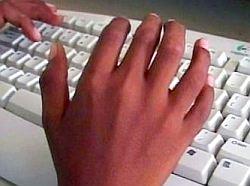
Would that we could all be mutants. Via Marginal Revolution, an Indian boy was born with six fingers on each hand, six toes one foot, and seven toes on the other foot. Full story here. The image below was apparently not Photoshopped; imagine how fast he can type! (And imagine how much work U.S. companies can outsource to him....) He can probably do base 12 math with no problem, too. His parents must have a heck of a time keeping him in shoes, I'll bet.
*David McCallum starred in "The Sixth Finger" episode of the original Outer Limits, in which he was forcibly evolved millions of years into mankind's future. He had six fingers on each hand, a giant head, pointed ears, and a snooty disposition.

Friday, October 07, 2005

What--Not the Theme From Flipper?

So apparently dolphins can be taught how to sing:
Scientists have taught dolphins to combine both rhythm and vocalisations to produce music, resulting in an extremely high-pitched, short version of the Batman theme song.
Well, it's probably better than anything on the radio these days.

Abridge Over Troubled Waters

Americans may be getting larger, but books are getting thinner, at least according to this USA Today article:
With its snazzy new "Great Ideas" series released this month, Penguin Books hopes to provide an economical remedy for time-pressed readers in search of intellectual sustenance.

Each of the paperbacks costs $8.95 and offers readers a sampling of the world's great non-fiction. For example, the Gibbon book is a slim 92-page selection called The Christians and the Fall of Rome. It presents Gibbon as sort of an intellectual tapas to be savored in one sitting.
Maybe I've been reading too many Adobe press releases, but this sounds like it could be marketed as Gibbon Elements. My favorite bit:
Because "we want readers to be able to get close to the text," the books do not have introductions or prefaces, Penguin publisher Kathryn Court says. "It's daunting. There are so many books and so little time."
Um...yeah, but the point of reading a book is not to read bits of it. The point of reading a book is to read a book, n'est-ce pas? Besides, Cliff's and Monarch Notes (do they still exist?) are a better cop out anyway, at least back when I was in high school.*

Granted, Gibbon is not everyone's cup of tea, but I think this idea is just a taste of things to come. People (usually silly people) wonder if e-books will kill off printed books (or p-books), but I don't think so. I think books will still be savored in print form by (a decreasing number of) people who really like books (at least for a few generations). What will ultimately kill off printed books is an increased trend away from reading books at all. I think the trend in reading in the long haul will be toward shorter and shorter documents--the contents of a Web page (or a blog post), or whatever electronic medium will replace the current computer screen.

*It just occurred to me that it's entirely conceivable that the next trend in "books" could very well be the PowerPoint presentation. I can see it now: "the Great Books of the World in PowerPoint format." Bulleted slides take you through the world's greatest literature. Hmm...this gives me an idea... What's scary, though, is that there probably already is such a thing, akin to the hysterically funny Gettysburg Address PowerPoint.

Thursday, October 06, 2005

Yet Another Reason to Avoid Spam

Ever been tempted to invest in the "gre@t st0ck t!ps" you receive via spam? Neither have I, but if you've ever been morbidly curious as to how much you could actually lose, SpamStockTracker has done the work so you don't have to. The premise:

On May 5th, 2005 (05/05/05 spooky!) I set out to determine just how much money I could lose by trusting SPAM.

What if I purchased 1000 shares of stock from EVERY stock tip mentioned in a SPAM email? Could we all really be missing out on a great opportunity?

Of course, I don't have the money to actually waste on an experiment like this. I made this little web site to keep track of the value of those stocks... without my actually purchasing anything.
How much has he hypothetically lost? click here to find out...

I Know the Feeling

A cautionary tale for those who are fond of all-you-can-eat buffets:
A 13-foot Burmese python recently burst after it apparently tried to swallow a live, six-foot alligator whole, authorities said.

Wednesday, October 05, 2005

Rich Media, Rich Response

Sez DoubleClick, via a new study:

RICH MEDIA, INCLUDING FLASH AND streaming ads, have a greater effect on advertisers' brand metrics than JPEG and GIF ads, according to a DoubleClick report released this week. DoubleClick considers rich media to be Web ad units based on technologies that are more complex than GIF and JPEG and simple animation.

The paper, "Evolution of Rich Media Advertising," cited a recent Dynamic Logic study in which ad awareness increased 9 percentage points for rich media above the control group, compared with a 7.5 percentage point jump for GIF and JPEG ads. Also, aided brand awareness for the RM ads rose 4 percentage points, compared with 3.3 points for the JPEG and GIF ads.

Dry-Clean Only, No Doubt

The New Scientist's patent office reporter finds this patent pending: a keyboard embdedded into a jacket sleeve.

In the not-too-distant future when you see someone impatiently tapping their sleeve while waiting for a flight , they might in fact be writing a letter of complaint to the airline company.

German electronics company Infineon Technologies reckons the main reason wearable computers have yet to take off is that there is no simple way to use a keyboard for text entry. The solution, according to Infineon, is to fit a keyboard into a jacket during manufacture.

The garment can be woven from ordinary cloth. The arm of the jacket is then interlaced with a criss-cross of thin insulated wires, with the insulation etched away at spots corresponding to the keys of a keyboard layout. When a low voltage is fed through the wires, touching the pads bridges the wires underneath, turning the sleeve into a keyboard.

To protect the keyboard from wear-and-tear and washing, the overall area is sealed with insulating polymer. The woven wires would be connected directly to the rest of the electronics, which would either be embedded in the lining of the coat or carried somewhere on the body.

WiMax on the Horizon

A "souped up" version of WiFi is on the verge of taking over the world, sez Business Week.

Demand [for WiFi] is soaring, thanks to faster, cheaper, and more reliable technology, and to open standards that let tech giants like Intel (INTC ) bundle Wi-Fi radios into mass-market computers. The number of Wi-Fi users is expected to soar 57% this year, to 118 million worldwide, according to Pyramid Research. Not bad for a technology that's only a few years old.
It's amazing how quickly we get spoiled by WiFi. It's reached the point where I get annoyed if I check into a hotel that doesn't have it (or charges through the nose for it). So bad has my jones for WiFi become that last week when my car was being worked on, I asked naively if the Saturn service center had WiFi in its waiting room (I can't believe I actually asked that question with a straight face!) and then proceeded to discover that I was in the only place in the universe (Central Avenue in Albany) without a Starbucks nearby.

Who will deliver universal WiFi hotspots (Google?) and how they are delivered is still up for grabs, but the biggest driver of increased WiFi (or WiMax) hotspots will simply be the increasing expectation that they will exist.

What if You Have a St. Bernard?

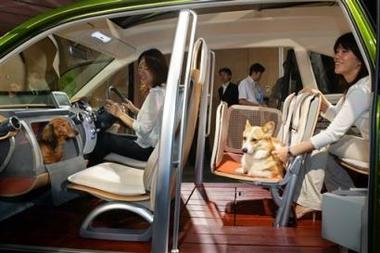
You know, whenever I go driving, I can never find a place to store my dachshund. The clever folks at Honda have it covered, apparently.

(Thanks to Audrey for the freakish link.)

Tuesday, October 04, 2005

What Have I Done?


Well, it's official: I bought a house. Closed a scant 45 minutes ago. Let the carnage begin!

Quantum Computing

Hoo boy. Scientists have trapped a pulse of laser light and can map information onto it, setting us up for a style of computing--called quantum computing--based on principles that maybe two people in the world understand (kind of like Windows, come to think of it...). The first company that names its computing system "Schrodinger's Cat" is going to get neutered.

Office Acrobatics

OK, so MS says the new version of Office will natively allow users to save documents as PDFs (without needing the colossally flaky PDFMaker plug-in). Yeah, I'll bet that will work flawlessly.

Georgia On My...Mind

Georgia-Pacific is cutting jobs, and it's odd which product lines are affected because you'd think, that there are certain, um, applications for paper that will never go away.

Lamp Unto My Feet, Apparently

Well, this--slippers with headlights--is either a good idea, or just plain silly. You be the judge.

Dr. Demento?

Sez the BBC:

Exercising for half an hour at least twice a week during midlife can significantly cut a person's risk of dementia later, say researchers.

People in their late 40s and early 50s who do this could reduce their risk of dementia by about 50%, according to a study reported in Lancet Neurology.
Of course, it does nothing for those of us who are demented now.

No No NO!

Oh, good: more mutually incompatible DVD formats on the horizon.

[T]he six major studios were evenly split between the Blu-ray technology backed by Sony Corp. and HD DVD supported by Toshiba Corp.

Both formats deliver movies in sharp high-definition and can store more data than traditional DVDs, which will allow them to offer interactive features such as games.

But the formats are incompatible and will force consumers to choose one over the other, a potentially costly decision if one format ultimately wins in the marketplace, the case when VHS defeated Betamax for home video in the 1980s.

Sorry--I made the transition to from vinyl to CD, and from VHS to DVD. I'm done transitioning to new formats. Until movie studios offer upgrade pricing, I'll pass.

Our Expanding Universe

According to the New York Times, last summer's discovery of a 10th planet (named Xena, after TV's warrior princess--sorry, I've never actually seen the show, but don't call me Xenaphobic) and last week's discovery that Xena had a moon (named Gabrielle, after Xena's sidekick, apparently), the question "what the heck is a planet?" rages again. Some may recall the debate back in 1998 or so when the powers that rule the heavens (or so it would seem) wanted to demote Pluto from "planet" to "Kuiper Belt object" or the more poetic (at least to me...) "trans-Neptunian object." Although, if you ever take the tour of the Lowell Observatory in Flagstaff, AZ (where Pluto was discovered), they're having none of it. To their mind, Pluto may as well be Jupiter.

Monday, October 03, 2005

Bad Words

One buzzphrase I would like to see wished into the cornfield: "viral marketing." I have nothing in particular against the phenomenon it refers to but surely we can come up with a better term for it than that.

Disneyland Goes to Us

Sez WSJ:

Robert Iger, who takes over today as Walt Disney Co.'s chief executive, is shaking up the Magic Kingdom by pushing a mandate for the digital age: Consumers must be able to use Disney content whenever and wherever they want it.

Mr. Iger is talking about selling episodes of ABC hits such as "Lost" and "Desperate Housewives" online like songs. He is roiling the movie-theater industry by publicly floating the idea of releasing movies in cinemas and on DVD at the same time. He is negotiating with telecom companies about ways to deliver entertainment over cellphones.

Google Takes on the Telecoms

Now that WSJ.com is back, I can read the article that was forwarded to me. And the plot thickens:

Internet companies are making an aggressive and unprecedented push into services traditionally offered by phone and cable companies -- threatening to upend the business of transmitting voice and data.

Google Inc. unveiled the latest such effort Friday with a proposal to provide free, wireless high-speed Internet access in the city of San Francisco. The service would allow users to bypass fee-based connections of cable and local phone companies in favor of wireless links.

Users could log on through computers and email, surf the Web, download music or do anything else they can do with a traditional Internet connection -- including, potentially, make phone calls with voice-over IP, or VOIP, technology.
But wait, there's more:
More troubling for telecoms, it would bring their industry an entirely different business model. Google generates nearly all its revenue, which totaled $3.2 billion last year, from the small advertisements it shows alongside search results and other Web content.

By offering consumers free service, Google could pressure traditional providers to slash fees for Internet access, a growing source of telecom revenue -- when they don't have Google's advertising revenue to make up the difference, and have large, extensive networks for transmitting voice and data to maintain.

Google's proposal to use wireless fidelity, or Wi-Fi, technology would cost far less than a traditional network. It also would give Google a direct pipeline into consumers' homes -- long the big edge for telephone and cable companies.
I am curious, though: Google's whole model is advertising-based. Indeed, both Google and Yahoo!--among others--can offer free maps, free searches, free VoIP, free this, free that, because it's all advertiser-supported. But is that truly sustainable? What happens to all our connectivity if the model collapses?

Video To Go

Oh, I don't know:

TV service on the go is being touted as the next big moneymaker for mobile phone operators
I do have mixed feelings about the idea of video on cellphones. I do like the idea of portable video players, especially while traveling. (Kind of like map laptop computer, on which I watch DVDs while on the road.) However, a cellphone is a pretty lousy medium for watching video. And I can see where this is going: the same dips**ts who cluelessly walk or drive while yakking will now be cluelessly walking or driving while watching TV. Not wild about this idea, speaking as someone who occasionally leaves the house and has unpleasant encounters with these people.

Score 1 For Print

Hmm...

Notice to Readers:
Full access to The Wall Street Journal Online is unavailable due to technical difficulties. Please see the What's News column for highlights of the top news of the day. We apologize for the inconvenience
I never got that error message in a print edition. Although, to be fair, I have had the print equivalent, I guess you could call it: newspaper subscriptions in which, at times papers weren't delivered; got stolen (in NYC, natch); ended up, I later discovered, on my roof; or, in the case of one exceptionally skilled L.A. Times delivery person, under my car at the exact point where it was unreachable from any direction without starting and moving the car.

Still, once I've actually had the paper in hand, nothing has ever stood in the way of my ability to read it (barring some Burgess Meredith/"Time Enough at Last" eyeglasses problem).

@ Large

CNet today mentions alternative terms for the "@" symbol that has become ubiquitous in our lives. This seems like as good a time as any to repeat a little history of the symbol I compiled for an e-letter a couple years ago:

Ever wonder where the “@” sign came from? It’s been a standard character on computer keyboards (and before that typewriters) practically since day one, and it’s a ubiquitous symbol these days, but it dates from the days of monk-based communication—in Medieval manuscript copying, “@” was how monks abbreviated the word “ad” which is Latin for “at.”

However, “@” as we know it technically comes not from Latin but Spanish.
In the 15th century, the symbol “@” began to be used an abbreviation of the word “arroba,” which is a Spanish and Portuguese unit of measure (equivalent to 25.37 pounds in Mexico and 32.38 pounds in Brazil) used in trade. The sign “@” itself soon came to become associated not with the weight of shipments but with billing and invoicing—“3 goats @ $5.00,” where it remained for centuries. As a result, it was for many people an arcane symbol that was merely the shift of the “2” key.

Until 1971. Bolt Beranek and Newman was a company hired by the U.S. Department of Defense to build the first Internet (then called ARPANET). One of the team members was a computer engineer named Ray Tomlinson, and in 1971 he invented the ability to send electronic messages from one computer to another. Naturally, messages needed to be addressed in some way so that the file transfer system knew where to send them. Tomlinson chose the “@” symbol to refer to what user was “at” which computer. The first e-mail message ever sent? The decidedly prosaic “QWERTYUIOP,” which was sent from a computer over the ARPANET to the computer sitting right next to it.

E-mail wouldn’t become ubiquitous until more than 20 years later.
Interestingly, one of the first organizations to grok the idea of e-mail was, seemingly ironically, the U.S. Postal Service. In the 1970s, the Post Office had created a system called E-Com, which was a network of 25 sites around the country among which electronic messages could be transmitted. Letters could be “e-mailed” (or “E-Commed,” you could probably say) from one site to another, where they could be printed on what was considered at the time to be high-speed laser printers. Once received and printed, a message could then be delivered as first class mail to the ultimate recipient.

But it was not to be. The telephone and telegraph companies freaked out about the idea of the Post Office becoming their competition, so they ran to the FCC, who, post haste (as it were), barred the Postal Service from getting into the electronic message business. As a kludge, the Post Office tried “snail mailing” magnetic tapes from site-to-site, but that was far less compelling. And that was the end of E-Com.

Saturday, October 01, 2005

Harrumph!

I don't get ESPN2, which is where today's Syracuse-Florida State game is being televised. I did notice that you can watch games over the Internet via a kind of pay-per-view system but, alas, I tried and got this error message:

We have detected that your system is not currently equipped to use ESPN Motion. A Mac OS X version is in development, but for now, if you would like to use ESPN Motion, you must be using a PC with Windows 98 or better.

Interesting wording: "Windows 98 or better." I have a Mac; it is better. Growl. Oh, well, at least the game is on the radio. Then again, maybe I don't want to see this game...

I STAND CORRECTED: the game is actually on ABC, not ESPN2. But I was right: I don't want to see it...

E-Mail Notice

I am switching Web hosts this weekend, which will affect (or, hopefully not affect adversely) all e-mail sent to my richtextandgraphics.com domain address(es) and, of course, my Web site at www.richtextandgraphics.com. There shouldn't be any interruptions of service (but, well, you know), but if anyone notices any e-mail bouncing on Monday, please let me know. My spam magnet--I mean, my Roadrunner address--rromano2@nycap.rr.com is still active and unaffected.

Hmm...suddenly, this blog is serving a constructive purpose...

They Called Him MISTER Tharp

I don't know how many of the folks reading this (if any) knew of Rick Tharp, an award-winning San Francisco-based graphic designer. In the late 1990s, we were always covering his firm Tharp Did It! in the Northern California Edition of Micro Publishing News, and we used to chuckle because Rick always insisted (with tongue-in-cheek, I later learned) on being referred to as "Mister Tharp." I met him once at a party in San Francisco in 1998 or so; this was about the time that the first batch of redesigned $20 bills were coming out and we were commenting about the redesign--I joked that the new money looked like it was the result of a font substitution (for those not in the know, this is what happens when the device printing something doesn't have the fonts that the designer used--a common problem in digital prepress). This amused him greatly and for several weeks afterward he tried to enlist my help in starting a rumor in the trade press that the new money was actually the result of a major production error at the Bureau of Printing & Engraving (it didn't work). We kept in touch for a short time afterward, but although I didn't know him well, I always remember him as a funny guy (and at the time I thought he looked like Frank Zappa, which is always a plus in my book). It hit me very weirdly, then, when I read this morning in Graphic Design: USA that, last summer, he apparently jumped off the Golden Gate Bridge. Very sad; he was extremely talented. A full bio here.